Reserve Bank of Australia (RBA) Deputy Governor Andrew Hauser adopted a hawkish tone in his recent comments, stating that “the inflation outlook looks worse than expected, slightly above expectations.” He also noted that, although monetary policy remains effective, the inflation outlook is showing signs of deterioration. These remarks suggest that inflationary pressures may prove more persistent than previously anticipated, potentially requiring the central bank to maintain restrictive monetary conditions for longer.
RBA Deputy Governor Christopher Kent said on Monday that several factors point to rising neutral interest rates, both in Australia and globally. His comments reinforce the possibility that the level of interest rates needed to keep inflation under control may be increasing, adding to expectations that Australian monetary policy could remain restrictive for longer than previously anticipated. Together, the remarks from RBA officials indicate growing concern about the inflation outlook and the potential need to maintain a tighter policy stance.
Following these comments, money markets priced in a probability of nearly 60% that the RBA would raise interest rates by 25 basis points to 4.85%, up from approximately 30% the previous day. The sharp increase in rate hike expectations reflects a reassessment of the central bank’s policy outlook as investors respond to the more hawkish tone from policymakers. If incoming inflation data continue to support these concerns, expectations for further tightening could remain elevated.
In Canada, inflation accelerated in September, with headline Consumer Price Index (CPI) inflation rising by 3.1% year over year. Although this was below market expectations of 3.2%, it exceeded August’s reading of 3.0%. On a monthly basis, consumer prices increased by 0.1%, indicating a modest rise in overall price pressures. The latest figures suggest that headline inflation is moving higher again, although the reading below consensus may limit the immediate impact on expectations for the Bank of Canada’s next policy decisions.
Meanwhile, the Bank of Canada’s preferred measure of core inflation, which excludes more volatile components such as food and energy, declined to 2.2% year over year from 2.4% previously. Core prices also remained unchanged compared with the previous month, suggesting that underlying inflationary pressures may be moderating despite the increase in the headline figure. This divergence between headline and core inflation leaves the central bank balancing the risk of higher energy-related costs against signs that underlying price pressures are becoming more contained.
Bank of Canada Governor Tiff Macklem addressed a roundtable during the annual meetings of the International Monetary Fund and the World Bank in Bangkok. Macklem said Canada had not yet raised interest rates in response to higher energy prices, but warned that maintaining this position would become more difficult if prices remained elevated for an extended period. His comments highlight the challenge facing the central bank as it assesses whether the recent increase in energy costs will prove temporary or begin to influence broader inflation trends.
“We have not raised our rates yet. We have been looking through the increase in energy prices, but the longer this continues, the harder it will be to do so,” Macklem said. His remarks suggest that the BoC is still willing to look beyond the immediate impact of higher energy prices, but that approach could become increasingly difficult to maintain if elevated costs persist. A prolonged period of energy-related inflation could eventually require policymakers to reconsider their current stance and adopt a more restrictive monetary policy.
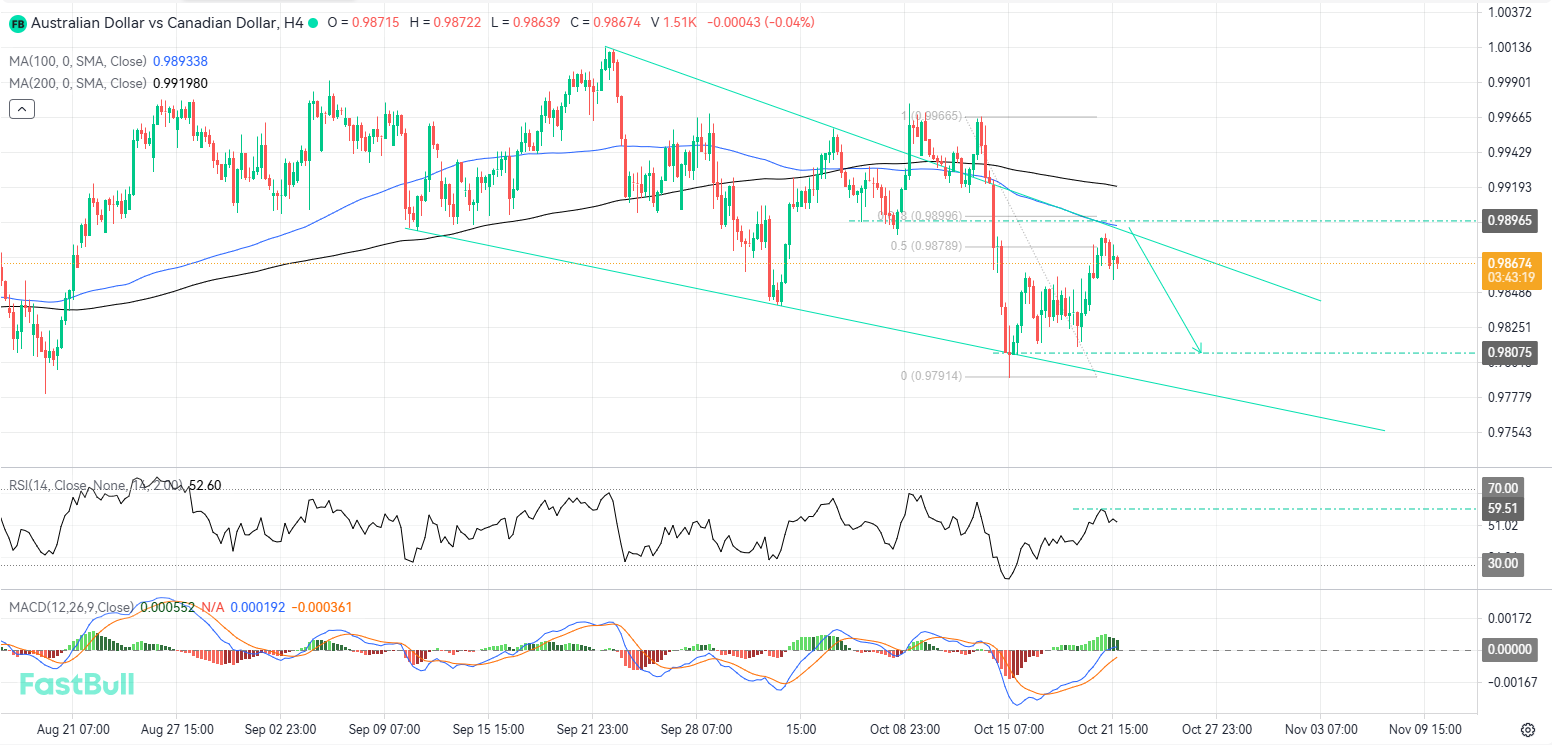
Technical Analysis
AUDCAD has recently developed a bullish rebound after reaching a local low near 0.9791, an area that appears to coincide with the lower boundary of a descending channel. The pair is now approaching resistance at 0.9896, which also aligns with the 0.618 Fibonacci retracement level, a zone where corrective rebounds can encounter selling pressure. If the price is rejected at this level, the pair could resume its broader bearish trend. The resistance area is further reinforced by the 100-period moving average, currently positioned at 0.9893, while the 200-period moving average sits at 0.9919 and could provide additional dynamic resistance if the recovery extends higher. This confluence of technical levels makes the current zone important for assessing whether the rebound can continue or whether sellers will regain control.
Looking at the oscillators, the RSI has climbed rapidly to 59, indicating improving bullish momentum relative to the recent price movement, although it has not yet entered overbought territory. A further advance toward the resistance zone could therefore provide a more favorable area for potential short entries, provided that price action confirms a bearish rejection. Meanwhile, the MACD displays a bullish histogram that has started to lose depth, suggesting that upward momentum may be weakening. A bearish crossover would add further weight to the possibility of a downside continuation, while the signal lines are only beginning to approach the neutral zone. If they turn lower and return to bearish territory, the MACD would align more clearly with the prevailing downtrend, strengthening the case for a renewed decline from the current resistance cluster.
Trading Recommendations
Trading direction: Sell
Entry price: 0.9896
Target price: 0.9810
Stop loss: 0.9930
Validity: Nov 03, 2026 15:00:00


