The European Central Bank (ECB) continues to face inflationary pressures, leaving further interest rate increases as a possibility. However, rising energy costs and the widening yield spread between French and German government bonds, amid concerns about France’s fiscal position, are increasing the risks to economic growth and financial stability. These competing factors are complicating the central bank’s policy outlook, as policymakers weigh the need to contain inflation against the potential consequences of tighter financial conditions and growing fiscal uncertainty across the euro area.
Belgian National Bank Governor Pierre Wunsch said on Wednesday that the ECB will probably need to raise interest rates again. Meanwhile, ECB President Christine Lagarde stated that she has not yet observed energy costs spilling over into wages and other prices. Her comments suggest that, although higher energy prices remain a concern, the central bank has not yet identified clear evidence of broader inflationary effects that would make the current energy shock more persistent.
Eurozone industrial production for August is scheduled for release on Thursday, with expectations pointing to no change following a 0.1% decline in July. Final inflation figures for September will follow on Friday, with core inflation expected to remain at 2.5% year over year. Both releases could influence the ECB’s policy decision on October 29, providing further information about the strength of industrial activity and the persistence of underlying price pressures.
In the United States, data released on Wednesday by the Bureau of Labor Statistics (BLS) showed that the Consumer Price Index (CPI) rose by 3.7% year over year in September, accelerating from 3.4% in August. The reading also exceeded market expectations of 3.6%, reinforcing concerns that inflationary pressures remain persistent and could complicate the Federal Reserve’s efforts to bring price growth back toward its target. The stronger headline figure could keep policymakers cautious about easing financial conditions, particularly if higher energy costs continue to influence the inflation outlook.
Core CPI, which excludes the more volatile food and energy components, increased by 2.6% year over year in September, compared with 2.4% in the previous month and above the market forecast of 2.5%. On a monthly basis, headline and core CPI rose by 0.6% and 0.3%, respectively. The figures point to renewed inflationary pressure, particularly in the headline reading, while the stronger-than-expected core figure could further influence expectations regarding the Fed’s next policy decisions. Together, the latest readings suggest that inflation remains a challenge even as markets assess the potential impact of higher energy prices on the broader economy.
Federal Reserve (Fed) President Mary Daly said on Wednesday that the central bank may need to raise interest rates further in the near term to contain inflation that remains too high. However, she also noted that there is no need to implement another increase at the Fed’s October 27–28 meeting. Her comments suggest that further tightening remains a possibility, although policymakers may prefer to evaluate incoming economic data before making another adjustment. The distinction between the need for additional action and its timing reflects the uncertainty surrounding the current inflation outlook.
According to the CME FedWatch tool, markets now assign approximately a 24.9% probability to a US interest rate increase this month, up from around 22.1% before the inflation data were released. Meanwhile, the probability of a rate increase in December is priced at approximately 66.7%. The shift in expectations reflects the market’s response to the stronger inflation figures, although the Fed’s eventual decision will depend on how policymakers assess the persistence of price pressures and the broader economic outlook.
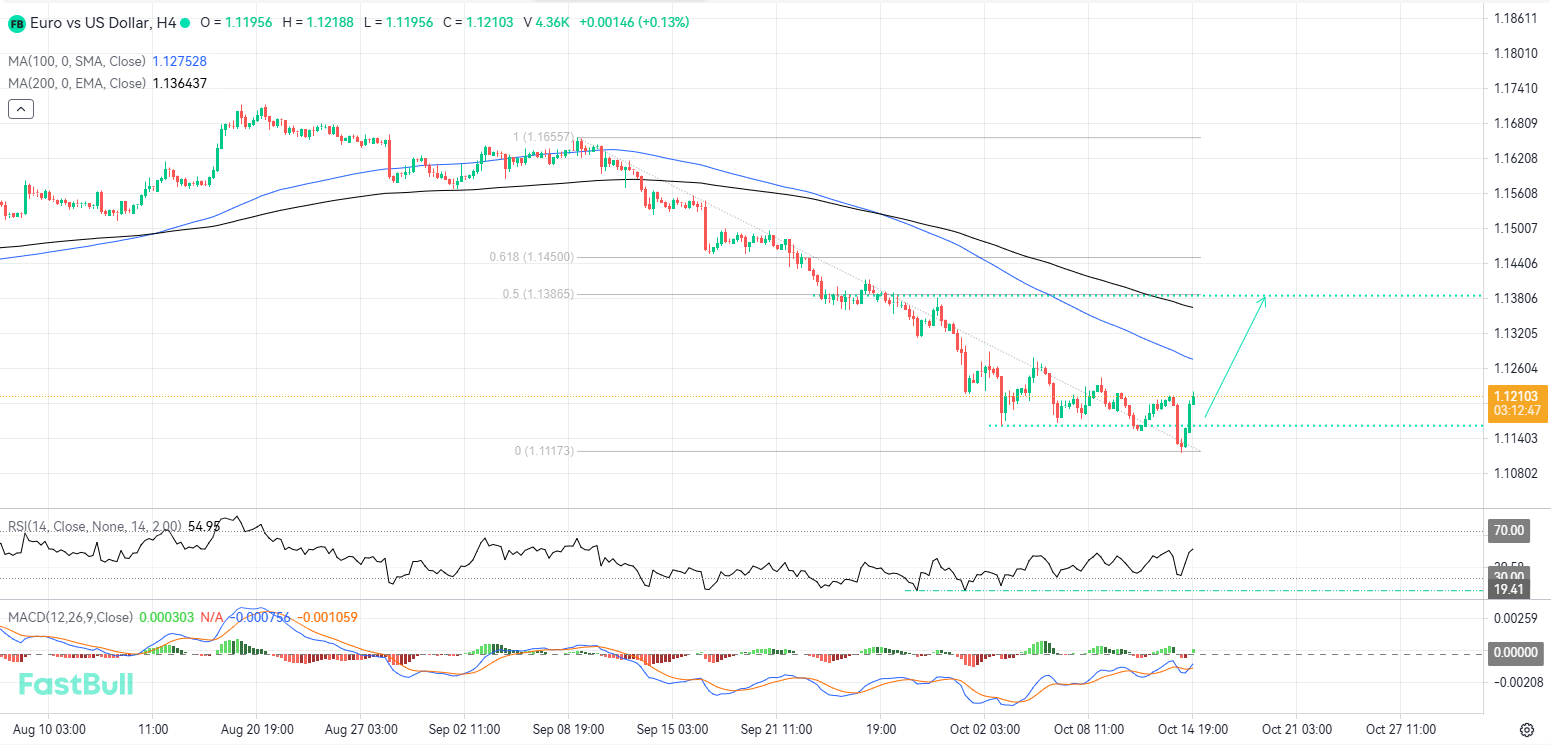
Technical Analysis
EURUSD recovered sharply after reaching an intraday low of 1.1117 following the release of US inflation data. Although the initial decline pushed the pair lower, the move was quickly reversed, and the price closed firmly above the local support level at 1.1162. This recovery suggests that buyers stepped in to defend the area, potentially creating opportunities for the bullish move to continue. If the pair maintains its position above this support, the next upside target could be the resistance level at 1.1384, which also aligns with the 0.50 Fibonacci retracement level. The 200-period moving average, currently positioned at 1.1364, is located near this zone, while the 100-period moving average sits closer to the current price at 1.1275, both moving averages could provide dynamic resistance along the way up.
Regarding the oscillators, the RSI is currently at 54, having moved back into bullish territory after reaching oversold levels near 19 in early October. This recovery in momentum suggests that the pair may have room to extend its advance, provided that buying pressure remains steady. Meanwhile, the MACD is displaying a bullish histogram that initially developed considerable depth. If the histogram continues to expand, the upward move could gain further momentum and support an extended recovery. At the same time, the signal lines are recovering from deeply bearish levels, and a crossover into bullish territory would provide additional confirmation of strengthening upside momentum.
Trading Recommendations
Trading direction: Buy
Entry price: 1.1160
Target price: 1.1380
Stop loss: 1.1070
Validity: Oct 27, 2026 15:00:00


