The Australian Dollar retreated for a second consecutive session on Friday as renewed demand for the US Dollar weighed on risk-sensitive currencies amid another sharp escalation in tensions between the United States and Iran. AUD/USD slipped toward the 0.6970 area during European trading, although the pair remains on course to record a third straight week of gains thanks to continued support from Australia's monetary policy outlook.
Investor sentiment deteriorated after fresh military exchanges between Washington and Tehran intensified concerns over the stability of global energy supplies. Iran's Islamic Revolutionary Guard Corps claimed responsibility for new attacks on US military facilities while warning that key energy shipping routes, including the Strait of Hormuz and the Red Sea, could face further disruptions. The renewed geopolitical uncertainty pushed investors toward traditional safe-haven assets, providing fresh support for the Greenback.
The US Dollar also continued to benefit from a series of stronger-than-expected economic releases. Weekly Initial Jobless Claims declined beyond market expectations, while the Philadelphia Fed Manufacturing Index climbed sharply, reinforcing evidence that the US economy remains resilient despite elevated interest rates. At the same time, Federal Reserve officials, including Lorie Logan and Philip Jefferson, reiterated that additional policy tightening could still be appropriate if inflation fails to move convincingly back toward the central bank's target.
The combination of resilient US economic data, persistent inflation concerns fueled by higher energy prices, and escalating geopolitical risks continues to favor the US Dollar in the near term. These factors are likely to keep expectations for another Federal Reserve rate hike alive, limiting the Australian Dollar's ability to extend recent gains.
Even so, the downside for the Aussie may remain contained. The Reserve Bank of Australia continues to maintain a relatively hawkish policy stance, while encouraging economic data from China, Australia's largest trading partner, is helping underpin demand for the Australian Dollar. As long as China's economic momentum remains resilient and the RBA keeps the door open to further tightening, broader losses in AUD/USD could prove limited despite the current risk-off environment.
Technical Analysis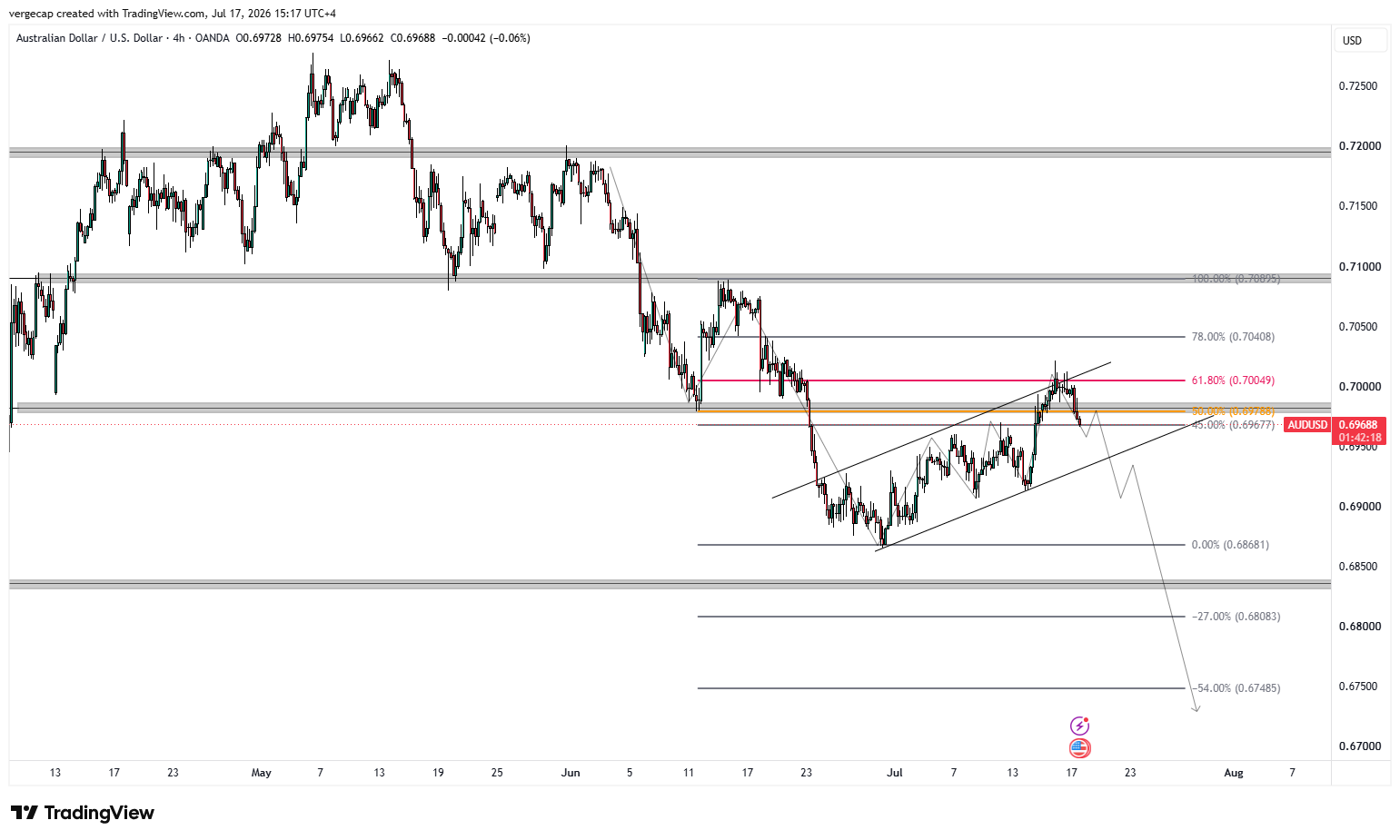
AUD/USD is showing signs of losing bullish momentum after failing to sustain a breakout above key Fibonacci resistance. On the 4-hour chart, the pair recently completed a strong recovery from the 0.6868 swing low, climbing within a well-defined ascending channel before stalling near the 61.8% Fibonacci retracement at 0.7005. That rejection has triggered a pullback toward the former breakout area around 0.6970–0.6980, where horizontal support converges with the 50% Fibonacci retracement and the lower boundary of the short-term bullish structure.
Price is now testing a critical decision zone. A sustained break below 0.6970 would confirm that buyers are losing control and expose the ascending channel to a downside break. Such a move would likely accelerate selling pressure toward the 0.6868 support, which marks the recent swing low and a major technical floor. Failure to defend that level would open the way toward the 0.6808 Fibonacci extension, with a deeper decline potentially extending to the 0.6748 measured downside objective.
On the upside, buyers must first reclaim the 0.7005 Fibonacci barrier before challenging the 0.7040 resistance area. A decisive break above these levels would invalidate the current corrective pullback and shift focus toward the major resistance near 0.7090, where previous supply emerged. Until then, the latest rejection suggests that bullish momentum is fading and that the recent rally may be entering a corrective phase rather than resuming its broader recovery.
Momentum studies also point to weakening upside conviction. The Relative Strength Index (RSI) is likely easing back toward the neutral 50 region after failing to sustain overbought conditions, indicating that buying pressure has moderated. Meanwhile, the Moving Average Convergence Divergence (MACD) appears to be rolling over, with bullish momentum flattening and a potential bearish crossover developing. This combination supports the view that sellers are beginning to regain control unless AUD/USD quickly recovers above key Fibonacci resistance.
TRADE RECOMMENDATION
SELL AUD/USD
ENTRY PRICE: 0.6970
STOP LOSS: 0.7100
TAKE PROFIT: 0.6748


