Rising tensions in the Middle East are fueling concerns about oil-driven inflation, adding another source of uncertainty to the global economic outlook. Yemen’s Houthi forces launched a barrage of missiles toward cities across Saudi Arabia, while the military reported that the projectiles were being intercepted. However, falling debris struck the city of Dhahran, and at least four people were reported injured in the capital, Riyadh. The escalation has renewed concerns about potential disruptions to energy supplies and the possibility that higher oil prices could add to inflationary pressures.
Nevertheless, comments from Federal Reserve Bank of New York President John Williams could help limit further losses in gold. Williams said on Tuesday that he continues to consider one additional interest rate increase this year appropriate, although he does not expect further monetary tightening in 2027. His remarks suggest that the Fed could maintain a cautious approach to inflation without necessarily committing to an extended cycle of rate increases, a factor that could influence expectations for interest rates and the direction of the US dollar.
Meanwhile, Federal Reserve Bank of Chicago President Austan Goolsbee described the labor market as very stable and economic growth as solid. He also emphasized that the Fed’s policy response would remain closely tied to developments in inflation, stating that “if inflation remains persistent, then I think it is clear what the Fed has to do.” His comments reinforce the importance of incoming inflation data in determining the central bank’s next policy decisions.
Fed Governor Christopher Waller said that investment in artificial intelligence is influencing US yields and could help the central bank manage demand. He also noted that inflation expectations remain well anchored, suggesting that expectations have not yet become a major source of concern for policymakers. However, the extent to which investment related to AI affects economic activity and financial conditions could remain relevant to the Fed’s assessment of inflation and growth.
Federal Reserve Bank of Boston President Susan Collins also stressed that inflation remains the central bank’s primary focus. She added that she expects inflation to remain above the Fed’s 2% target because of elevated energy prices. Her comments highlight the risk that higher energy costs could delay the return of inflation to target, potentially limiting the scope for monetary easing and keeping interest rate expectations sensitive to developments in the energy market.
Bank of England (BoE) policymaker Catherine Mann, widely regarded as one of the more hawkish members of the Monetary Policy Committee, acknowledged that the central bank had misjudged some of the consequences of the energy supply shock. During a speech on Thursday at the Nomura London Macro Forum, Mann suggested that policymakers should have responded more decisively when the conflict involving Iran first escalated, with the aim of containing inflationary pressures before they became more persistent. Her remarks point to the challenges central banks face when responding to supply-driven inflation, particularly when energy costs rise sharply.
Meanwhile, Bank of England Monetary Policy Committee member Alan Taylor said last week that monetary policy should not respond mechanically to fluctuations in energy prices. However, he also warned that policymakers would need to reassess the appropriate policy stance if inflationary pressures intensified and second-round effects began to emerge. This distinction highlights the BoE’s need to determine whether higher energy prices represent a temporary shock or are beginning to affect broader price-setting behavior across the economy.
In the United Kingdom, Gross Domestic Product (GDP) data are due on Thursday, while market attention remains focused on the publication of the Autumn Budget on October 28. The upcoming economic figures could provide further insight into the strength of domestic activity, while the budget announcement may influence expectations surrounding the government’s fiscal outlook and its potential implications for the economy and monetary policy.
Technical Analysis
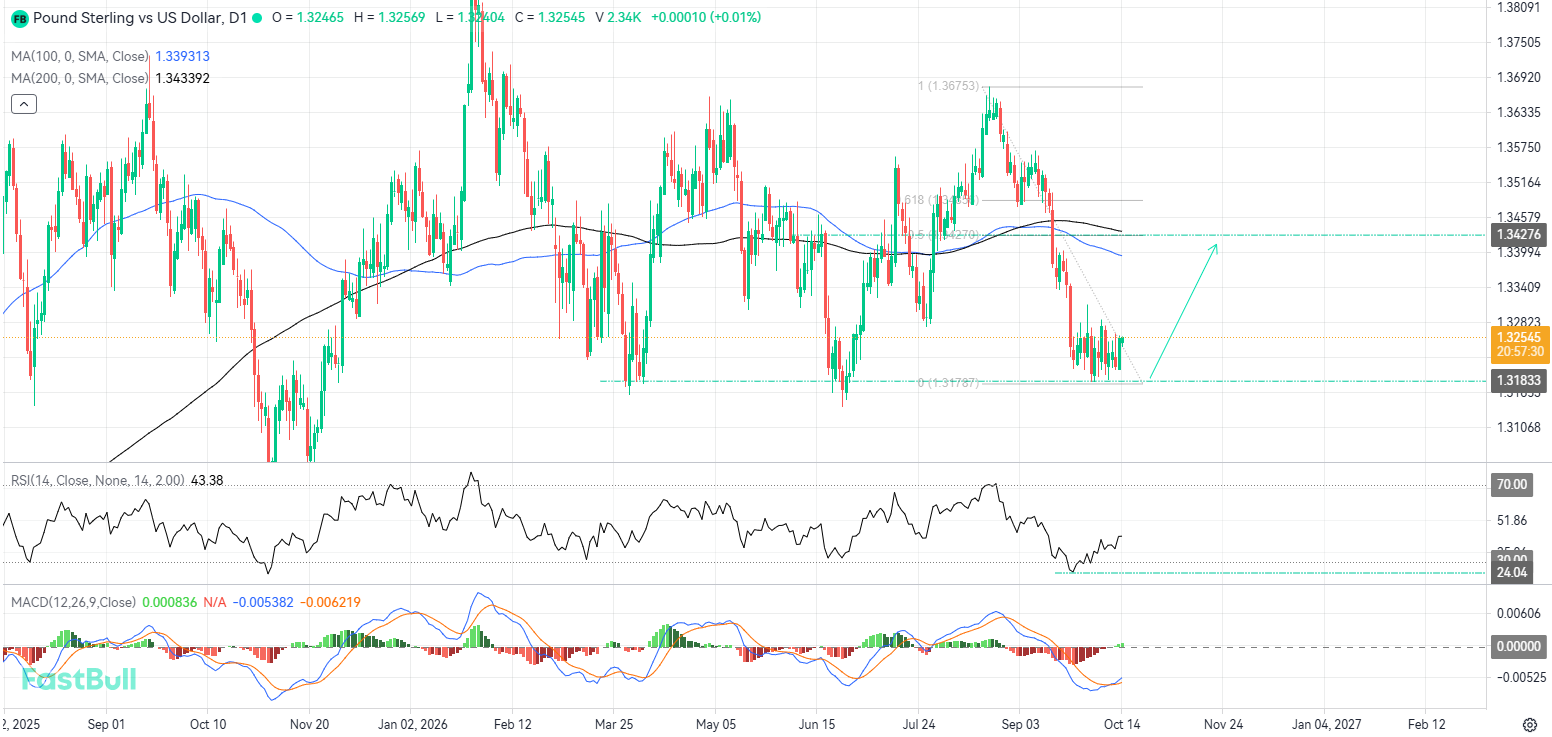
GBPUSD has once again found support around the 1.3183 level, an area that previously triggered bullish rejections in June and, before that, in March. On this occasion, the pair has also rebounded from this zone, suggesting that buyers are attempting to defend the level. If the price fails to break decisively below support, the recovery could extend toward 1.3427, near the 0.50 Fibonacci retracement level. This area also aligns with the 100-period and 200-period moving averages, currently positioned at 1.3393 and 1.3433, respectively.
Regarding the oscillators, the RSI is currently at 43, recovering after falling to 24, a level associated with considerable oversold conditions. This rebound suggests that bearish momentum has eased and that the recent rejection at support could allow for a stronger corrective move to the upside. Meanwhile, the MACD is showing a bullish histogram that is beginning to gain depth, indicating that upward momentum is gradually improving. However, the signal lines remain firmly within bearish territory, suggesting that the broader momentum structure has not yet turned bullish.
Trading Recommendations
Trading direction: Buy
Entry price: 1.3255
Target price: 1.3427
Stop loss: 1.3100
Validity: Oct 23, 2026 15:00:00


