The unimaginable has become reality in the gold market this morning. In what is shaping up to be the most dramatic single-session rally in the history of the precious metals complex, XAU/USD has absolutely detonated to the upside, shattering every technical level in its path to trade firmly above the $5,400 mark—an astronomical surge to its highest level since late January, though that timestamp now feels like ancient history given the velocity of this move.
Let that number sink in for a moment. Five-thousand-four-hundred dollars an ounce.
We are witnessing a complete and utter repricing of geopolitical risk the likes of which this generation of traders has never seen. The world is rapidly abandoning riskier assets across the board, triggering a violent flight into safe-haven investments following an intense and unprecedented wave of global risk aversion that has fundamentally altered the investment landscape overnight.
The catalyst for this historic melt-up in bullion is nothing short of a geopolitical cataclysm. Over the weekend, global markets were blindsided by a dramatic and dangerous escalation of tensions in West Asia. In a coordinated military action that has shocked world capitals, the United States and Israel launched a strike on Iran that has reportedly resulted in the death of Supreme Leader Ayatollah Ali Khamenei.
The geopolitical establishment is still reeling from the implications. This is not merely another skirmish or proxy action; this represents a direct, high-stakes confrontation with the leadership of a major regional power. But as seismic as that development is, the situation has spiraled into even more dangerous territory for the global economy.
In a move that effectively draws a dagger at the heart of the world's energy supplies, Iran's Islamic Revolutionary Guard Corps (IRGC) Navy has announced the immediate and indefinite closure of the Strait of Hormuz—the single most critical maritime chokepoint on the planet. For those unfamiliar with the logistics of global energy trade, approximately one-fifth of the world's total oil consumption, roughly 20 million barrels per day, must pass through this narrow waterway. By closing it, Tehran has raised the specter of a protracted, region-wide war that threatens to send oil prices into triple digits and strangle supply chains already brittle from years of disruption.
For gold, this is rocket fuel. The traditional safe-haven asset is absorbing inflows at a pace that market makers are struggling to match, with liquidity thinning out and bid-ask spreads widening as dealers scramble to reprice risk in real-time.
Yet, astonishingly, the geopolitical flashpoint is only half of the story driving this parabolic move in bullion. The domestic U.S. macroeconomic backdrop has added a volatile accelerant to an already raging fire. Friday's Producer Price Index (PPI) report came in hotter than expected, reviving deep-seated concerns about inflation that remains stubbornly sticky, particularly in the services sector and along supply chains.
When you layer that hot inflation reading onto a slowing economic growth trajectory, you create the most toxic environment for traditional policymakers: the dreaded "stagflation" scenario. The market is now acutely aware that the Federal Reserve finds itself in an impossible position. They cannot cut interest rates aggressively to stimulate growth without running the immediate risk of reigniting inflationary pressures. Yet they cannot maintain a restrictive policy stance without potentially slowing the economy further into contraction territory.
This policy paralysis is a godsend for non-yielding assets like gold. In an environment where real yields are likely to remain suppressed regardless of what the Fed does, the opportunity cost of holding bullion evaporates. Investors are piling in not just as a hedge against war, but as a hedge against the creeping realization that central banks may have lost their ability to manage the business cycle.
What makes this rally particularly remarkable from a technical perspective is that it is occurring despite significant strength in the U.S. Dollar. The Dollar Index has mounted an impressive rally of its own, surging to its highest level since January 23. Historically, a strong dollar acts as a heavy anchor on dollar-denominated commodities like gold, making them more expensive for foreign buyers and typically capping upside potential.
The fact that gold is absolutely shredding through $5,400 while the dollar simultaneously powers higher tells you everything you need to know about the sheer velocity and intensity of the "fear trade" currently gripping global capital markets. Investors are buying both—the dollar for its liquidity and reserve currency status in a time of crisis, and gold for its millennia-old role as the ultimate store of value when faith in fiat and governments begins to waver.
Looking forward, traders are bracing for what promises to be a historically volatile week, with high-impact U.S. economic data set against this explosive geopolitical backdrop. The calendar kicks off today with the ISM Manufacturing PMI, which will offer the first glimpse into how the industrial sector is holding up and whether supply chains are already showing signs of stress. Wednesday brings the ADP private-sector employment report and the crucial ISM Services PMI, culminating in Friday's marquee event: the closely-watched Nonfarm Payrolls (NFP) report.
However, in the current climate, even the most significant economic data releases are likely to play second fiddle to the headlines streaming out of the Middle East. The focus will remain absolutely glued to geopolitical developments—any further military action, diplomatic interventions, or signs of retaliation from Iran or its proxies could easily propel gold even further into uncharted territory.
For now, the path of least resistance points firmly to the upside. Support is likely to consolidate around the psychological $5,400 level, but in a market driven by conflict, uncertainty, and the decaying credibility of traditional policy responses, the only certainty is that volatility will remain the defining characteristic of this new paradigm.
Technical Analysis 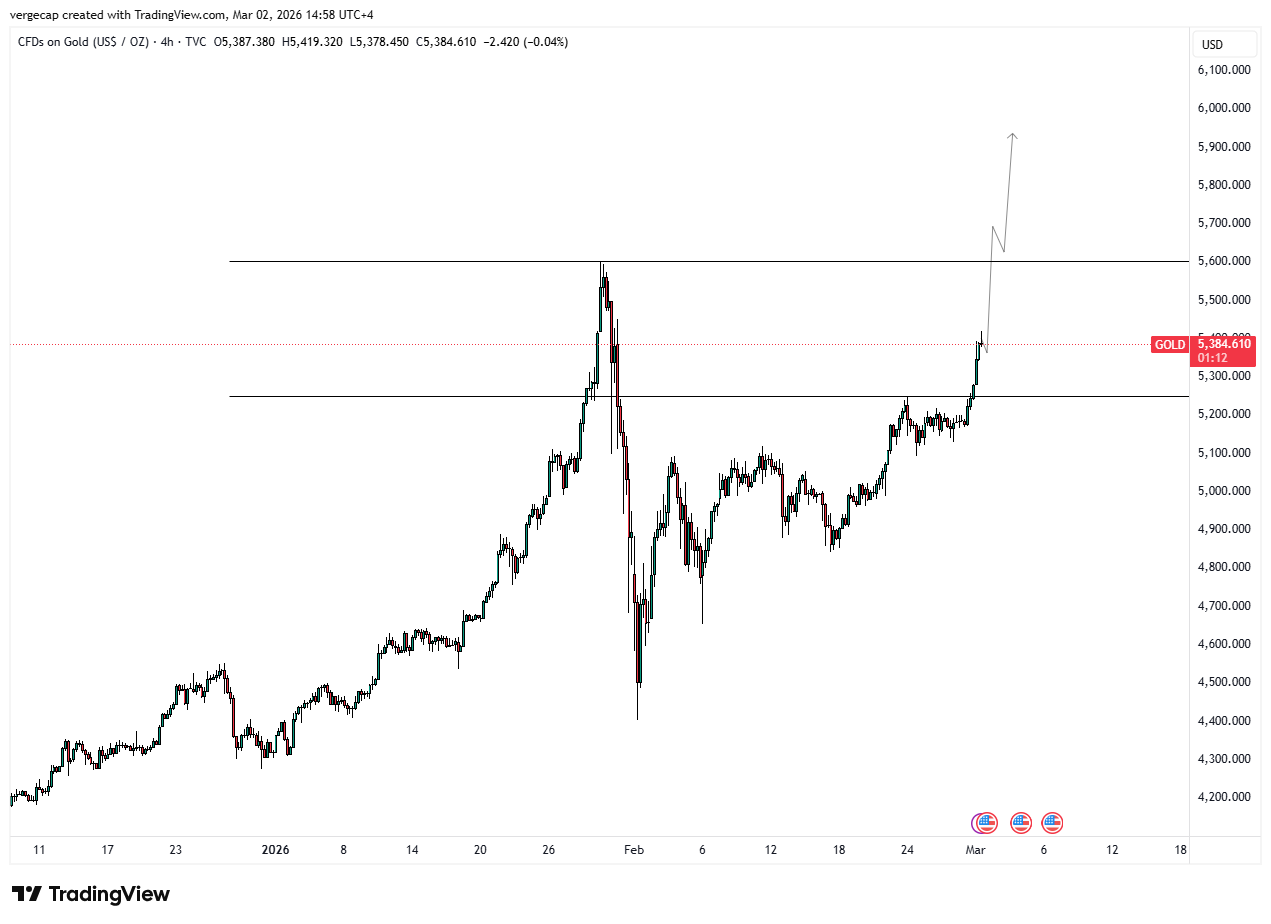
From a technical standpoint, gold continues to trade within a clearly constructive bullish framework, with the broader trend remaining intact despite intermittent volatility. On the 4-hour chart, price action shows a strong recovery from the sharp February sell-off, followed by a sequence of higher lows and higher highs, underscoring renewed upside control. The recent advance has carried prices back toward a key horizontal resistance zone near $5,380–$5,400, an area that previously acted as both supply and a pivot point.
While the latest candles suggest a brief pause near this resistance band, there is little evidence of structural weakness. The market appears to be digesting recent gains rather than signaling distribution. Former resistance in the $5,250–$5,300 region has now transitioned into an important support zone, reinforced by prior consolidation and the midpoint of the recent impulse move. A sustained hold above this area keeps the short-term bullish narrative firmly in place.
From a risk perspective, a decisive break back below $5,250 would be the first warning that upside momentum is fading. Such a move could open the door for a deeper retracement toward the $5,100–$5,150 region, where earlier demand emerged following the post-spike correction. A failure to hold that zone would suggest a broader corrective phase rather than a routine pullback within an uptrend.
On the upside, bullish participants are closely watching for a clean and sustained break above $5,400. A confirmed move through this ceiling would likely attract fresh momentum buying and expose higher upside objectives toward the $5,600 area initially, with scope for an extension toward the $5,900–$6,000 psychological region if bullish conditions persist.
Momentum dynamics favor continuation rather than exhaustion. The Relative Strength Index (RSI) has moderated from earlier elevated readings but remains comfortably above the neutral 50 level, indicating that bullish momentum is cooling in an orderly fashion rather than reversing. Meanwhile, the MACD remains in positive territory, though momentum has flattened, reinforcing the view that gold is consolidating before attempting its next directional move.
TRADE RECOMMENDATION
BUY GOLD
ENTRY PRICE: 5,400
STOP LOSS: 5,180
TAKE PROFIT: 5,600


