USDX
99.460

0.39%

XAUUSD
4568.55

1.72%

WTI
96.212

2.27%

EURUSD
1.15377

0.44%

GBPUSD
1.33166

0.84%

USDJPY
159.086

0.88%

USNDAQ100
24097.65

1.33%

Global Markets

Economic Calendar
7x24
Quotes

Video

Latest Update

Risk Warning on Trading HK Stocks

Despite Hong Kong's robust legal and regulatory framework, its stock market still faces unique risks and challenges, such as currency fluctuations due to the Hong Kong dollar's peg to the US dollar and the impact of mainland China's policy changes and economic conditions on Hong Kong stocks.

HK Stock Trading Fees and Taxation

Trading costs in the Hong Kong stock market include transaction fees, stamp duty, settlement charges, and currency conversion fees for foreign investors. Additionally, taxes may apply based on local regulations.

HK Non-Essential Consumer Goods Industry

The Hong Kong stock market encompasses non-essential consumption sectors like automotive, education, tourism, catering, and apparel. Of the 643 listed companies, 35% are mainland Chinese, making up 65% of the total market capitalization. Thus, it's heavily influenced by the Chinese economy.

HK Real Estate Industry

In recent years, the real estate and construction sector's share in the Hong Kong stock index has notably decreased. Nevertheless, as of 2022, it retains around 10% market share, covering real estate development, construction engineering, investment, and property management.

Analysis
Data

Data Warehouse Market Trend Institutional Data Policy Rates Macro

Market Trend

Speculative Sentiment Orders and Positions Correlation

Popular Indicators

Pro
AI Signal

Trading Signals

AI Signal

News
Recent Searches
    Trending Searches
      News
      7x24
      Quotes
      Economic Calendar
      Video
      Data
      • Names
      • Latest
      • Prev.

      View All

      No data

      Sign in

      Sign up

      --

      • My Favorites
      • My Subscription
      • Profile
      • Orders
      • Account Settings
      • Sign out
      Reminder Settings
      • Economic Calendar
      • Quotes/Market Quotes

      Reminders Temporarily Unavailable

      FastBull Membership Privileges
      Quick Access to 7x24
      Quick Access to More Editor-selected Real-time News
      Real-time Quotes
      View more faster market quotes
      Upgrade to {0} Pro
      I have read and agreed to the
      Pro Policy
      Feedback
      0 /250
      0/4
      Contact Information
      Submit

      Interest Rates Unchanged! USD/CAD Holds Steady Above 1.37

      Summary:

      The Bank of Canada (BoC) kept its benchmark interest rate unchanged at 2.25%, maintaining the level seen since October last year. At the post-meeting press conference, Governor Tiff Macklem stated: "If energy prices stay high and we start to see evidence that [inflation] is generalizing and becoming more persistent, we can raise the policy rate to cool inflation."

      Buy USDCAD
      EXP
      Trading

      1.37300

      ENTRY

      1.40000

      TGT

      1.35000

      SL

      1.37406 +0.00015 +0.01%

      0

      Point

      Flat

      1.35000

      SL

      CLOSING

      1.37300

      ENTRY

      1.40000

      TGT
      Fundamentals
      Against the backdrop of rising global trade uncertainty and ongoing geopolitical tensions in the Middle East, monetary policies in both Canada and the U.S. are characterized by high caution and a wait-and-see approach—reflecting the complex global economic landscape where slowing growth coexists with inflationary pressures. In Canada, the BoC decided at its latest policy meeting to maintain the key overnight rate at 2.25%, extending its stance since October. This decision largely aligned with market expectations, but the underlying considerations have grown increasingly complex. Governor Macklem noted that the economy is currently in a state of "extreme and severe uncertainty," affected not only by shifts in U.S. trade policy but also by new shocks from the Middle East conflict (particularly involving Iran). These overlapping factors make future economic trends difficult to predict, with outcomes hinging on the duration of the conflict and whether it spreads further. Domestically, Canadian inflation has remained close to the 2% target for over a year, recently dipping to 1.8%, while core inflation remains broadly stable. However, rising international oil prices driven by Middle Eastern tensions pose short-term upside risks to inflation. Meanwhile, Canada's economic growth has been weak: after contracting in Q4 2025, it resumed growth in 2026 but lacks momentum and falls short of prior forecasts. The labor market has also weakened, with the unemployment rate climbing to 6.7%, employment growth slowing, and exports showing no clear improvement. This puts the BoC in a classic policy dilemma: raising rates to counter potential inflationary pressures could further dampen an already sluggish economy, while cutting rates to support growth might push inflation away from target. Notably, higher oil prices boost energy export revenues but erode household purchasing power, weighing on consumption. More critically, the Middle East conflict could disrupt supply chains—for example, blockages in the Strait of Hormuz affecting supplies of key goods like fertilizers—further increasing cost pressures. Additionally, tightening global financial conditions (rising bond yields, falling stock markets, and widening credit spreads) impose further constraints on the economy. Overall, Canada's economic outlook leans downward, while inflation risks tilt upward.  
      In the U.S., inflationary pressures have also picked up. The Producer Price Index (PPI) rose 0.7% month-on-month in February, the largest increase in seven months, with the year-on-year rate climbing to 3.4%. This uptick was driven by both services and goods prices: service prices have maintained strong growth for several months, reflecting businesses passing on cost pressures downstream. On the goods side, food and energy prices saw notable increases, especially a sharp rise in vegetable prices and a rebound in energy costs, reinforcing the foundation for higher inflation. Meanwhile, Middle East tensions pushing up oil prices and lingering tariff effects add uncertainty to future inflation trends. Against this macro backdrop, the Federal Reserve (Fed) decided at its March meeting to keep the federal funds rate unchanged in the 3.50%-3.75% range, continuing to project just one 25-basis-point cut in 2026. This decision follows upward revisions to inflation expectations—the Fed now expects the PCE inflation rate to reach 2.7% by the end of 2026, significantly higher than previous forecasts. While U.S. economic resilience persists (with GDP growth slightly revised upward and the unemployment rate holding around 4.4%), employment growth momentum has weakened. Fed Chair Jerome Powell stated at the press conference that the current rate level is "appropriate," helping control inflation while maintaining labor market stability. He emphasized that Middle East tensions and higher energy prices will lift inflation in the short term, but their persistence and transmission scope remain highly uncertain—potentially dragging on consumption or being partially offset by gains in the energy sector. Overall, such shocks are more likely to be temporary, with inflation expected to gradually ease over the medium to long term. However, divisions within the Fed over the future policy path are widening: some officials favor no cuts, others support one cut, and a few anticipate more easing—even the first hints of longer-term rate hikes. These disagreements reflect the growing difficulty of policymaking amid sticky inflation and frequent external shocks.  
      Technical Analysis
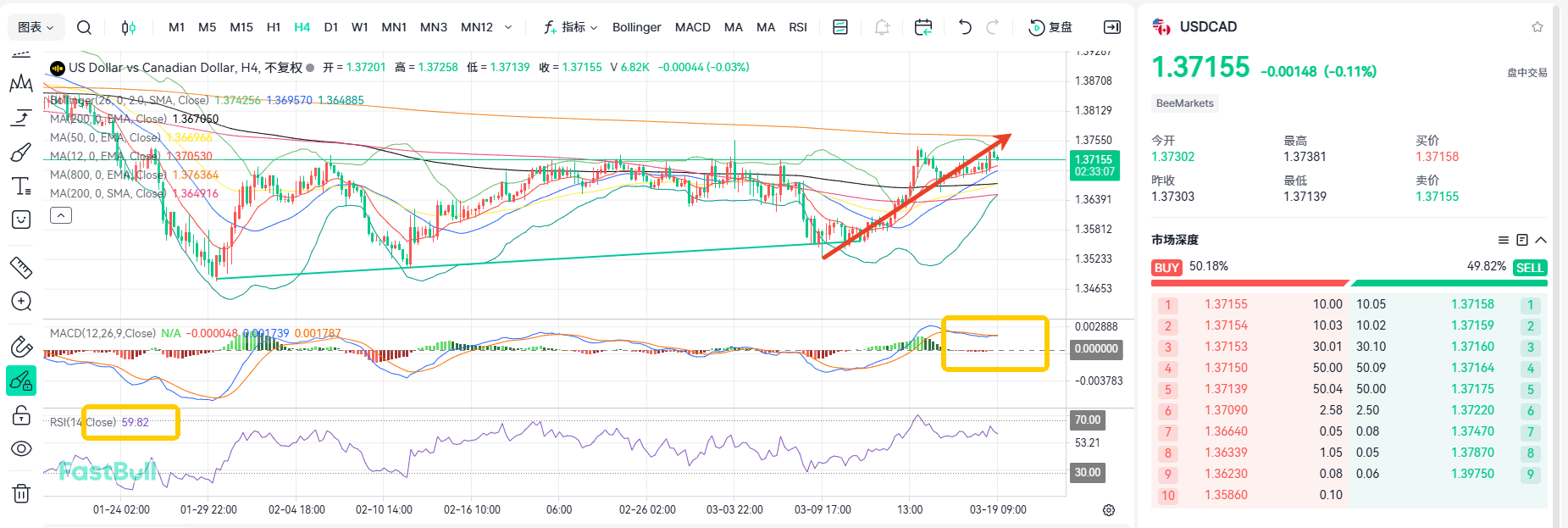
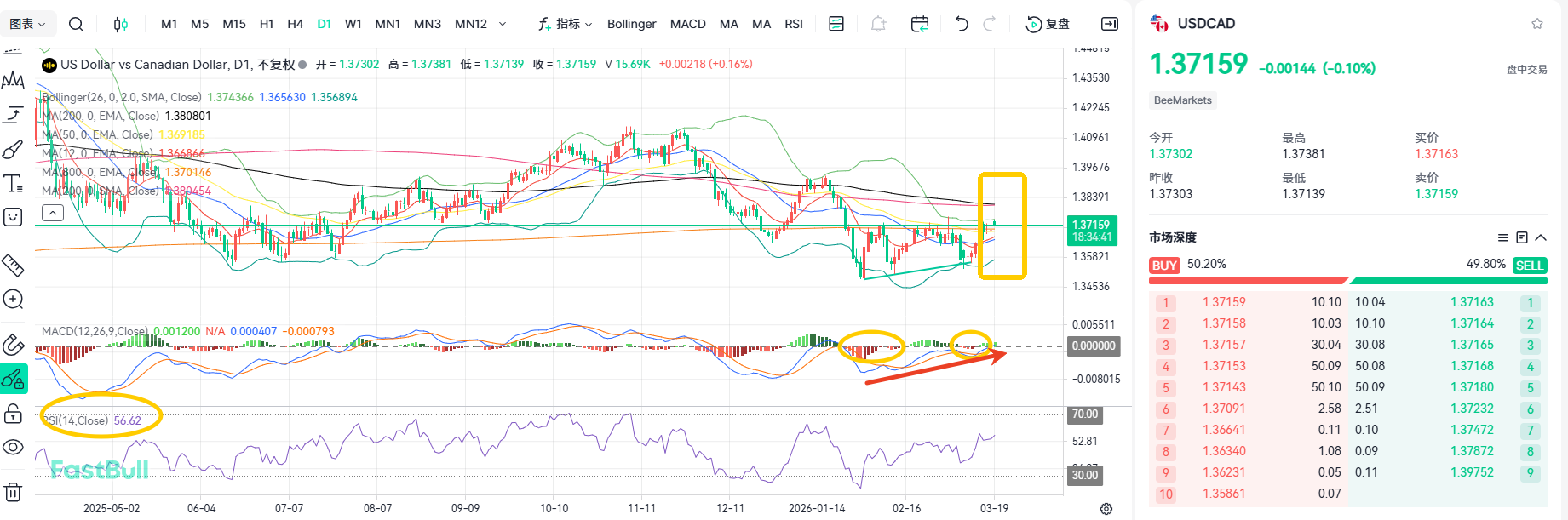
      Based on the 4-hour chart, USD/CAD shows a narrowing Bollinger Band, with flat moving averages. After yesterday's sharp rally, the short-term uptrend holds. Prices oscillate upward along the EMA12 and the Bollinger Upper Band. Moreover, the MACD and signal lines are above the 0-axis but have formed a death cross, pulling back toward the 0-axis (still far from it), indicating the uptrend remains intact, but a pullback is possible. Resistance lies near the EMA800 and Bollinger Upper Band, at 1.376 and 1.34, respectively. RSI stands at 59, signaling a dominant buying sentiment. Regarding the daily chart, the Bollinger Bands are narrowing, while moving averages are flat. A golden cross emerges again, with the MACD and signal lines hovering near the 0-axis—weakening downward momentum, a sign of bullish divergence suggesting a potential rebound. Last Friday's large bullish candle breaking through the Bollinger Middle Band and EMA50 confirms another test of the EMA200 (around 1.38). RSI is at 56, reflecting cautious market sentiment, with lows gradually rising. Thus, it is recommended to buy at lows.
      Interest Rates Unchanged! USD/CAD Holds Steady Above 1.37_1Interest Rates Unchanged! USD/CAD Holds Steady Above 1.37_2
      Trading Recommendations
      Trading direction: Buy
      Entry Price: 1.37
      Target Price: 1.4
      Stop Loss: 1.35
      Support: 1.35/1.325/1.28
      Resistance: 1.38/1.4/1.42
      Risk Warnings and Investment Disclaimers
      You understand and acknowledge that there is a high degree of risk involved in trading with strategies. Following any strategies or investment methodologies is the potential for loss. The content on the site is being provided by our contributors and analysts for information purposes only. You alone are solely responsible for determining whether any trading assets, or securities, or strategy, or any other product is suitable for you based on your investment objectives and financial situation.

      Quick Access to 7x24

      Quick Access to More Editor-selected Real-time News

      Exclusive video for free

      FastBull project team is dedicated to create exclusive videos

      Real-time Quotes

      View more faster market quotes

      More comprehensive macro data and economic indicators

      Members have access to entire historical data, guests can only view the last 4 years

      Member-only Database

      Comprehensive forex, commodity, and equity market data

      Tank

      Analysts

      20 years of trading experience, specializing in naked price action analysis, Elliott Wave Theory, and Chan Theory. Has conducted in-depth research on forex, stocks, and cryptocurrencies. Achieved a tenfold profit during the 2005 bull market and doubled profits within one month of entering the crypto market in 2015. Adheres to the trading philosophy: "Trend is king; focus on the big picture, act on

      Rank

      1

      Articless

      602

      Win Rate

      72.23%

      P/L Ratio

      0.49

      Focus on

      USDJPY, XAUUSD

      Related Analysis

      Panic Selling! Drop in Gold Prices Isn't Over Yet

      PENDING

      Panic Selling! Drop in Gold Prices Isn't Over Yet

      PENDING

      Policy Split! U.S.-Japan Adjustment Nears Completion

      PENDING

      Policy Split! U.S.-Japan Adjustment Nears Completion

      PENDING

      Oil Prices Become the Biggest Variable! USD/CAD Maintains an Upward Trend

      Trading
      FastBull
      English
      English
      العربية
      繁體中文
      简体中文
      Bahasa Melayu
      Bahasa Indonesia
      ภาษาไทย
      Tiếng Việt
      Economic Calendar 7x24 Quotes Video Analysis Data Warehouse Pro AI Signal News