Fundamentals
The Bank of Canada announced on Wednesday that it has held the benchmark interest rate steady at 2.25% for the third consecutive time. This decision reflects the complex economic situation triggered by the war in Iran: rising energy prices and domestic economic weakness are creating opposing forces, leaving the central bank in a dilemma. Since the U.S. and Israel launched attacks on Iran, global energy prices have risen by about 40%, creating complex inflationary pressures for Canada, a major oil-producing country. However, domestic economic fundamentals are not optimistic: employment decreased by 84,000 jobs in February, working hours declined, and trade and manufacturing sales data were weak. Economists estimate that the annualized Q1 GDP growth rate may be below 1%, far lower than the central bank's previous forecast of 1.8%. Q4 GDP of 2025 had already contracted by 0.6%. Bradley Saunders, North American economist at Capital Economics, believes the central bank's tone is "slightly dovish," noting that while the bank acknowledges a deterioration in the economic outlook, it "ignores" the direct impact of the Iran war. He argues that future rate decisions will depend on two "highly uncertain" events—the Iran war and the outcome of trade negotiations with the United States. If oil prices remain high, the central bank may hike rates to curb inflation. However, if Trump withdraws from trade talks, rates could be cut instead. Markets expect a possible rate hike by year-end, but many economists believe this expectation "lacks foundation," especially given ongoing uncertainty surrounding the review of the USMCA (United States-Mexico-Canada Agreement). Governor Macklem emphasized that the range of potential outcomes is broader than at any time in recent years.
Latest U.S. economic data show that the labor market remains generally robust. According to the U.S. Department of Labor, initial jobless claims fell by 8,000 to 205,000 for the week ending March 14th, below market expectations. The four-week moving average also declined during the nonfarm payroll survey period, reflecting continued resilience in the job market. Although tensions in the Middle East have pushed up oil prices and gasoline costs, there has been no significant impact on business hiring so far. However, the number of continuing jobless claims edged up to 1.857 million, indicating persistent reemployment pressure for some groups. Economists generally believe that, given that price increases may be temporary, businesses are unlikely to conduct large-scale layoffs in the short term. Still, rising uncertainty, tightening financial conditions, and higher financing costs for small businesses will continue to constrain hiring. Meanwhile, rising oil prices are gradually being passed through to sectors such as aviation, transportation, and food. Combined with stock market volatility, this may prompt households—especially high-income groups—to reduce spending. Compared to the relative stability of the labor market, the housing market has weakened substantially. U.S. single-family new home sales plunged 17.6% month-on-month in January to an annualized 587,000 units, the lowest level in nearly three and a half years, with December data also revised downward. Extreme cold weather and snowstorms limited homebuying activity, which was a key reason for the short-term decline, but rising interest rates also exerted significant pressure. Although mortgage rates briefly retreated earlier this year, the recent rebound in oil prices has pushed Treasury yields higher, causing mortgage rates to climb again and dampening the recovery in housing demand. At the same time, new home inventory rose slightly, with the months' supply based on current sales pace increasing to 9.7 months—a relatively high level. On the pricing front, the median price of new homes sold fell 6.8% year-on-year, reflecting developers' efforts to clear inventory amid weak demand and elevated stock levels. Structural factors, such as rising construction costs, labor shortages, and limited land availability, continue to constrain residential construction activity. On the macro policy front, the Federal Reserve maintained its benchmark rate in the 3.50%–3.75% range and expects only one rate cut this year, while raising its inflation forecast—signaling continued vigilance against inflation risks. Beyond the policy environment, uncertainty within the Fed is also growing. Chair Powell stated he will not step down until the Justice Department completes its investigation into him, and may remain in office after his term ends until the Senate confirms his successor. The probe involves cost overruns in the renovation project of the Fed's headquarters and is still under legal proceedings, expected to last some time. This creates obstacles for the government's plans to replace the Fed chair and push for looser monetary policy. Against the backdrop of ongoing tensions between the government and the Fed, markets worry that political and legal pressures could undermine central bank independence—historical experience shows that independence is crucial for effectively controlling inflation. Overall, the U.S. economy presents a complex picture characterized by "stable employment, weak housing, cautious policy, and rising uncertainty."
Technical Analysis
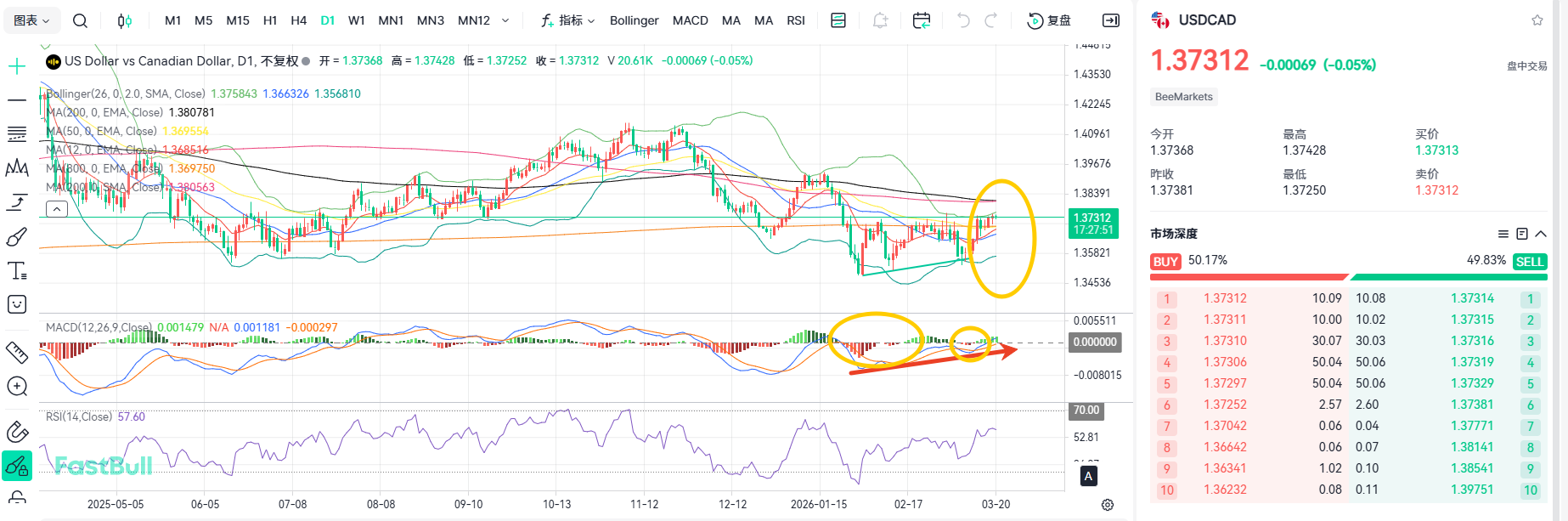
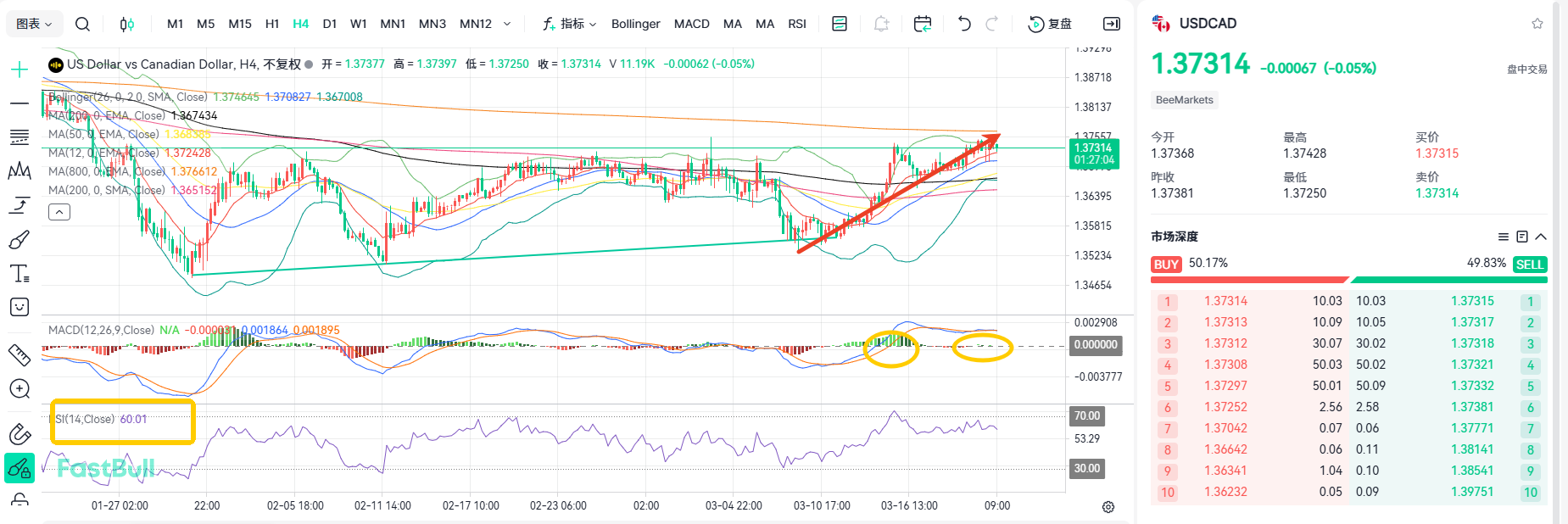
Based on the 4H chart, USD/CAD shows narrowing Bollinger Bands and flattening moving averages. After yesterday's sharp rally, the short-term upward trend remains intact. Prices oscillate upward along the EMA12 and the Bollinger Upper Band. The MACD and signal lines are above the zero axis but have formed a death cross, indicating weakening upward momentum. This proves that while the uptrend persists, a pullback is possible. Resistance lies near the EMA800 and round-number levels at approximately 1.376 and 1.38. RSI stands at 59, showing investors are predominantly bullish. Daily, Bollinger Bands are narrowing and moving averages are flattening. The MACD has formed a golden cross, with both lines returning above the zero axis—indicating weakening downward momentum and signaling a continuation of the rebound. Friday's strong bullish candle broke through the Bollinger Middle Band and EMA50, confirming another attempt to challenge EMA200 around 1.38. RSI is at 57, reflecting a wait-and-see sentiment, though RSI lows are gradually rising. Therefore, buying at lows is recommended.
Trading Recommendations
Trading direction: Buy
Entry Price: 1.371
Target Price: 1.4
Stop Loss: 1.35
Support: 1.35/1.325/1.28
Resistance: 1.38/1.4/1.42