The European Central Bank (ECB) continued its tightening cycle by raising its three key interest rates by 25 basis points, marking its second increase of the year and bringing the deposit facility rate to 2.50%. Policymakers justified the decision by highlighting the ongoing conflict in the Middle East, which continues to generate inflationary pressures and increases the risk that inflation could remain above the ECB’s 2% target for a prolonged period.
The ECB’s latest economic projections reflect these concerns. The central bank expects headline inflation to average 3.0% in 2026, moderate to 2.5% in 2027, and gradually decline toward 2.1% in 2028. While inflation is still projected to move lower over the medium term, policymakers acknowledged that the disinflation process is advancing more slowly than previously expected.
During the press conference following the policy meeting, ECB President Christine Lagarde stated that the Eurozone economy continues to demonstrate resilience, while most underlying inflation indicators remain relatively stable. Nevertheless, she warned that short-term inflation expectations remain elevated and that higher energy prices are likely to continue passing through into food and goods prices over the coming months.
Meanwhile, the ZEW Economic Sentiment Survey for the Eurozone fell to 25.8 in September, significantly below both the market forecast of 39.9 and the previous reading of 31.4. In Germany, investor sentiment also weakened, with the index declining to 34.7 from 42.5. However, current conditions improved notably, rising to -13.9 from -21.5 in the Eurozone and to -47.1 from -61.1 in Germany. The data suggests that while current economic conditions have improved compared with previous months, expectations for future growth have become less optimistic.
Geopolitical developments also contributed to higher energy prices after Saudi Arabia informed European refiners of shipment delays following attacks by Houthi forces that damaged the East-West crude oil pipeline. The disruption added to existing concerns regarding energy supply and inflationary pressures across the region.
In Australia, Reserve Bank of Australia (RBA) Assistant Governor Sarah Hunter stated on Tuesday that the housing market remains one of the primary transmission channels through which monetary policy affects the broader economy. Hunter added that policymakers continue to seek moderation in both housing activity and overall economic growth as part of the central bank’s efforts to reduce inflationary pressures.
Australia’s Trimmed Mean CPI remained unchanged at 3.6% year-over-year in July, exceeding the RBA’s year-end forecast of 3.3%. At the same time, real GDP growth reached 2.1% year-over-year during the second quarter, surpassing the central bank’s estimate of 1.9%. Together, these figures continue to support expectations that the RBA could deliver a 25-basis-point rate increase to 4.60% at its September 29 meeting, a scenario currently assigned a probability of around 70% by financial markets.
Data released by the Australian Bureau of Statistics (ABS) showed that the economy expanded by 0.4% quarter-over-quarter during the second quarter, slightly above market expectations. The stronger-than-expected result further reinforces the case for an additional interest rate increase in the near term.
Following the GDP release, market participants increased their expectations for a September rate hike, with the implied probability rising to nearly 70%, compared with approximately 50% before the report was published.
Technical Analysis
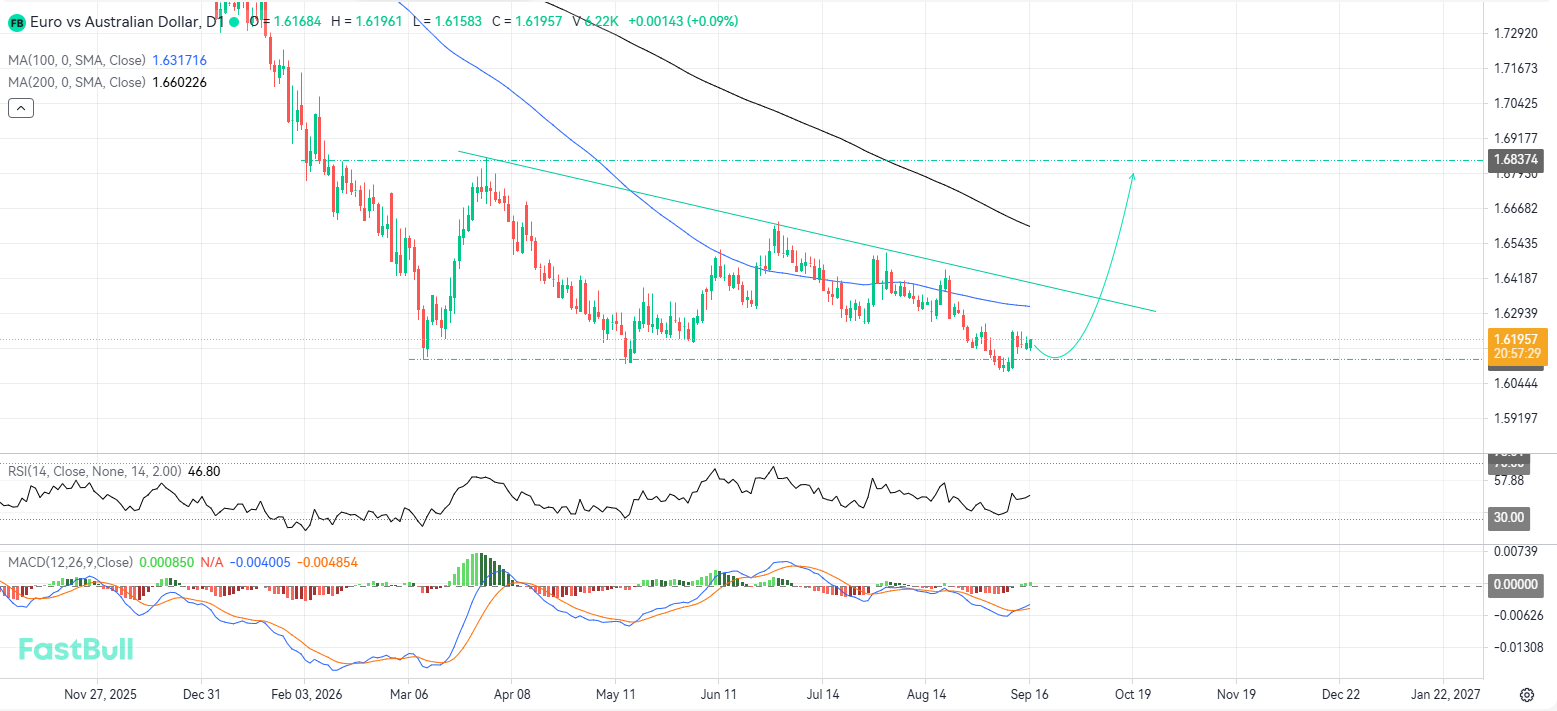
EURAUD has established an important support area around 1.6128, a level that has repeatedly resisted attempts to break lower in a decisive manner. Most recently, the pair briefly moved below this support zone but quickly recovered and returned above it, highlighting the continued presence of buyers in the area. This marks the third occasion on which the market has reacted positively from the same support level, reinforcing its technical significance and creating the foundation for a potential change in direction.
If buyers continue to defend this area, the first objective would be a break above the descending trendline that has guided the broader bearish structure. A successful breakout above that trendline could strengthen bullish momentum and open the door for an extension toward 1.6837, a level last reached on March 31 and an area that may once again act as local resistance. Meanwhile, the 100-period and 200-period moving averages are positioned at 1.7148 and 1.7492 respectively. Both indicators remain above current price action and are likely to provide dynamic resistance should the recovery continue to develop.
Looking at momentum indicators, the Relative Strength Index (RSI) is currently positioned near 59, already within bullish territory and suggesting that momentum has begun to shift in favor of buyers. The indicator supports the view that market sentiment may be gradually changing after the repeated defense of support.
At the same time, the MACD displays a bullish histogram that is beginning to gain depth, indicating that upside momentum is gradually strengthening. Meanwhile, the signal lines remain only slightly below neutral territory, leaving room for a bullish crossover in the near term. Such a move would provide additional confirmation of a potential upward reversal and align the technical conditions for a broader bullish extension in the sessions ahead.
Trading Recommendations
Trading direction: Buy
Entry price: 1.6191
Target price: 1.6837
Stop loss: 1.5980
Validity: Sep 29, 2026 15:00:00


