The US Dollar is extending its weekly slide against the Canadian Dollar on Friday, touching three-week lows at 1.3670 as an unrelenting wave of Dollar selling — driven by fading safe-haven demand and cautious optimism surrounding a potential US-Iran diplomatic breakthrough — continues to dominate the directional narrative for the pair. USD/CAD has now depreciated continuously for five consecutive sessions, accumulating a weekly loss of approximately 1.3% that reflects just how dramatically the market's risk appetite has shifted since the geopolitical tensions of earlier in the month were at their most acute.
On the surface, the Canadian Dollar's performance this week looks impressive. Stripping out the geopolitical noise, however, the picture that emerges is far more nuanced — and for those of us who track the Loonie's fundamental drivers with any degree of rigor, there are warning signs accumulating beneath the surface that suggest the CAD's current rally may be more fragile than the headline move implies. The Bank of Canada's own governor has essentially said as much, and a critical inflation data release on Monday could rapidly transform the narrative from one of Canadian Dollar strength to one of stagflationary vulnerability.
Let me be precise about what is actually driving USD/CAD lower this week, because the distinction is important. This is not a story of Canadian Dollar strength in the traditional sense — driven by strong economic fundamentals, rising commodity revenues, or a hawkish Bank of Canada pivot. This is, first and foremost, a story of US Dollar weakness. The Greenback has been under sustained selling pressure across the board as traders systematically reduce their safe-haven Dollar holdings in response to a shifting geopolitical landscape, and USD/CAD is simply one of the pairs where that Dollar weakness is most visibly expressed.
US President Donald Trump has been the primary catalyst for the week's Dollar selling. His announcement on Thursday of a ten-day ceasefire between Lebanon and Israel — followed by his notably optimistic public declaration that a deal to end the broader Middle East hostilities is "very close" — injected a dose of risk appetite into markets that had been braced for a prolonged and economically damaging conflict. When Trump speaks with that degree of public confidence about diplomatic progress, markets tend to listen, even when the details remain murky and the gap between presidential optimism and diplomatic reality is substantial.
The ceasefire announcement in particular was received as a meaningful confidence-building signal — evidence that at least one front in the broader regional conflict is moving toward de-escalation, and that the diplomatic momentum that has been building in Washington over the past week is producing tangible results on the ground. For Dollar bears, this was the confirmation they needed to press their positions further, and USD/CAD obliged by extending its decline to the 1.3670 level with minimal resistance.
But as has been the recurring theme throughout this entire geopolitical episode, the optimism generated by Trump's public comments collided almost immediately with a more sobering reality. A Reuters report citing Iranian sources revealed on Friday that US and Iranian negotiators have substantially scaled back their ambitions for this weekend's planned talks and are now targeting nothing more ambitious than a temporary memorandum designed to prevent a return to open conflict — rather than the comprehensive agreement that markets had been beginning to hope for.
This is a development that I believe the Canadian Dollar market has not yet fully priced, and it represents a meaningful asymmetric risk for CAD bulls at current levels. The difference between a credible, structured peace framework and a stopgap memorandum is enormous in terms of its implications for global energy markets — and by extension, for the Canadian economy, whose fortunes are inextricably linked to the trajectory of crude oil prices.
Canada is, of course, one of the world's largest oil producers and exporters, and the relationship between crude prices and the Canadian Dollar is one of the most well-documented in global FX markets. When oil prices are high and rising, the Loonie typically benefits from improved terms of trade, stronger fiscal revenues in oil-producing provinces, and increased corporate investment in the energy sector. But the current episode of elevated oil prices is categorically different from previous commodity booms that strengthened the CAD, and this is a distinction that deserves serious emphasis.
The Strait of Hormuz remains closed to normal commercial traffic as of Friday, and WTI Crude Oil continues to trade approximately 35% above its pre-war levels — a staggering premium that reflects the severity of the supply disruption and the market's ongoing uncertainty about when and how the waterway will reopen. For a casual observer, elevated oil prices and a stronger Canadian Dollar might seem like natural bedfellows, and historically that relationship has held. But the current situation is more complicated and, for the Canadian economy, potentially more threatening than the simple oil price headline suggests.
The critical issue is that elevated oil prices in the context of a geopolitical supply shock are simultaneously a revenue windfall for Canada's energy sector and a devastating cost shock for every other sector of the economy. When oil prices rise because of strong global demand — the classic commodity supercycle scenario — the benefits are broadly distributed: energy companies profit, government revenues increase, employment in oil-producing regions rises, and the economy as a whole tends to accelerate. When oil prices rise because a critical shipping chokepoint has been closed by military conflict — the current scenario — the dynamics are fundamentally different. Import costs surge, transportation and logistics expenses escalate across the entire supply chain, inflationary pressures build, and consumer purchasing power erodes in real time. The economy gets the pain of an energy price shock without the offsetting demand stimulus that normally accompanies a commodity boom.
This is precisely the stagflationary trap that Bank of Canada Governor Tiff Macklem described with unusual candor on Thursday at the Montreal Chamber of Commerce. Macklem warned explicitly about "higher price levels" and acknowledged the profound challenge facing the Bank of Canada in keeping inflation anchored without simultaneously triggering a recession — a statement that, coming from a central bank governor known for measured and carefully calibrated public communication, carries considerable weight. When a central banker of Macklem's stature uses language that explicitly frames the stagflation risk as a genuine policy dilemma rather than a tail risk, markets should take notice.
Against this backdrop, Monday's release of Canadian Consumer Price Index data for March has elevated itself to the most consequential domestic economic event on the Canadian calendar in recent weeks. Expectations heading into the release are, to put it plainly, alarming. Consumer inflation is widely forecast to have accelerated significantly in March, driven primarily by the energy shock triggered by the Middle East conflict — with higher gasoline prices, elevated heating costs, and rising transportation expenses all feeding into the headline number in ways that are difficult for households to avoid or absorb.
If the final figures meet or exceed those expectations — and given the magnitude of the energy price surge, there is a credible case that they could surprise even further to the upside — the implications for the Canadian Dollar are deeply uncomfortable. A hot CPI print would validate Macklem's stagflation warning in real data terms, force a significant reassessment of the Bank of Canada's policy options, and remind markets that the Loonie's current strength is being sustained by Dollar weakness rather than Canadian economic resilience. In that environment, the CAD could reverse sharply and rapidly — and USD/CAD's three-week lows at 1.3670 could begin to look less like a floor and more like a brief pause before a recovery.
The Bank of Canada faces a genuinely impossible policy calculus. Raising interest rates to combat energy-driven inflation would be economically destructive in an environment where growth is already under pressure from elevated input costs, weakening consumer confidence, and the global uncertainty generated by the ongoing conflict. Cutting rates to support the economy would risk entrenching inflationary expectations and abandoning the price stability mandate that underpins the central bank's credibility. Holding rates steady — the most likely near-term course of action — risks doing too little on both fronts simultaneously, leaving the economy to absorb the stagflationary shock without meaningful policy support in either direction.
This is not a theoretical exercise. Canada's economic vulnerability to energy price shocks is structural and well-documented, and the combination of a closed Strait of Hormuz, oil prices 35% above pre-war levels, and an inflation data release that is expected to confirm accelerating price pressures creates a genuinely difficult environment for the Canadian Dollar to sustain its current levels, let alone extend its gains meaningfully.
Technical Analysis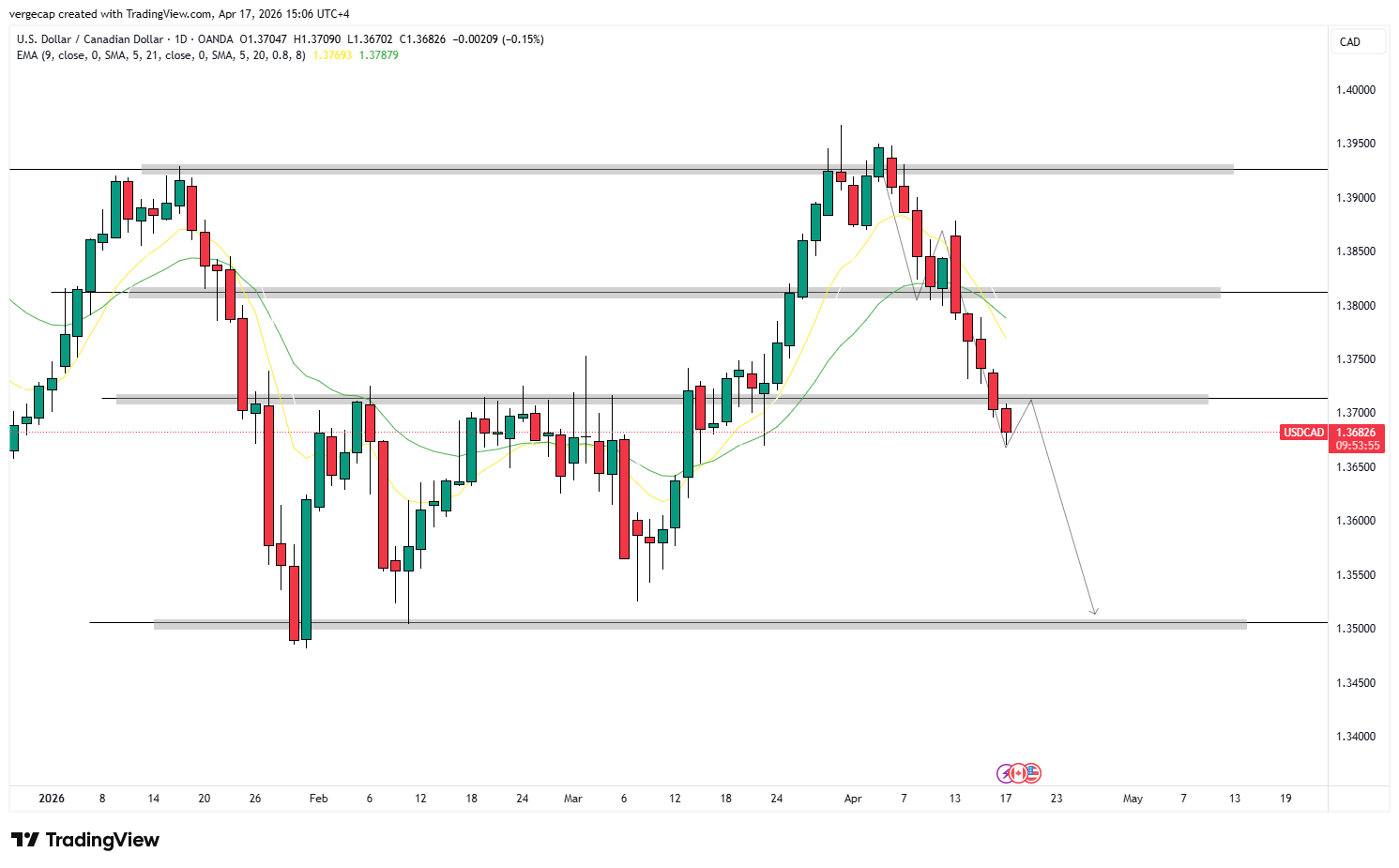
From a technical perspective, USD/CAD is showing signs of a developing bearish structure following a rejection from higher resistance levels. On the daily chart, price action recently tested the 1.3900–1.3950 supply zone but failed to sustain momentum above it, triggering a sharp reversal that has shifted near-term sentiment in favor of sellers. This rejection marks a potential lower high within a broader range, raising the risk of a deeper downside move.
The pair has since broken below the 1.3800 support zone, which previously acted as a key consolidation area. This breakdown is technically significant, as it suggests that prior support has now turned into resistance, reinforcing the bearish outlook. Price is currently trading around the 1.3680–1.3700 region, approaching another important support level that could determine the next directional move.
The 21-period Simple Moving Average (SMA), now trending lower and positioned near the 1.3750 region, is acting as immediate dynamic resistance. Price has moved decisively below this level, indicating that short-term momentum has shifted to the downside. Meanwhile, the 50-period SMA, located slightly higher around the 1.3780–1.3800 zone, is beginning to flatten and turn lower. This suggests weakening bullish momentum and adds further weight to the bearish bias.
If USD/CAD fails to hold above the 1.3650–1.3700 support zone, a decisive break lower could trigger an extension of the current decline. In such a scenario, downside targets would likely extend toward the 1.3500 region, which aligns with a strong historical demand zone and previous consolidation base. A sustained move below this level would expose deeper losses toward the 1.3400 handle, marking a more pronounced bearish continuation.
On the upside, any recovery attempts are likely to face initial resistance at the 1.3750 level, followed by stronger supply around the 1.3800 zone. A sustained move back above this region would be required to neutralize the bearish outlook and shift focus back toward the 1.3900 resistance area. However, given the current structure and momentum, such a move appears less likely in the near term.
Momentum indicators suggest increasing bearish pressure rather than exhaustion. The Relative Strength Index (RSI) is likely trending lower toward the mid-40s, indicating weakening momentum while still leaving room for further downside before reaching oversold conditions. Meanwhile, the Moving Average Convergence Divergence (MACD) has likely crossed below the zero line, with a widening histogram that points to strengthening bearish momentum and supports the case for continued downside movement.
Overall, USD/CAD appears to be transitioning into a bearish phase, with price action breaking key support levels and momentum indicators aligning with downside risks. Unless the pair can reclaim broken resistance zones, the path of least resistance remains to the downside.
TRADE RECOMMENDATION
SELL USD/CAD
ENTRY PRICE: 1.3700
STOP LOSS: 1.3820
TAKE PROFIT: 1.3500


