XAUUSD
4061.96

0.47%

WTI
78.795

7.04%

EURUSD
1.15276

0.00%

GBPUSD
1.34654

0.09%

USDJPY
156.483

0.59%

USNDAQ100
28528.00

1.31%

Global Markets

Economic Calendar
7x24
Quotes

Video

Latest Update

Risk Warning on Trading HK Stocks

Despite Hong Kong's robust legal and regulatory framework, its stock market still faces unique risks and challenges, such as currency fluctuations due to the Hong Kong dollar's peg to the US dollar and the impact of mainland China's policy changes and economic conditions on Hong Kong stocks.

HK Stock Trading Fees and Taxation

Trading costs in the Hong Kong stock market include transaction fees, stamp duty, settlement charges, and currency conversion fees for foreign investors. Additionally, taxes may apply based on local regulations.

HK Non-Essential Consumer Goods Industry

The Hong Kong stock market encompasses non-essential consumption sectors like automotive, education, tourism, catering, and apparel. Of the 643 listed companies, 35% are mainland Chinese, making up 65% of the total market capitalization. Thus, it's heavily influenced by the Chinese economy.

HK Real Estate Industry

In recent years, the real estate and construction sector's share in the Hong Kong stock index has notably decreased. Nevertheless, as of 2022, it retains around 10% market share, covering real estate development, construction engineering, investment, and property management.

Analysis
Data

Data Warehouse Market Trend Institutional Data Policy Rates Macro

Market Trend

Speculative Sentiment Orders and Positions Correlation

Popular Indicators

Pro
AI Signal

Trading Signals

AI Signal

News
Recent Searches
    Trending Searches
      News
      7x24
      Quotes
      Economic Calendar
      Video
      Data
      • Names
      • Latest
      • Prev.

      View All

      No data

      Sign in

      Sign up

      --

      • My Favorites
      • My Subscription
      • Profile
      • Orders
      • Account Settings
      • Sign out
      Reminder Settings
      • Economic Calendar
      • Quotes/Market Quotes

      Reminders Temporarily Unavailable

      FastBull Membership Privileges
      Quick Access to 7x24
      Quick Access to More Editor-selected Real-time News
      Real-time Quotes
      View more faster market quotes
      Upgrade to {0} Pro
      I have read and agreed to the
      Pro Policy
      Feedback
      0 /250
      0/4
      Contact Information
      Submit

      US-Iran Suspension of Hostilities Fuels Ceasefire Hopes, Keeping Downside Risks for Oil Prices in Play

      Summary:

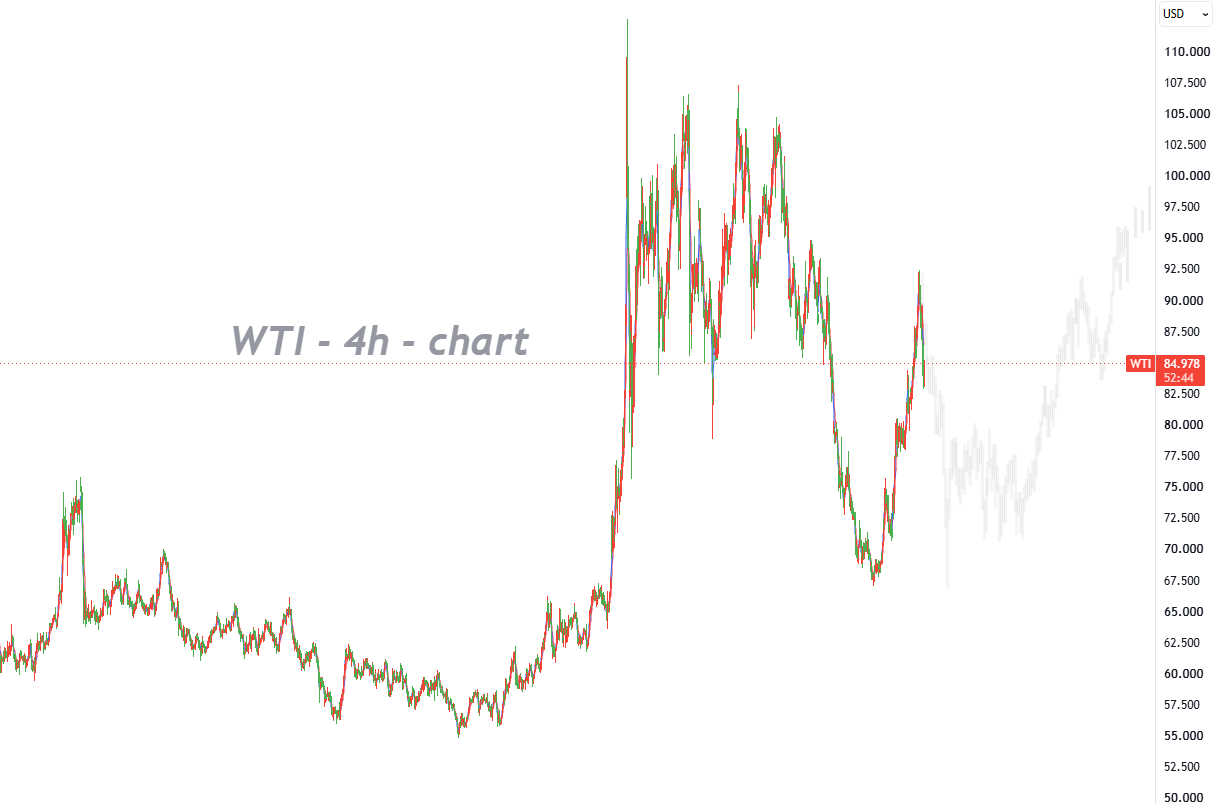
      International oil prices opened sharply lower on Monday. As the United States suspended airstrikes against Iran, expectations of further de-escalation in the US-Iran conflict and a potential ceasefire strengthened, prompting the rapid unwinding of the geopolitical risk premium previously priced into the crude oil market. After closing lower last Friday, WTI crude plunged nearly 8% at the start of this week, falling below the $83 per barrel level. Although market sentiment has clearly turned more cautious in the short term, recent price action, volume-price dynamics, and sentiment indicators suggest that previous negative events and bearish narratives have already been largely reflected in prices. As the process of risk-off positioning gradually approaches its later stages, oil prices may enter a period of technical recovery. Nevertheless, the medium-term trend still faces further downside risks.

      Sell WTI
      EXP
      Trading

      82.813

      ENTRY

      67.000

      TGT

      93.500

      SL

      78.793 -5.973 -7.05%

      0

      Point

      Flat

      67.000

      TGT

      CLOSING

      82.813

      ENTRY

      93.500

      SL
      Fundamental

      International oil prices opened sharply lower on Monday as traders reassessed supply risks in the Middle East. The United States suspended airstrikes against Iran over the weekend, rapidly strengthening expectations that the US-Iran conflict could further de-escalate and potentially move toward a temporary ceasefire. After conducting strikes against Iran for 13 consecutive days, the United States suspended military operations late Friday, prompting markets to reassess the Trump administration’s next policy and military moves.
      After closing lower last Friday, WTI crude fell another roughly 8% at the beginning of this week, briefly breaking below $83 per barrel. The sharp decline indicates that the geopolitical risk premium previously priced into oil has been unwinding rapidly.
      It is worth noting that the current Middle East oil shock is not simply a repeat of the first wave of the conflict. Instead, it represents more of a second shock following the gradual depletion of the market’s previous risk buffers. The most crowded positioning structures during the two oil-price shocks have also differed significantly, suggesting that the current market is unlikely to simply replicate the trading pattern seen in the second quarter.
      What remains relatively certain is that the future trajectory of the Middle East conflict remains highly unpredictable, while the risk of a prolonged confrontation is increasing. Against this backdrop, the market will inevitably need to go through a period of declining risk appetite and capital reallocation in the short term.
      However, judging from the recent magnitude of the price decline, volume-price dynamics, and market sentiment indicators, a substantial amount of negative news and bearish expectations has already been concentrated in the sharp drop in oil prices. As the process of further risk reduction gradually approaches its later stages, the probability of broad-based sentiment recovery and asset rotation in August is increasing. Therefore, although oil prices remain under short-term downside pressure, the room for further declines may become increasingly limited, and traders should remain alert to the risk of an oversold rebound.
      US-Iran Suspension of Hostilities Fuels Ceasefire Hopes, Keeping Downside Risks for Oil Prices in Play_1

      Technical Analysis

      From a technical perspective, WTI crude broke below the rising trendline that had previously extended from around $67.00 to the recent high of $92.46. This indicates that the structure of the current uptrend has been disrupted, while bullish momentum has weakened significantly.
      If oil prices fail to reclaim the trendline and establish a sustained breakout above it, the trendline breakdown could further confirm the formation of a short-term top. WTI is expected to retain considerable downside potential, with the first major target around the previous bottom near $67.00. At that point, the market could enter another period of consolidation.
      In terms of the moving-average structure, the 100-day moving average remains above the 200-day moving average, while both long-term moving averages continue to slope upward. This suggests that although the short-term rising trendline has been broken, WTI’s medium- to long-term bullish structure has not yet been completely reversed.
      WTI prices are currently still slightly above the 200-day moving average. If the correction deepens, the 200-day moving average could provide important dynamic support. However, a decisive break below this moving average would increase the risk of further deterioration in the medium- to long-term market trend.
      Regarding momentum indicators, the Stochastic Oscillator recently entered oversold territory before beginning to recover, suggesting that the market may be developing some potential for a short-term oversold rebound. Meanwhile, the RSI is also gradually recovering from depressed levels, indicating that the market has not yet entered an extreme bearish condition.
      Therefore, although the medium-term downside structure remains dominant for WTI, the sharp short-term decline has created some technical demand for a rebound. Traders should avoid aggressively chasing the downside and instead focus on signs of stabilization around key support levels, as well as whether oil prices can reclaim key resistance levels during any rebound.

      Trading Strategy

      Trading Direction: Sell
      Entry Price: 87.30
      Target Price: 67.00
      Stop Loss: 93.50
      Strategy Valid Until: August 26, 2026, 23:55
      Support Levels: 82.87, 81.17, 79.52
      Resistance Levels: 87.87, 89.85, 92.46
      Risk Warnings and Investment Disclaimers
      You understand and acknowledge that there is a high degree of risk involved in trading with strategies. Following any strategies or investment methodologies is the potential for loss. The content on the site is being provided by our contributors and analysts for information purposes only. You alone are solely responsible for determining whether any trading assets, or securities, or strategy, or any other product is suitable for you based on your investment objectives and financial situation.

      Quick Access to 7x24

      Quick Access to More Editor-selected Real-time News

      Exclusive video for free

      FastBull project team is dedicated to create exclusive videos

      Real-time Quotes

      View more faster market quotes

      More comprehensive macro data and economic indicators

      Members have access to entire historical data, guests can only view the last 4 years

      Member-only Database

      Comprehensive forex, commodity, and equity market data

      Eva Chen

      Analysts

      Master of Economics, 8 years in the financial industry, CFA holder, joined HSBC (Hong Kong) Bank in 2013 after graduating from the University of California, USA in the Investment Research and Markets Department. With years of financial market experience and trading experience, having provided excellent investment advice to many brokerages, entity derivatives importers and clients in Greater China.

      Rank

      4

      Articless

      2709

      Win Rate

      60.52%

      P/L Ratio

      0.67

      Focus on

      XAUUSD, WTI, GBPUSD

      Related Analysis

      US-Iran Suspension of Hostilities Fuels Ceasefire Hopes, Keeping Downside Risks for Oil Prices in Play

      Trading

      Fed Holds Rates Steady, Yen Outlook Depends on BoJ Rate-Hike Signals

      PENDING

      Fed Holds Rates Steady, Yen Outlook Depends on BoJ Rate-Hike Signals

      PENDING

      Ignore Technical Noise and Focus on Algorithmic Guidance

      Trading

      Ignore Technical Noise and Focus on Algorithmic Guidance

      Trading
      FastBull
      English
      English
      العربية
      繁體中文
      简体中文
      Bahasa Melayu
      Bahasa Indonesia
      ภาษาไทย
      Tiếng Việt
      Economic Calendar 7x24 Quotes Video Analysis Data Warehouse Pro AI Signal News