News
7x24
Quotes
Economic Calendar
Video
Data
- Names
- Latest
- Prev.

Latest Update

Risk Warning on Trading HK Stocks
Despite Hong Kong's robust legal and regulatory framework, its stock market still faces unique risks and challenges, such as currency fluctuations due to the Hong Kong dollar's peg to the US dollar and the impact of mainland China's policy changes and economic conditions on Hong Kong stocks.

HK Stock Trading Fees and Taxation
Trading costs in the Hong Kong stock market include transaction fees, stamp duty, settlement charges, and currency conversion fees for foreign investors. Additionally, taxes may apply based on local regulations.

HK Non-Essential Consumer Goods Industry
The Hong Kong stock market encompasses non-essential consumption sectors like automotive, education, tourism, catering, and apparel. Of the 643 listed companies, 35% are mainland Chinese, making up 65% of the total market capitalization. Thus, it's heavily influenced by the Chinese economy.

HK Real Estate Industry
In recent years, the real estate and construction sector's share in the Hong Kong stock index has notably decreased. Nevertheless, as of 2022, it retains around 10% market share, covering real estate development, construction engineering, investment, and property management.
View All

No data


Explore BTCI dividend history from 2024 to 2026, including monthly payouts, ex-dividend dates, payment dates, distribution yield, and return of capital.
The BTCI dividend history shows how much the NEOS Bitcoin High Income ETF has distributed to shareholders each month since its launch in 2024. This page covers historical payouts, ex-dividend dates, payment dates, and the next scheduled distribution. It also explains BTCI's distribution yield and what investors should know about return of capital (ROC).

BTCI (NEOS Bitcoin High Income ETF) began making monthly distributions in October 2024. Its payout amounts have varied over time, reflecting changes in the fund's options strategy and market conditions. The table below lists its historical distributions, including the amount per share and key dates.
BTCI Dividend History (2024–2026)
| Ex-Dividend Date | Distribution Per Share | Record Date | Payment Date |
|---|---|---|---|
| Nov 18, 2026 | $0.5481 | Nov 18, 2026 | Nov 20, 2026 |
| Oct 21, 2026 | $0.6954 | Oct 21, 2026 | Oct 23, 2026 |
| Sep 16, 2026 | $0.7184 | Sep 16, 2026 | Sep 18, 2026 |
| Aug 19, 2026 | $0.6289 | Aug 19, 2026 | Aug 21, 2026 |
| Jul 22, 2026 | $0.6458 | Jul 22, 2026 | Jul 24, 2026 |
| Jun 16, 2026 | $0.6525 | Jun 16, 2026 | Jun 18, 2026 |
| May 20, 2026 | $0.7934 | May 20, 2026 | May 22, 2026 |
| Apr 22, 2026 | $0.7982 | Apr 22, 2026 | Apr 24, 2026 |
| Mar 18, 2026 | $0.7804 | Mar 18, 2026 | Mar 20, 2026 |
| Feb 18, 2026 | $0.7608 | Feb 18, 2026 | Feb 20, 2026 |
| Jan 21, 2026 | $1.0427 | Jan 21, 2026 | Jan 23, 2026 |
| Dec 24, 2025 | $0.9967 | Dec 24, 2025 | Dec 26, 2025 |
| Nov 26, 2025 | $1.0181 | Nov 26, 2025 | Nov 28, 2025 |
| Oct 22, 2025 | $1.2999 | Oct 22, 2025 | Oct 24, 2025 |
| Sep 24, 2025 | $1.3401 | Sep 24, 2025 | Sep 26, 2025 |
| Aug 20, 2025 | $1.4153 | Aug 20, 2025 | Aug 22, 2025 |
| Jul 23, 2025 | $1.4716 | Jul 23, 2025 | Jul 25, 2025 |
| Jun 25, 2025 | $1.3978 | Jun 25, 2025 | Jun 27, 2025 |
| May 21, 2025 | $1.5145 | May 21, 2025 | May 23, 2025 |
| Apr 23, 2025 | $1.2591 | Apr 23, 2025 | Apr 25, 2025 |
| Mar 26, 2025 | $1.3350 | Mar 26, 2025 | Mar 28, 2025 |
| Feb 26, 2025 | $1.4319 | Feb 26, 2025 | Feb 28, 2025 |
| Jan 22, 2025 | $1.5718 | Jan 22, 2025 | Jan 24, 2025 |
| Dec 24, 2024 | $1.4578 | Dec 24, 2024 | Dec 26, 2024 |
| Nov 20, 2024 | $1.4081 | Nov 20, 2024 | Nov 21, 2024 |
| Oct 23, 2024 | $1.1253 | Oct 23, 2024 | Oct 24, 2024 |
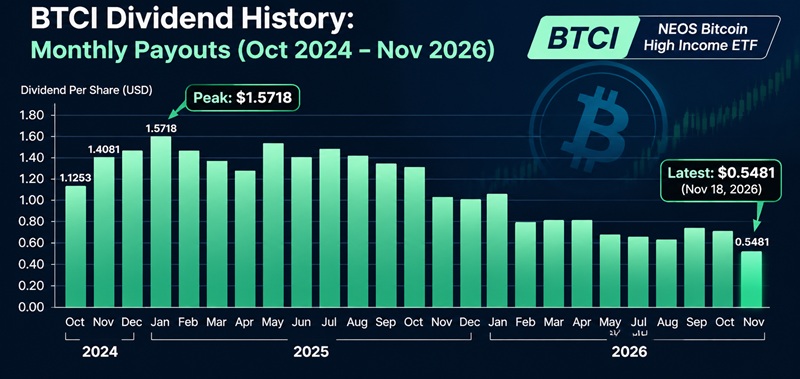
BTCI's monthly distributions have not remained at a fixed level. The fund paid $1.5718 per share in January 2025, its highest monthly distribution in the history shown above, compared with $0.5481 in November 2026. This difference highlights why investors should review actual payout records rather than assume that a high monthly distribution will continue at the same level.
Although investors commonly search for BTCI dividends, NEOS reports these payments as fund distributions. The distinction matters because a distribution can include different sources of income and capital, not just traditional dividend income.
Source: NEOS Investments official BTCI distribution history. Historical amounts are shown per share. Past distributions do not guarantee future payments.
BTCI pays distributions monthly. Since its first distribution in October 2024, the fund has generally followed a monthly schedule, with an announced declaration date, ex-dividend date, record date, and payment date for each distribution.
Yes. BTCI makes monthly distributions rather than following a quarterly or annual payment schedule. This can appeal to investors looking for more frequent cash flow, but monthly payments should not be confused with guaranteed monthly income.
The amount can change from one month to the next, and the fund does not promise a fixed distribution. Investors should check each month's official announcement for the confirmed amount and relevant dates.
BTCI's distributions can vary because the fund's income depends partly on its options strategy and the market conditions affecting that strategy. The premiums collected from selling call options are not necessarily the same every month. Changes in Bitcoin-related market volatility, option pricing, and the fund's portfolio can therefore affect the amount available for distribution.
A larger distribution in one month does not automatically mean the fund has become more profitable. Likewise, a smaller payment does not by itself explain the fund's total return. Investors should consider both distributions and changes in the fund's net asset value (NAV).
Investors tracking the next BTCI distribution should distinguish between the scheduled dates and the amount. NEOS publishes its distribution calendar in advance, but the per-share amount may not be available until the fund announces that month's distribution.
As of November 27, 2026, NEOS lists the following dates for BTCI's next scheduled distribution:
| Distribution Detail | Date |
|---|---|
| Declaration Date | Dec 15, 2026 |
| Ex-Dividend Date | Dec 16, 2026 |
| Record Date | Dec 16, 2026 |
| Payment Date | Dec 18, 2026 |
The ex-dividend date is particularly important. Investors generally need to purchase BTCI shares before the ex-dividend date to qualify for the upcoming distribution. Buying on or after that date does not qualify for that payment.
As of November 27, 2026, NEOS has listed the December distribution dates, but the amount per share has not yet been published. Investors should wait for the official distribution announcement rather than use the previous month's payment as a forecast.
The most recently announced distribution was $0.5481 per share, with an ex-dividend date of November 18, 2026, and a payment date of November 20, 2026. This is a historical reference, not a confirmed estimate for December.
BTCI's monthly distributions can provide regular cash flow, but its distribution rate should not be confused with its actual investment return. Investors should understand how the fund calculates its distribution rate and how much cash they might receive based on the number of shares they own.
According to NEOS data as of October 31, 2026, BTCI had a distribution rate of 24.96%, a 12-month trailing distribution rate of 28.51%, and a 30-day SEC yield of 2.36%.
These figures measure different things. The distribution rate annualizes the latest monthly distribution and compares it with the fund's NAV. It shows what the annualized payout would look like if that distribution remained unchanged, rather than predicting what investors will actually earn.
The 12-month trailing distribution rate reflects distributions over the previous 12 months relative to the fund's NAV. The 30-day SEC yield is a standardized measure based on the fund's recent net investment income. For an options-based income ETF like BTCI, it can differ significantly from the cash distributions shareholders receive.
Investors should also distinguish between distribution rate and total return. Total return accounts for both distributions and changes in the fund's share price, providing a more complete picture of investment performance.
BTCI's monthly distribution amount determines how much cash shareholders receive. Using its latest announced distribution of $0.5481 per share in November 2026, the estimated payment for different shareholdings would be:
| BTCI Shares | Distribution Per Share | Estimated Monthly Distribution |
|---|---|---|
| 100 | $0.5481 | $54.81 |
| 500 | $0.5481 | $274.05 |
| 1,000 | $0.5481 | $548.10 |
These examples represent gross cash distributions before taxes, based on one month's announced payment. They are not guaranteed future earnings. BTCI's distribution amount can change each month, so investors should avoid treating a single payment as a reliable estimate of ongoing income.
BTCI's relatively high distribution rate can attract income-focused investors, but the amount distributed does not necessarily represent income generated entirely from investments. Understanding the fund's options strategy and the role of return of capital (ROC) is essential when evaluating its distributions.
BTCI uses an actively managed options strategy to generate monthly income while maintaining exposure to Bitcoin-related exchange-traded products (ETPs). One of its main income-generating methods involves writing (selling) call options on Bitcoin futures ETFs and collecting option premiums.
NEOS states that BTCI's distributions may include option premiums, dividends, capital gains, and interest payments. These sources can contribute to the fund's monthly distributions, although their amounts may vary with market conditions.
Selling call options comes with a trade-off. If Bitcoin-related assets rise substantially above the options' strike prices, the fund may not participate fully in those gains. The strategy converts part of its potential price appreciation into current income, but it does not eliminate the risk of losses when the underlying assets decline.
Return of capital (ROC) is an important part of BTCI's distribution structure. It refers to a distribution classified as a return of part of an investor's original capital rather than investment income or capital gains.
NEOS's November 18, 2026, Section 19(a) notice provides a useful example. For BTCI's $0.5481 per-share distribution, the fund estimated the following breakdown:
| Distribution Source | Amount Per Share | Percentage |
|---|---|---|
| Estimated Net Investment Income | $0.0589 | 11% |
| Estimated Return of Capital | $0.4892 | 89% |
| Total Distribution | $0.5481 | 100% |
This means most of that month's announced distribution was initially estimated to be a return of capital rather than net investment income.
ROC is not automatically a sign that a fund is losing money or that its distribution is unsustainable. For U.S. tax purposes, a return-of-capital distribution generally reduces an investor's cost basis rather than being immediately treated as taxable dividend income. Once the cost basis reaches zero, additional nondividend distributions are generally treated as capital gains.
Importantly, Section 19(a) figures are preliminary estimates calculated on a book basis. They are not final tax classifications and should not be used for tax reporting. Investors should refer to the fund's year-end Form 1099-DIV and applicable tax guidance.
For more information, see the NEOS November 18, 2026, Section 19(a) notice and the IRS Publication 550.
Before investing in BTCI for monthly income, investors should consider several risks:
BTCI may appeal to investors seeking monthly cash distributions and Bitcoin-related exposure. However, its distribution rate should not be the only factor in an investment decision. Evaluating NAV performance, total return, distribution sources, and risk tolerance provides a more complete picture of the fund.

Quick Access to 7x24
Quick Access to More Editor-selected Real-time News

Exclusive video for free
FastBull project team is dedicated to create exclusive videos

Real-time Quotes
View more faster market quotes

More comprehensive macro data and economic indicators
Members have access to entire historical data, guests can only view the last 4 years

Member-only Database
Comprehensive forex, commodity, and equity market data


