News
7x24
Quotes
Economic Calendar
Video
Data
- Names
- Latest
- Prev.

Latest Update

Risk Warning on Trading HK Stocks
Despite Hong Kong's robust legal and regulatory framework, its stock market still faces unique risks and challenges, such as currency fluctuations due to the Hong Kong dollar's peg to the US dollar and the impact of mainland China's policy changes and economic conditions on Hong Kong stocks.

HK Stock Trading Fees and Taxation
Trading costs in the Hong Kong stock market include transaction fees, stamp duty, settlement charges, and currency conversion fees for foreign investors. Additionally, taxes may apply based on local regulations.

HK Non-Essential Consumer Goods Industry
The Hong Kong stock market encompasses non-essential consumption sectors like automotive, education, tourism, catering, and apparel. Of the 643 listed companies, 35% are mainland Chinese, making up 65% of the total market capitalization. Thus, it's heavily influenced by the Chinese economy.

HK Real Estate Industry
In recent years, the real estate and construction sector's share in the Hong Kong stock index has notably decreased. Nevertheless, as of 2022, it retains around 10% market share, covering real estate development, construction engineering, investment, and property management.
View All

No data


Explore the Ethereum price prediction for 2026–2030 and beyond. Compare ETH forecasts, long-term price targets, and the key factors shaping Ethereum's future value.
Ethereum remains one of the most important cryptocurrencies in the digital asset market, but its future price is uncertain amid changing institutional demand, network developments, and broader market conditions. This Ethereum price prediction examines potential ETH prices through 2030 and beyond, including the factors that could shape its long-term value.
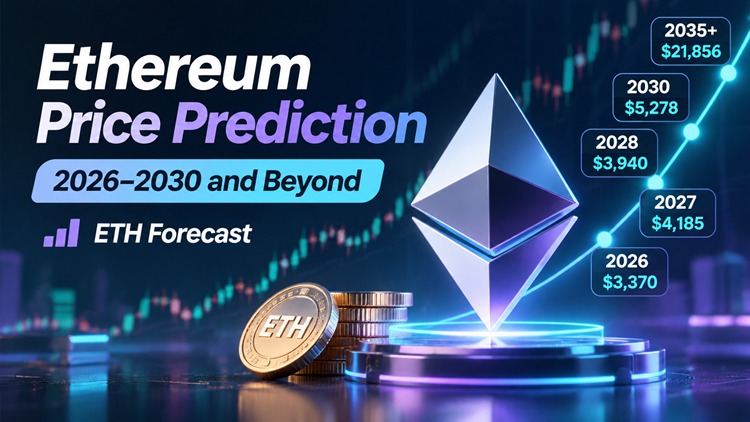
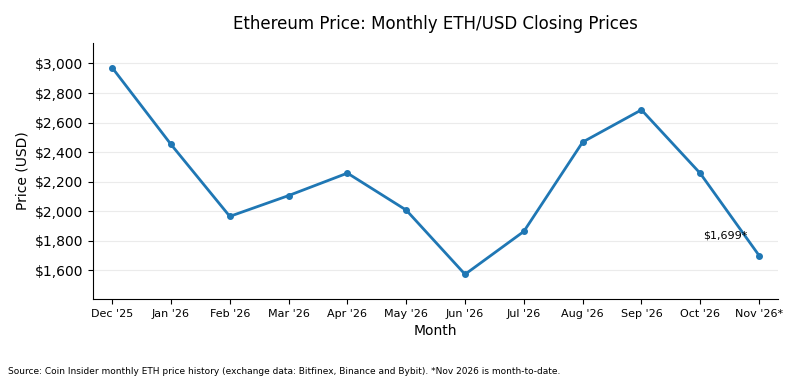
As of November 27, 2026, Ethereum (ETH) is trading at approximately $1,721.40, with a market capitalization of around $209.61 billion. ETH has gained about 0.9% over the past 24 hours and 6.3% over the past seven days. However, it remains approximately 65.3% below its all-time high of $4,953.70, recorded on August 24, 2025.
The broader price trend remains under pressure despite the recent short-term recovery. Institutional demand has also weakened. U.S. spot Ethereum ETFs recorded $68.5 million in net outflows on November 25, extending their outflow streak to eight consecutive trading sessions.
The following chart shows Ethereum's monthly price performance from December 2025 through November 2026. The November figure represents month-to-date data rather than a completed monthly close.
Ethereum's technical indicators currently present a mixed picture. Based on the November 26 daily trading session, the Relative Strength Index (RSI) was around 29.2, indicating oversold conditions. Meanwhile, ETH remained below its 50-day moving average near $2,170 and its 200-day moving average near $2,111.
Several price levels are worth watching:
Although oversold conditions may support a short-term rebound, they do not automatically signal a trend reversal. A stronger recovery would require improving buying volume, sustained ETF inflows, and a move back above key moving averages.
Ethereum's price forecasts vary significantly depending on the assumptions and models used. Algorithmic platforms generally rely on historical prices and technical indicators, while institutional forecasts may incorporate adoption, capital flows, and long-term blockchain growth.
The following table compares published ETH forecasts available in November 2026.
| Year | CoinCodex | CoinLore | Standard Chartered |
|---|---|---|---|
| 2026 | $1,661 | $3,370 | $4,000 |
| 2027 | $2,268 | $4,185 | $10,000 |
| 2028 | $3,415 | $3,940 | $18,000 |
| 2029 | $2,855 | $4,827 | $28,000 |
| 2030 | $2,331 | $5,278 | $40,000 |
Note: All figures are in USD. CoinCodex's 2026 and 2030 figures are year-end estimates, while its 2027–2029 figures are December forecast averages. CoinLore figures reflect its published annual forecasts. Standard Chartered's targets are dated institutional scenarios reported in January 2026, not updated November forecasts.
Ethereum's outlook for the remainder of 2026 is relatively challenging. With ETH trading near $1,721 in late November, the market has limited time to recover before the year ends.
CoinCodex's year-end estimate of approximately $1,661 suggests limited upside from current levels, while CoinLore's $3,370 forecast is considerably more optimistic. Standard Chartered's earlier $4,000 target represents a more bullish scenario.
For ETH to approach the higher forecasts, cryptocurrency market sentiment, institutional investment demand, and expectations for future network upgrades would likely need to improve. Continued ETF outflows or tighter financial conditions could instead keep prices under pressure.
Ethereum's 2027 outlook depends on whether its current market weakness gives way to a broader recovery. CoinCodex forecasts approximately $2,268, compared with CoinLore's $4,185. Standard Chartered's $10,000 target reflects a much more optimistic long-term adoption scenario.
Network improvements could play an important role. Ethereum upgrades are intended to improve transaction capacity, usability, and efficiency. If these developments attract more applications and institutional activity, demand for ETH could strengthen.
However, higher network usage does not automatically translate into higher ETH prices. The extent to which activity generates demand for ETH and contributes to the token's economic value will also matter.
By 2028, Ethereum's price may increasingly reflect its position in the broader digital financial ecosystem. Its role in decentralized finance, stablecoin transactions, and tokenized real-world assets could support long-term demand if adoption continues to expand.
CoinCodex estimates approximately $3,415, while CoinLore projects around $3,940. Standard Chartered's $18,000 target represents a much stronger growth scenario, requiring substantial expansion in institutional participation and Ethereum-based financial applications.
The main uncertainty is whether Ethereum can convert ecosystem growth into sustainable value for ETH holders. Competition from other blockchain networks and the expansion of Layer 2 solutions could influence how much economic activity ultimately benefits the Ethereum mainnet.
Longer-term forecasts become increasingly uncertain, and the differences between algorithmic models and institutional estimates become particularly clear by 2030.
For 2029, CoinCodex estimates approximately $2,855, while CoinLore projects $4,827. By 2030, their estimates are approximately $2,331 and $5,278, respectively. Standard Chartered's earlier $40,000 target is considerably more bullish.
These differences highlight how strongly long-term ETH valuations depend on assumptions about adoption, institutional capital, network economics, and the overall cryptocurrency market. Rather than treating any single figure as a reliable outcome, investors should compare the underlying assumptions and consider multiple scenarios.
By 2035, Ethereum's valuation will depend less on short-term market cycles and more on whether it can maintain its position as a major settlement layer for digital finance.
CoinCodex has estimated ETH at approximately $5,607 for 2035, while CoinLore has projected around $7,580. Finder's panel of cryptocurrency specialists published a considerably higher average estimate of $21,856 in its early 2026 survey. These forecasts use different methodologies and were produced at different times, so they should not be treated as directly comparable targets.
Ethereum could benefit from wider use of tokenized assets, stablecoins, and decentralized financial services. However, long-term adoption is not guaranteed, and competing networks could capture part of this growth.
Predicting Ethereum's price in 2040 is particularly difficult because technological developments, regulation, and competition could substantially change the cryptocurrency market over such a long period.
CoinCodex has published an estimate of approximately $4,548 for 2040. This is an algorithmic projection rather than a long-term institutional valuation. Its lower estimate compared with its 2035 forecast also illustrates why model-generated predictions should not be interpreted as a guaranteed upward path.
Ultimately, Ethereum's value in 2040 will depend on whether it remains relevant, secure, competitive, and economically useful. Long-term adoption may create significant opportunities, but technological disruption and changing market conditions could also limit its growth.
Ethereum's potential to reach higher price levels depends on more than market sentiment. Its circulating supply, total market capitalization, institutional demand, and real-world adoption all play important roles.
Based on a circulating supply of approximately 122.26 million ETH in November 2026, the implied market capitalizations would be:
| ETH Price Target | Implied Market Cap | Growth from $1,721 |
|---|---|---|
| $10,000 | $1.22 trillion | Approximately 5.8x |
| $20,000 | $2.45 trillion | Approximately 11.6x |
| $100,000 | $12.23 trillion | Approximately 58.1x |
These are illustrative calculations using today's approximate circulating supply. Ethereum's supply can change over time, so the actual market capitalization required could be different. Market capitalization also does not mean that an equivalent amount of new money must enter the market.
A $10,000 ETH price would imply a market capitalization of approximately $1.22 trillion at the current supply level. Although this would represent substantial growth from current prices, it is a more conceivable long-term scenario than the higher targets.
Stronger institutional participation, wider use of Ethereum-based financial applications, and sustained demand for ETH could support this valuation. However, reaching $10,000 would likely require a favorable cryptocurrency market cycle and continued growth in Ethereum's economic activity.
At $20,000, Ethereum's market capitalization would approach $2.45 trillion. Reaching this level would require much stronger adoption and capital demand than the $10,000 scenario.
Ethereum would need to maintain its position as a leading blockchain infrastructure network while benefiting from institutional investment, stablecoin growth, and tokenized real-world assets. Competition and the ability to capture value from its expanding Layer 2 ecosystem would also influence whether this target is achievable.
A $100,000 ETH price would imply a market capitalization of more than $12 trillion at today's circulating supply. This is an extremely ambitious scenario and would require a fundamental transformation in the scale of the digital asset market.
For this target to become plausible, Ethereum would likely need to become a major global settlement infrastructure, attract substantial institutional and financial activity, and maintain strong long-term demand for ETH.
While such a price cannot be ruled out mathematically, it should be treated as a highly speculative possibility rather than a realistic base-case forecast for investors.
Ethereum's long-term value depends on several interconnected factors. Some can increase demand for ETH, while others may limit its growth or create downward price pressure.
Institutional investment can influence Ethereum's market liquidity and price discovery. Spot ETH ETFs provide traditional investors with a regulated way to gain exposure without directly managing cryptocurrency wallets.
Consistent ETF inflows, corporate holdings, and institutional participation could strengthen demand. However, sustained outflows may have the opposite effect, particularly during periods of weak market sentiment.
Ethereum supports a large ecosystem of decentralized finance applications, stablecoins, and tokenized assets. Growth in these sectors can increase network activity and strengthen Ethereum's role in digital financial infrastructure.
However, greater transaction activity does not always translate directly into higher ETH prices. The economic value captured by the network and the demand for ETH itself remain important considerations.
Network upgrades aim to improve Ethereum's scalability, security, and efficiency. Layer 2 networks can make transactions faster and cheaper while expanding the ecosystem's capacity.
ETH's supply dynamics also matter. New issuance rewards validators, while Ethereum's fee-burning mechanism removes a portion of transaction fees from circulation. The balance between issuance and burning influences whether ETH supply expands or contracts over time.
Ethereum remains sensitive to broader financial conditions. Lower interest rates and stronger risk appetite may encourage investment in digital assets, while tighter monetary policy and weaker liquidity can pressure cryptocurrency prices.
Regulatory developments also influence institutional participation and market confidence. Meanwhile, competition from other blockchain networks could challenge Ethereum's market position. Its ability to maintain developer activity, security, and real-world adoption will be important for long-term growth.
Daily ETH price predictions are possible using technical indicators, trading volume, and market sentiment, but they are inherently uncertain. Short-term volatility, unexpected news, and changes in liquidity can quickly invalidate a forecast.
Long-term predictions are generally less reliable than short-term estimates because they depend on assumptions about adoption, regulation, technology, and market cycles. Investors should compare multiple scenarios rather than rely on a single price target.
A price target is a specific valuation estimate set by an analyst or institution, often based on a particular timeframe and set of assumptions. A price prediction is a broader estimate of where ETH may trade, which can come from technical models, historical data, or fundamental analysis. Neither guarantees future performance.
Ethereum has significant long-term opportunities, but its future price will depend on adoption, institutional demand, network economics, and broader market conditions. Rather than relying on a single ETH price target, investors should consider multiple scenarios and the risks behind each forecast.

Quick Access to 7x24
Quick Access to More Editor-selected Real-time News

Exclusive video for free
FastBull project team is dedicated to create exclusive videos

Real-time Quotes
View more faster market quotes

More comprehensive macro data and economic indicators
Members have access to entire historical data, guests can only view the last 4 years

Member-only Database
Comprehensive forex, commodity, and equity market data


