News
7x24
Quotes
Economic Calendar
Video
Data
- Names
- Latest
- Prev.

Latest Update

Risk Warning on Trading HK Stocks
Despite Hong Kong's robust legal and regulatory framework, its stock market still faces unique risks and challenges, such as currency fluctuations due to the Hong Kong dollar's peg to the US dollar and the impact of mainland China's policy changes and economic conditions on Hong Kong stocks.

HK Stock Trading Fees and Taxation
Trading costs in the Hong Kong stock market include transaction fees, stamp duty, settlement charges, and currency conversion fees for foreign investors. Additionally, taxes may apply based on local regulations.

HK Non-Essential Consumer Goods Industry
The Hong Kong stock market encompasses non-essential consumption sectors like automotive, education, tourism, catering, and apparel. Of the 643 listed companies, 35% are mainland Chinese, making up 65% of the total market capitalization. Thus, it's heavily influenced by the Chinese economy.

HK Real Estate Industry
In recent years, the real estate and construction sector's share in the Hong Kong stock index has notably decreased. Nevertheless, as of 2022, it retains around 10% market share, covering real estate development, construction engineering, investment, and property management.
View All

No data


Turkey plans to focus on testing honey products for authenticity as fake versions become a growing issue in the country, the world's third-largest producer of honey, amid high inflation and a decline in beekeepers.
Turkey plans to focus on testing honey products for authenticity as fake versions become a growing issue in the country, the world's third-largest producer of honey, amid high inflation and a decline in beekeepers.
Turkey produced roughly 95,000 metric tons of natural honey in 2024, according to the Food and Agriculture Organization of the United Nations -- behind only mainland China and India.
"We're being forced into unreasonable price competition," said Ali Demir, who heads the more than 70,000-member Turkish Association of Beekeepers. Fake products include those augmented with adulterants, while some products are fully industrially produced, he said.
Turkey's four seasons and diversity of flower species make it ideal for honey production, with something in bloom for the majority of the year. Bees make honey using the flowers in bloom through the seasons, including orange and tangerine blossoms in the spring, sunflowers in the summer, and pine trees in the fall.
The issue of fake honey has become more pronounced in recent years. In September 2024, authorities confiscated 960 million lira ($22.2 million at current rates) of sugar, fructose syrup and another ingredient used to make fake or adulterated honey from a producer in the capital, Ankara, according to local media.
There is some debate as to how prevalent fake honey actually is. According to sampling data released in 2023 by the European Commission -- the European Union's executive arm -- 93% of honey imported from Turkey was suspected of being adulterated. That is the highest proportion for any country, surpassing China's 74%.
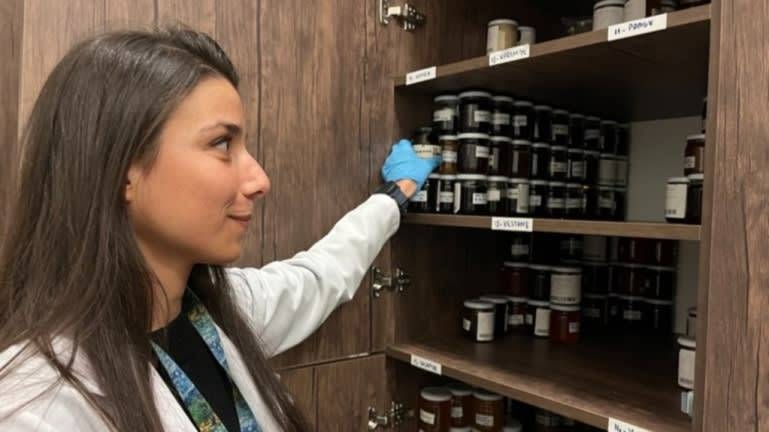 Turkey's Ministry of Agriculture and Forestry keeps samples from all over the country for testing and research. (Photo by Kana Watanabe)
Turkey's Ministry of Agriculture and Forestry, which has jurisdiction over counterfeit foods, has rejected the European Commission's claim outright.
The ministry's own testing in 2025 indicated that 0.02% of the honey available on the domestic market was fake. No counterfeits were found among products for export, it said. "They are disparaging Turkish honey to push down its price," a ministry spokesperson said, contesting the EU statistics.
But counterfeit products have undeniably grown more common in recent years. In 2019, testing of more than 2,000 samples revealed just nine cases of fake honey.
Stubborn inflation has come to affect honey, too. Turkey's consumer price index rose 30.9% on the year in December 2025. Beekeepers are also on the decline as many age out without passing on their knowledge to the next generation.
"There are also hotels, restaurants and other businesses that are seeking out cheaper products in hopes of saving on costs," Demir said.
Fake honey cannot be distinguished from the genuine article by taste, smell or appearance alone. Counterfeiting techniques are sophisticated and sometimes even involve feeding syrup to the bees. Honey can be verified as genuine only through analysis at a specialized laboratory.
The ministry is stepping up its testing with the aim of stamping out the fakes. "By having labs with access to the latest equipment, we can prevent counterfeits from ever getting to market," a spokesperson said.
Turkish honey has appeal abroad as well. A traditional Turkish breakfast dish, bal kaymak, in which rich clotted cream and honey are spread onto toast, has caught on as a sweet treat in South Korea. The trend has started to slowly gain traction in Japan as well.

Quick Access to 7x24
Quick Access to More Editor-selected Real-time News

Exclusive video for free
FastBull project team is dedicated to create exclusive videos

Real-time Quotes
View more faster market quotes

More comprehensive macro data and economic indicators
Members have access to entire historical data, guests can only view the last 4 years

Member-only Database
Comprehensive forex, commodity, and equity market data


