The domestic Canadian swaps curve continues to display a heavily hawkish configuration, discounting more than 50 basis points of additional monetary tightening from the Bank of Canada (BoC) over the coming twelve months—a trajectory that would propel the terminal policy rate toward the 2.75% handle. However, this aggressive market valuation appears increasingly detached from underlying macroeconomic realities, given that both core inflation metrics and long-term inflationary expectations within Canada remain comfortably anchored within moderate thresholds.
Compounding this disconnect, the BoC's own internal projections estimate a persistent output gap for the first quarter of 2026, tracking between -1.5% and -0.5%, while a battery of high-frequency leading indicators continues to expose underlying frailties within the domestic labor landscape. Against this backdrop, consensus market forecasts had anticipated that Canadian employment would expand by a modest 15,000 positions in April, following the 14,100 job additions logged in March, while the unemployment rate was projected to hold steady at 6.7%.
The actual data stream, however, delivered a significant downside surprise, revealing a much deeper deterioration in labor market health than market participants had discounted. The Canadian economy unexpectedly shed 18,000 net jobs in April, extending a sequence of monthly contractions observed since the turn of the year and bringing the aggregate tally of destroyed positions to a staggering 112,000 over the course of 2026. Concurrently, the national unemployment rate ticked up to print at 6.9%, successfully matching the cycle highs recorded in April of the previous year.
In contrast, Eurozone inflation accelerated in line with market expectations to print at 3.2% year-over-year in May, up from the 3.0% threshold registered in April, while the core inflationary metric delivered an upside surprise by ascending to 2.5% against the expected consensus baseline of 2.4%, rising from its prior 2.2% clip. This pricing pressure unfolds alongside a moderate optimization of European economic fundamentals; consumer confidence advanced by 1.6 points in May to print at -19, improving from the -20.6 reading logged in April and matching market forecasts.
Concurrently, the Economic Sentiment Indicator (ESI) ticked up to 93.5 points from its previous revised print of 93.2, comfortably beating the median consensus of analysts who had anticipated a cooling to 92.8. Corporate indicators also reflected structural stabilization; the business climate metric edged minorly higher to -0.26 from -0.27, securing its strongest operational performance since July 2023. This marginal improvement provides a compelling backdrop for cross-currency pairs, as traders continue to weigh improving regional growth profiles against aggressive monetary expectations. Framing this policy debate, European Central Bank (ECB) Chief Economist Philip Lane pointed out that the second-round inflationary effects triggered by the global energy shock could persist well beyond the immediate duration of the conflict in Iran.
Within this framework, Lane warned that the central bank must act decisively to prevent consumers and corporate price-setters from embedding the assumption that inflation will remain structurally elevated over an extended period. His cautionary remarks align seamlessly with those of ECB Executive Board member Isabel Schnabel, who re-asserted on Tuesday that the institution is fundamentally required to deliver another interest rate hike during the upcoming June session. Reflecting this hawkish rhetoric, broader money market expectations remain firmly aligned with a more restrictive policy trajectory for the central bank as consumer price indices heat up.
Technical Analysis
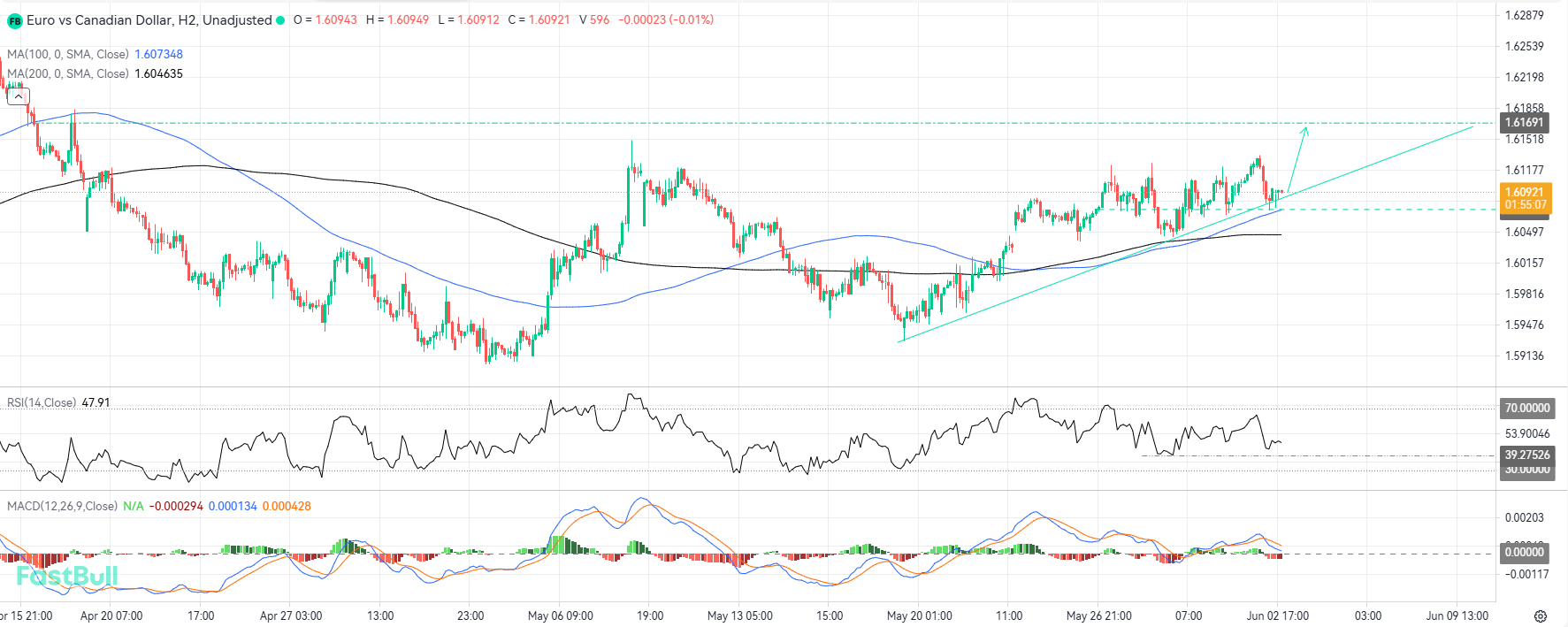
From a technical perspective, EUR/CAD has maintained a well-defined bullish structure stretching from May 19 to the present date, recently tracking its 100 and 200-period Moving Averages as reliable dynamic support floors that reinforce the broader uptrend. These moving averages are currently situated at 1.6033 and 1.6003, respectively, mapping out a trajectory that mirrors a primary ascending trendline. Price action has recently executed a direct test of this ascending trendline within a high-confluence demand zone. This area is heavily fortified by a local horizontal support floor at the 1.6075 handle, which converges seamlessly with the 100-period moving average. Given that the asset has already printed an immediate upside rejection from this structural intersection, the technical setup favors for a resumption of the bullish impulse, with buyers initially targeting an expansion toward the 1.6169 region—a vital structural swing high registered on April 17 that functions as the next major resistance ceiling.
Our analysis of momentum oscillators provides further cross-verification for this emerging upside continuation. The Relative Strength Index (RSI) has successfully rebounded from a local bottom at the 39 level reached on May 28, a corrective low that occurred precisely as price action mitigated the moving average cluster. The index is currently tracking at the 48 level, establishing a healthy platform that retains ample structural runway to facilitate a deep upward march before approaching overbought extremes.
Simultaneously, the MACD reinforces this positive transition in market physics, as its bearish histogram has systematically begun to lose depth and contract in negative territory. Because the MACD signal lines remain firmly entrenched above the neutral zero threshold, the broader bullish baseline continues to dictate the tape. A confirmed positive histogram crossover would deliver the final, high-conviction confirmation required to accelerate this upward leg, making long positions on technical retests of this trendline confluence the path of least resistance.
Trading Recommendations
Trading direction: Buy
Entry price: 1.6090
Target price: 1.6165
Stop loss: 1.6020
Validity: Jun 12, 2026 15:00:00


