Eurozone inflation accelerated in line with market expectations to print at 3.2% year-over-year in May, up from the 3.0% threshold registered in April, while the core inflationary metric delivered an upside surprise by ascending to 2.5% against the expected consensus baseline of 2.4%, rising from its prior 2.2% clip.
This pricing pressure unfolds alongside a moderate optimization of European economic fundamentals; consumer confidence advanced by 1.6 points in May to print at -19, improving from the -20.6 reading logged in April and matching market forecasts. Concurrently, the Economic Sentiment Indicator (ESI) ticked up to 93.5 points from its previous revised print of 93.2, comfortably beating the median consensus of analysts who had anticipated a cooling to 92.8. Corporate indicators also reflected structural stabilization; the business climate metric edged minorly higher to -0.26 from -0.27, securing its strongest operational performance since July 2023. This marginal improvement provides a compelling backdrop for cross-currency pairs, as traders continue to weigh improving regional growth profiles against aggressive monetary expectations.
Framing this policy debate, European Central Bank (ECB) Chief Economist Philip Lane pointed out that the second-round inflationary effects triggered by the global energy shock could persist well beyond the immediate duration of the conflict in Iran. Within this framework, Lane warned that the central bank must act decisively to prevent consumers and corporate price-setters from embedding the assumption that inflation will remain structurally elevated over an extended period. His cautionary remarks align seamlessly with those of ECB Executive Board member Isabel Schnabel, who re-asserted on Tuesday that the institution is fundamentally required to deliver another interest rate hike during the upcoming June session. Reflecting this hawkish rhetoric, broader money market expectations remain firmly aligned with a more restrictive policy trajectory for the central bank as consumer price indices heat up.
Across the English Channel, Bank of England (BoE) Governor Andrew Bailey is scheduled to deliver a public address at the upcoming Reykjavik Economic Conference. However, institutional analysts suggest it is highly improbable that Bailey will introduce any novel forward guidance regarding the United Kingdom's immediate monetary policy trajectory. Instead, prevailing market expectations indicate that the BoE is poised to maintain its current restrictive interest rate corridor unchanged for a prolonged duration. This policy inertia is further amplified by a notable contraction in 10-year UK Gilt yields, which fell approximately 1% to trade near the 4.81% threshold—marking their lowest operational level in nearly six weeks. This softening of the sovereign yield curve is actively being driven by a broad-based unwinding of near-term hawkish rate hike bets among market participants, a dynamic that continues to exert substantial downward pressure on the British Pound (GBP). This sudden dovish recalibration follows a sequence of softer-than-expected inflation and employment data points out of the United Kingdom, which has compelled market participants to drastically scale back expectations for further aggressive interest rate hikes from the Bank of England (BoE). This sudden shift materializes after a period where short-term interest rate markets had fully discounted two to three additional upward adjustments before the close of the calendar year.
Technical Analysis
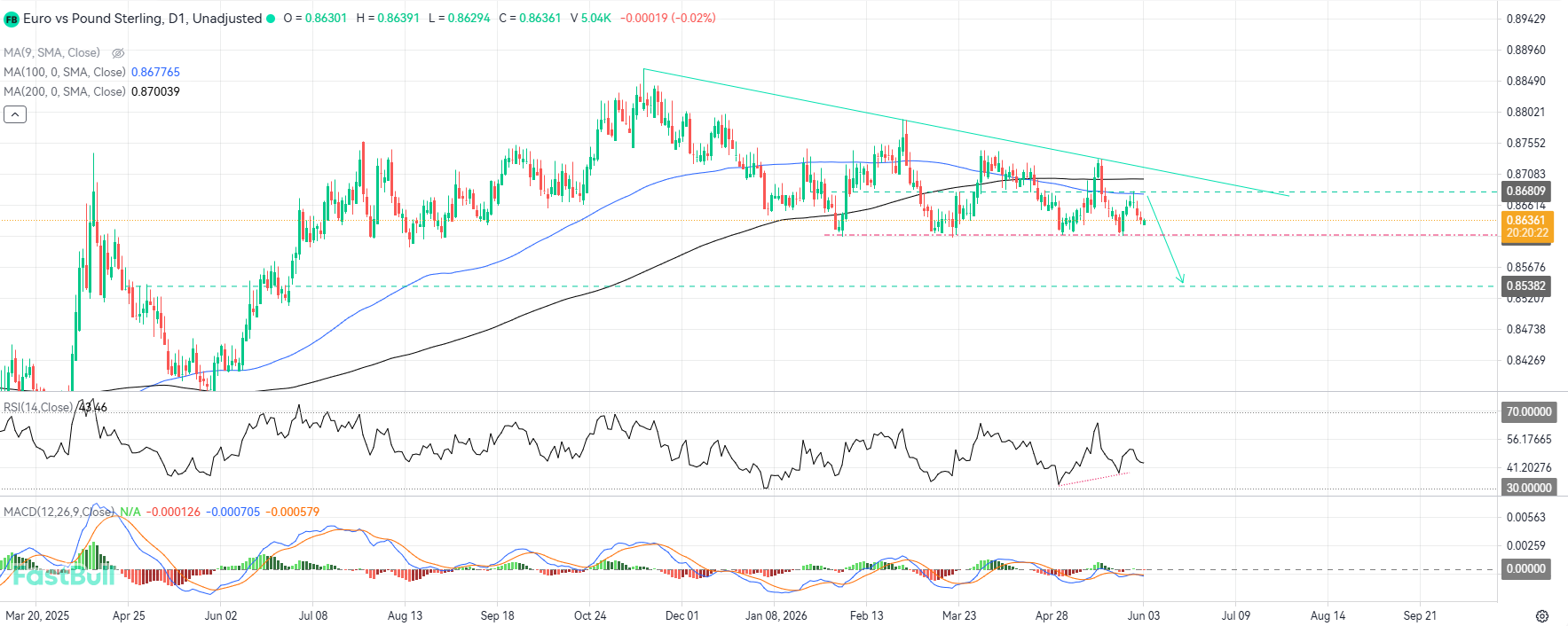
From a technical perspective, EUR/GBP has encountered significant sell-side liquidity upon testing the horizontal resistance barrier anchored at the 0.8680 handle. This supply wall carries immense technical weight, as it aligns perfectly with the 100-period Moving Average on the daily chart, which is currently tracking at 0.8677, while the institutional 200-period Moving Average looms just above as an additional protective ceiling at 0.8700. The sharp bearish rejection engineered at this dual-indicator confluence effectively sets the stage for a potential downside breakout of the major local support floor situated at 0.8614. Should the bears successfully materialize this breakdown on a daily closing basis, it would open the floodgates for an extended downward expansion toward the next structural target at 0.8538, an area that represents a key historical support zone and would effectively fill a prominent market gap left open in that region.
Our analysis of momentum oscillators provides further cross-verification for this developing bearish trajectory. The Relative Strength Index (RSI) is currently tracking at the 43 level, establishing a clear foothold beneath technical neutrality but retaining substantial structural runway to facilitate a deep downward attack before hitting oversold extremes. Crucially, a comparative look at the oscillator reveals that during the pair's most recent retest of the lower range, the RSI printed higher relative troughs than the previous attempt, indicating that macro sellers are systematically compressing the market and accumulating the necessary volume to force a structural breakdown.
Simultaneously, the MACD reinforces this negative shift in market physics, as its histogram remains locked in negative territory with an inherent downward slope, even as the bars temporarily compress in depth. Because the MACD signal lines have already completed a clean crossover beneath the neutral zero line, the underlying technical indicators collectively confirm that the path of least resistance remains skewed to the downside, transforming dynamic rallies into strategic selling opportunities.
Trading Recommendations
Trading direction: Sell
Entry price: 0.8636
Target price: 0.8538
Stop loss: 0.8710
Validity: Jun 12, 2026 15:00:00


