Overview
During early Asian trading on 3 December 2025, AUD/USD is hovering in the 0.6550–0.6560 region, near the top of today’s intraday range, after having traded roughly between 0.6538 and 0.6571 so far. The immediate catalyst for the latest push higher has been Australia’s Q3 2025 GDP, which printed at 0.7% q/q versus a 0.6% forecast, the strongest quarterly pace since late 2022 and lifting annual growth to about 2.2%.
This data reinforces the narrative that the Australian economy is still expanding at or slightly above the Reserve Bank of Australia’s trend estimate, with government spending and business investment doing most of the heavy lifting.
Paradoxically, that strength reduces the odds of near-term RBA easing. Recent commentary suggests markets now expect the RBA to keep the cash rate on hold well into 2026, as policymakers remain uneasy about sticky inflation and surging housing wealth.
A “higher-for-longer” stance from the RBA is structurally AUD-supportive, but it also raises concerns that restrictive policy will eventually bite into household demand, especially given elevated debt levels and high mortgage sensitivity in Australia.
On the US side, the macro backdrop is different. The ISM Manufacturing PMI has slipped to 48.2 in November, marking the softest reading in four months and pointing to renewed contraction in the industrial sector. Fed funds futures now price more than an 80% probability of a rate cut at the 9–10 December FOMC meeting, effectively confirming that the Fed is moving deeper into an easing cycle.
However, the external environment is not purely AUD-bullish. China’s private-sector manufacturing PMIs have dipped back below 50, with the Caixin manufacturing index printing 49.9 in November versus 50.5 expected and 50.6 prior, signalling borderline contraction and soft external demand.
For an export-sensitive, China-linked currency like the AUD, this acts as a medium-term drag, especially if the market starts to question how long Australia can outgrow a slowing regional backdrop.
Market sentiment
Risk sentiment going into today’s session is cautiously constructive but no longer euphoric. The VIX, Wall Street’s “fear gauge”, has retreated to the mid-teens after spiking above 20 during recent tariff headlines, with the latest close around 16.7–17.0, signalling moderate rather than extreme risk aversion. Global equities have stabilised and, in some markets, are pushing back toward recent highs, supported by expectations of further monetary easing across the major economies and by the OECD’s projection of global GDP growth around 3.2% for 2025.
For AUD specifically, the sentiment picture is nuanced. On one hand, the stronger-than-expected GDP print has attracted fresh buying interest from macro and systematic funds that allocate toward economies with relative growth and yield advantages. The Australian housing market’s renewed strength and the record A$12 trillion value of housing stock also bolster perceptions of wealth and balance sheet resilience, which can support consumption in the near term.
On the other hand, that same strength is problematic for the RBA’s inflation fight, undermining the case for rate cuts and raising the risk of a policy stance that remains restrictive for longer than markets or households can comfortably digest.
In the very short term, intraday positioning suggests that the knee-jerk AUD buying after the GDP surprise may be getting stretched. The pair has already repriced a more hawkish RBA path against a more dovish Fed, while at the same time China’s sub-50 PMI and mixed Asian factory data highlight that the external demand story is far from robust.
This “good domestic news versus weak external backdrop” mix often produces asymmetric risk on short intraday timeframes: traders happily chase the first spike higher, but once the obvious data surprise is priced in, they become more willing to fade extended moves, especially ahead of risk events such as the US ISM Services PMI later in the day.
Technical analysis
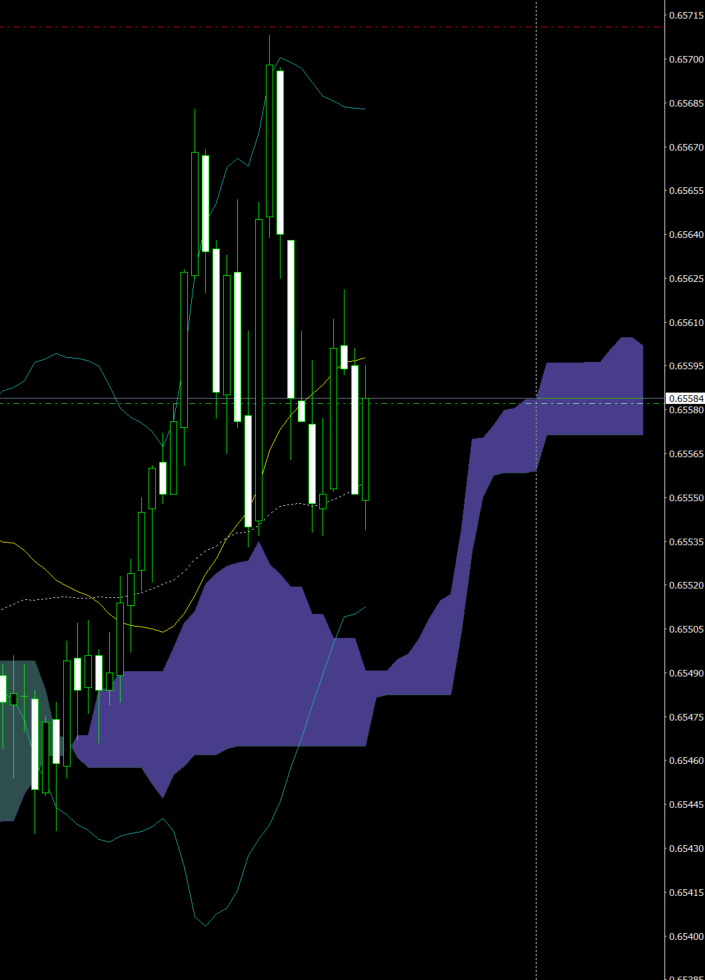
On the M15 chart, AUD/USD’s intraday structure since the GDP release is that of a sharp impulsive move higher from the lower 0.65s into the mid-0.65s, followed by increasingly hesitant candles as price tests resistance near 0.6565–0.6570, close to the top of today’s range. Given the reported high around 0.6571 and low near 0.6538, the 20-period Bollinger Bands (20,0,2) on M15 are likely anchored around a mid-band roughly at 0.6550, with the upper band extending toward 0.6570–0.6580 and the lower band near 0.6535–0.6540.
Price currently trades near or slightly above the upper band, which statistically corresponds to an overextended move relative to the last 20 M15 candles. When price repeatedly “rides” the upper band and then begins to print smaller real bodies or wicks on the topside, it often signals that buying momentum is losing steam and that a mean-reversion move back toward the middle band is becoming more likely.
Under the Ichimoku Kinko Hyo settings of 9,26,52 on the same M15 chart, the short-term bullish impulse is visible in the way price has broken above the Kumo cloud after the data release, with the Tenkan-sen (conversion line) initially pointing steeply upward. However, as AUD/USD consolidates around 0.6565, the Tenkan-sen begins to flatten and the gap between Tenkan-sen and Kijun-sen widens. That distance between price and the Kijun-sen is a classic sign of overextension; short-term price momentum has outrun its “fair value” equilibrium zone, increasing the probability that price will either move sideways until the Kijun catches up, or pull back toward the Kijun itself, which on M15 is likely clustering around 0.6550. The Kumo ahead is relatively thin, suggesting that if price does rotate lower and re-enters the cloud, support may not be particularly strong, opening the door for a deeper dip toward the lower 0.65s.
The Stochastic Oscillator (5,3,3) on M15 reinforces this mean-reversion narrative. After the GDP-driven spike, Stoch has pushed decisively into the overbought zone above 80, indicating that recent gains have been fast and concentrated. Now, as price stalls near resistance, the %K line is likely beginning to curl lower and approach a bearish crossover with %D, a pattern that often precedes short-term pullbacks when it happens at or near a key resistance zone.
Trade Recommendations
Entry: 0.65565
Take Profit: 0.6520