USDX
99.480

0.35%

XAUUSD
4438.68

1.12%

WTI
93.988

2.55%

EURUSD
1.15966

0.29%

GBPUSD
1.34145

0.36%

USDJPY
160.029

0.06%

USNDAQ100
30650.55

0.26%

Global Markets

Economic Calendar
7x24
Quotes

Video

Latest Update

Risk Warning on Trading HK Stocks

Despite Hong Kong's robust legal and regulatory framework, its stock market still faces unique risks and challenges, such as currency fluctuations due to the Hong Kong dollar's peg to the US dollar and the impact of mainland China's policy changes and economic conditions on Hong Kong stocks.

HK Stock Trading Fees and Taxation

Trading costs in the Hong Kong stock market include transaction fees, stamp duty, settlement charges, and currency conversion fees for foreign investors. Additionally, taxes may apply based on local regulations.

HK Non-Essential Consumer Goods Industry

The Hong Kong stock market encompasses non-essential consumption sectors like automotive, education, tourism, catering, and apparel. Of the 643 listed companies, 35% are mainland Chinese, making up 65% of the total market capitalization. Thus, it's heavily influenced by the Chinese economy.

HK Real Estate Industry

In recent years, the real estate and construction sector's share in the Hong Kong stock index has notably decreased. Nevertheless, as of 2022, it retains around 10% market share, covering real estate development, construction engineering, investment, and property management.

Analysis
Data

Data Warehouse Market Trend Institutional Data Policy Rates Macro

Market Trend

Speculative Sentiment Orders and Positions Correlation

Popular Indicators

Pro
AI Signal

Trading Signals

AI Signal

News
Recent Searches
    Trending Searches
      News
      7x24
      Quotes
      Economic Calendar
      Video
      Data
      • Names
      • Latest
      • Prev.

      View All

      No data

      Sign in

      Sign up

      --

      • My Favorites
      • My Subscription
      • Profile
      • Orders
      • Account Settings
      • Sign out
      Reminder Settings
      • Economic Calendar
      • Quotes/Market Quotes

      Reminders Temporarily Unavailable

      FastBull Membership Privileges
      Quick Access to 7x24
      Quick Access to More Editor-selected Real-time News
      Real-time Quotes
      View more faster market quotes
      Upgrade to {0} Pro
      I have read and agreed to the
      Pro Policy
      Feedback
      0 /250
      0/4
      Contact Information
      Submit

      AUD/USD Under Pressure as Soft GDP Data Dampens Rate Hike Expectations

      Traders' Opinions
      Summary:

      AUD/USD drops to 0.7150 as Australia's Q1 GDP misses badly at 0.3%, unemployment hits a four-and-a-half-year high, and inflation softens enough to seriously question the RBA's June rate hike case.

      Sell AUDUSD
      EXP
      PENDING

      0.71700

      ENTRY

      0.71100

      TGT

      0.72100

      SL

      0.71305 -0.00484 -0.67%

      --

      Point

      PENDING

      0.71100

      TGT

      CLOSING

      0.71700

      ENTRY

      0.72100

      SL
      The Australian Dollar is absorbing punishment from every direction on Wednesday and the session is only half done. AUD/USD has dropped to 0.7150 as a badly missed GDP print, a sharply escalating Middle East conflict, and a Federal Reserve moving toward a rate hike have aligned against the currency simultaneously.
      Australia's first quarter GDP grew just 0.3%, against 0.8% the prior quarter. That is not a mild softening. It is a halving of growth momentum in three months, arriving alongside softening inflation in April and unemployment at its highest in four and a half years. The RBA's June rate hike case has not been killed by this data but it has been seriously wounded. Markets that were already pricing the hike with declining conviction are now reassessing whether the RBA can justify tightening into an economy that is visibly losing steam.
      The Middle East has meanwhile taken a genuinely alarming turn. US CENTCOM confirmed self-defense strikes on Iran's Qeshm Island. Tehran responded by launching missiles and drones at US military facilities in Kuwait and Bahrain. Most were intercepted, but the fact that Iran is now firing across multiple Gulf nations simultaneously represents the most significant regional escalation of the conflict to date. Israeli-Hezbollah fighting has intensified in parallel. The broader conflict is widening, the peace talks appear stalled, and the safe-haven Dollar is absorbing every headline with predictable appreciation.
      On the Fed side, Cleveland Fed President Hammack said on Tuesday that the central bank remains firmly committed to 2% inflation and may need to act soon. The CME FedWatch Tool now puts the probability of a December rate hike above 50%, a meaningful shift from just weeks ago. A Fed moving toward hiking while the RBA questions whether it can hike at all is exactly the kind of divergence that grinds a currency pair lower week after week.
      The ADP report and ISM Services PMI later today will be read as NFP previews. Friday's payrolls remain the week's defining event. Strong data firms the Fed hike case further and keeps AUD/USD under pressure. The 0.7100 level is the next reference below current price and a daily close below it opens the door to 0.7000.
      Selling AUD/USD rallies is the trade the fundamentals support most clearly right now.

      Technical AnalysisAUD/USD Under Pressure as Soft GDP Data Dampens Rate Hike Expectations_1

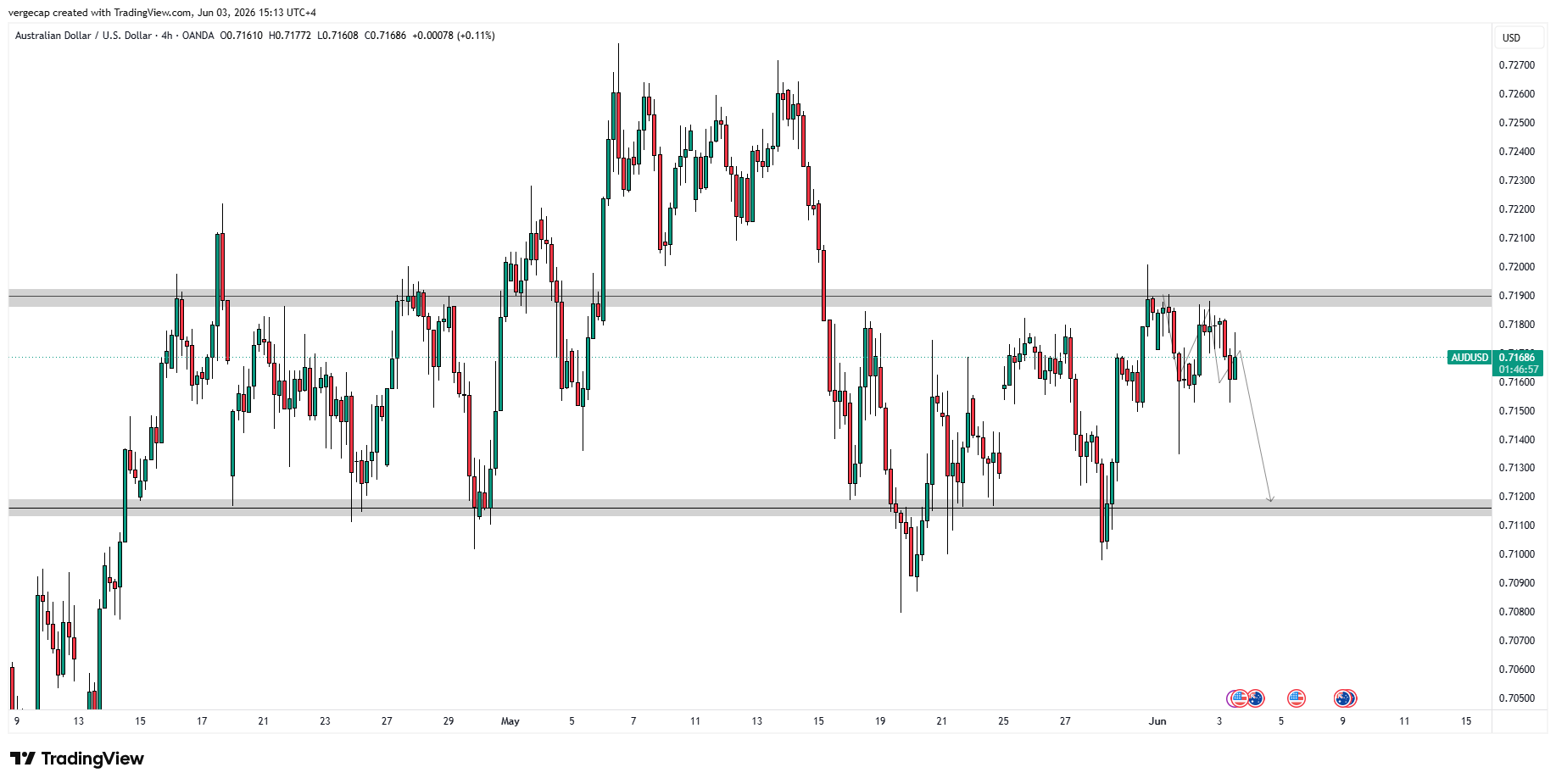
      AUD/USD has spent the better part of seven weeks trapped inside one of the most clearly defined horizontal ranges visible on any major pair's 4-hour chart, and the price action developing right now at 0.71686 suggests that range is approaching a resolution that deserves serious attention from traders on both sides of the position.
      The range boundaries are clean and well-validated. The 0.7190 to 0.7200 zone has acted as a ceiling on no fewer than four separate occasions since mid-April, each time producing a meaningful rejection that sent price back toward the lower boundary. The 0.7110 to 0.7130 band has functioned as the corresponding floor, catching the May 14 to 15 spike lows and the late May selloff with equal precision. Between those two levels, the pair has oscillated with a regularity that reflects genuine two-sided uncertainty rather than any clear directional conviction from either buyers or sellers.
      What has changed in the most recent sessions is the character of the price action near the upper boundary. The early June recovery from the 0.7110 lows was sharp and impulsive, covering approximately 90 pips in just a few sessions and carrying characteristics of genuine demand absorption rather than a short-covering bounce. Price pushed into the 0.7190 to 0.7200 resistance zone, stalled, and is now pulling back toward the midpoint of the range near 0.7170. That pullback is being watched carefully because the structure of lower highs forming just below the upper boundary over the past two sessions is the kind of pattern that precedes range breakdowns rather than breakouts.
      The projected path on the chart is the most instructive element of the current setup and it is not painting a bullish picture. The arrow points directly toward the 0.7110 to 0.7130 lower support band as the next destination, and the measured move from the failed upper boundary test is entirely consistent with that target. If price breaks below 0.7110 on a sustained 4-hour closing basis, the range that has defined AUD/USD since mid-April will have been broken to the downside and the next significant support does not emerge until the 0.7050 to 0.7060 area, with the 0.7000 psychological level as the broader medium-term target below that.
      The 0.7190 to 0.7200 resistance zone is the level that invalidates the bearish thesis. A sustained break and close above 0.7200 would represent a genuine range breakout to the upside and would shift focus toward the May highs near 0.7270 to 0.7280 as the next bullish objective. That scenario requires a fundamental catalyst of sufficient magnitude to overcome the structural headwinds currently pressing on the Aussie, including a weak GDP print, rising unemployment, and fading RBA rate hike expectations.
      Until 0.7200 is convincingly cleared, the range's upper boundary is where selling pressure resides and the lower boundary is where the real test awaits.
      TRADE RECOMMENDATION
      SELL AUD/USD
      ENTRY PRICE: 0.7170
      STOP LOSS: 0.7210
      TAKE PROFIT: 0.7110
      Risk Warnings and Investment Disclaimers
      You understand and acknowledge that there is a high degree of risk involved in trading with strategies. Following any strategies or investment methodologies is the potential for loss. The content on the site is being provided by our contributors and analysts for information purposes only. You alone are solely responsible for determining whether any trading assets, or securities, or strategy, or any other product is suitable for you based on your investment objectives and financial situation.

      Quick Access to 7x24

      Quick Access to More Editor-selected Real-time News

      Exclusive video for free

      FastBull project team is dedicated to create exclusive videos

      Real-time Quotes

      View more faster market quotes

      More comprehensive macro data and economic indicators

      Members have access to entire historical data, guests can only view the last 4 years

      Member-only Database

      Comprehensive forex, commodity, and equity market data

      Warren Takunda

      Analysts

      Warren Takunda, a seasoned finance leader specializing in the Middle East, is a trusted senior analyst with a proven track record. As head of the finance team, he excels in financial planning, analysis, and reporting. Warren's expertise in financial modeling and investment analysis delivers valuable insights to clients.

      Rank

      2

      Articless

      2566

      Win Rate

      63.37%

      P/L Ratio

      0.74

      Focus on

      XAUUSD, EURUSD, GBPUSD

      Related Analysis

      USD/JPY Pulls Back from 160 as Japan Reignites Intervention Threats

      Trading

      USD/JPY Pulls Back from 160 as Japan Reignites Intervention Threats

      Trading

      AUD/USD Under Pressure as Soft GDP Data Dampens Rate Hike Expectations

      PENDING

      Gold Slides to Weekly Low as Rising Oil Prices Fuel Inflation Fears

      Trading

      Gold Slides to Weekly Low as Rising Oil Prices Fuel Inflation Fears

      Trading
      FastBull
      English
      English
      العربية
      繁體中文
      简体中文
      Bahasa Melayu
      Bahasa Indonesia
      ภาษาไทย
      Tiếng Việt
      Economic Calendar 7x24 Quotes Video Analysis Data Warehouse Pro AI Signal News