Japan's Prime Minister just sent the clearest warning to Yen bears she has issued since the conflict began, and for now the market is listening. USD/JPY has pulled back from 160.00 to session lows near 159.55 after Sanae Takaichi stated that Tokyo is ready to take appropriate steps on foreign exchange as needed at any time. Those are not generic comments. They are almost word for word the language used before April 30's alleged intervention that sent USD/JPY crashing 400 pips in minutes. Traders who were in the market that day remember it clearly and they are not waiting around to find out if Wednesday is a repeat.
The warning is coming from multiple sources simultaneously, which is what makes it feel more serious than the routine verbal caution Japan deploys whenever the Yen approaches uncomfortable territory. Finance Minister Katayama made her own matching pledge earlier in the session, responding appropriately at any time as necessary, and noted that BoJ Governor Ueda, who speaks later today, is likely to signal a positive stance toward a rate hike. When the Prime Minister and Finance Minister issue near-identical statements on the same morning with the pair sitting one figure away from the intervention trigger, the message is coordinated and deliberate.
Takaichi went further by specifically calling out speculative flows and pledging international cooperation including with the United States to prevent unwanted Yen weakness. Invoking US coordination raises the stakes considerably. Internationally endorsed intervention carries far more force than solo action, and that reference alone is enough to keep aggressive shorts cautious at current levels.
The honest assessment though is that verbal warnings do not change structural realities. The Yen is weak because Japan imports virtually all its crude oil and is absorbing the full cost of Middle East energy disruption. JGB yields remain dramatically lower than US Treasuries, making the carry trade against the Yen one of the most mechanically reliable positions in the market. And the BoJ's tightening pace, even if June delivers a hike, is nowhere near fast enough to close the yield gap with a Federal Reserve that is itself moving toward a rate increase.
April 30 proved this precisely. USD/JPY fell 400 pips on intervention day. It spent the entire following month retracing every single pip and returned to 160.00 anyway. Interventions in a fundamentally driven market are speed bumps. Painful ones if you are caught offside, but speed bumps nonetheless.
What changes the picture durably is either a Hormuz reopening that reduces Japan's energy import burden or a BoJ that hikes aggressively enough to actually narrow the yield differential. Neither is happening today. What is happening is a government repeating the warning it issued before the last intervention, at the same level, hoping institutional memory does the heavy lifting.
It is working on Wednesday. Whether it works through Thursday depends on what Ueda says and whether US PCE data gives the Dollar another reason to push through 160.00 regardless of Tokyo's preferences. Any dip toward 158.50 to 159.00 looks like an opportunity rather than a warning to anyone with a medium-term view on this pair.
Technical Analysis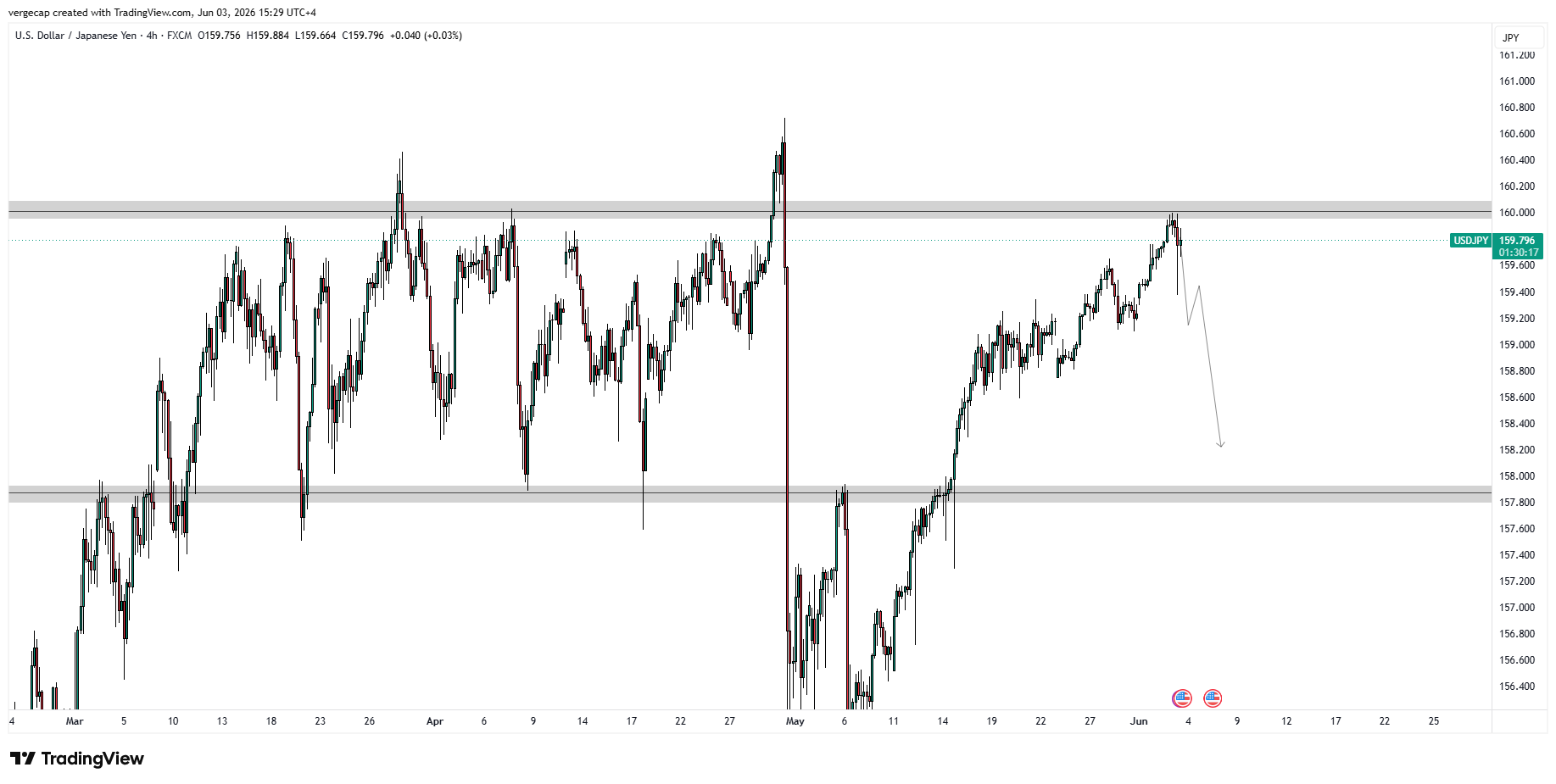
The USD/JPY chart is navigating one of the most politically charged technical setups in the major pairs right now, with price sitting at 159.796 directly beneath the 160.00 to 160.20 resistance band that has functioned as both a technical ceiling and a political red line across the entirety of the chart's visible history. Understanding what this chart is saying requires understanding that the 160.00 level is not merely a round number. It is the threshold that Japanese authorities have demonstrated a willingness to defend with direct market intervention, and that institutional memory is embedded in every rejection visible on this chart.
The horizontal gray band between 160.00 and 160.20 has now rejected price on three separate occasions across the chart. The April 26 spike, the early May attempt, and now Wednesday's push to 159.884 before the intervention warnings from Prime Minister Takaichi pulled price back. Each rejection has been followed by a meaningful corrective move, with the most severe being the early May intervention-driven collapse that sent USD/JPY all the way to the 156.40 to 156.60 lows in a matter of sessions. The subsequent recovery from those lows has been the most impressive structural development on this chart, a clean impulsive advance from 156.40 to 160.00 that covered nearly 360 pips and established a clear sequence of higher lows that defines the current bullish trend.
The 157.80 to 158.00 horizontal support band is the most important downside reference on the chart right now. It arrested the recovery rally on multiple occasions in mid-May before being broken to the upside, and that break converted it from resistance to support with the kind of conviction that gives technical traders confidence in its durability. The projected path on the chart points directly toward this zone as the next destination following the current pullback from 160.00, suggesting a corrective move toward 158.20 to 158.40 before any fresh attempt on the resistance ceiling.
That corrective structure is consistent with the political reality. When Japanese authorities have issued credible intervention warnings, USD/JPY tends to consolidate or pull back for several sessions before the underlying structural forces reassert themselves and push price back toward the trigger level. The April 30 intervention dropped price 400 pips and the pair spent a month recovering every single pip. Wednesday's pullback from 160.00 to 159.664 is, at this stage, a reaction to political risk rather than a genuine trend reversal.
A sustained 4-hour close above 160.20 would represent the decisive breakout that bulls have been attempting to engineer across multiple sessions and would shift focus toward the 160.60 to 161.00 area as the next target. A close below 159.00 on the other hand would signal that the political pressure is generating more sustained selling than the current candle structure suggests and would accelerate the projected move toward 158.00. The 157.80 support band is the level whose breach would require a genuine reassessment of the bullish structure built since the May lows.
TRADE RECOMMENDATION
SELL USD/JPY
ENTRY PRICE: 159.80
STOP LOSS: 160.30
TAKE PROFIT: 158.20


