Fundamentals
The Reserve Bank of New Zealand announced last week a 25 basis point reduction in the official cash rate to 2.25%. The central bank indicated that future monetary policy adjustments will be contingent on economic growth and inflation prospects, with analysts suggesting that the current easing cycle may be nearing an end. This could potentially strengthen the New Zealand dollar exchange rate. In her inaugural public appearance as the new Governor, Anna Breman clarified the bank's future policy priorities. During her address to the Parliamentary Finance and Expenditure Committee, she emphasized that the Reserve Bank remains committed to its core mandates: maintaining low and stable inflation, ensuring financial stability, and promoting a secure and efficient payments system. While acknowledging that economic growth and employment levels influence inflation dynamics, Anna Breman underscored that the primary tool of monetary policy—the official cash rate—is fundamentally aimed at controlling inflation. She highlighted that high inflation disproportionately impacts low-income households and, in the long term, could hinder healthy employment market development. Regarding the relationship between fiscal and monetary policy, she delineated responsibilities, stating that fiscal policy falls under the jurisdiction of the government, while the Reserve Bank's focus is on inflation targeting. The New Zealand economy is currently experiencing localized adjustments, characterized by a surplus in real estate supply and softening asking prices, shifting market dominance toward buyers. Meanwhile, the new Governor has explicitly prioritized inflation control, indicating that monetary policy in the near term is likely to retain a tightening bias to stabilize the macroeconomic environment.
The persistent weakening of the U.S. dollar index reflects market confidence in the Federal Reserves imminent interest rate cut cycle next week. According to the CME FedWatch Tool, the implied probability of a 25 basis point rate cut has risen to 89%. This dovish pricing continues to pressure the dollar, as investors adjust positions to accommodate a more accommodative monetary policy stance, impeding substantial rebound prospects. Concurrently, the unexpectedly sluggish ADP private payrolls report has further weighed on the dollar. Data indicates a decline of 32,000 private sector jobs in November—the largest drop since March 2023—significantly below market expectations of a 40,000 gain. This decline underscores increasing employment market pressures amid the Feds policy pivot, with small businesses bearing the brunt of layoffs. Companies with fewer than 50 employees shed a total of 120,000 jobs, including 74,000 layoffs from firms with 20 to 49 employees. Conversely, large enterprises with over 50 employees added 90,000 jobs, highlighting notable labor market segmentation. Signs of a weakening labor market are also reflected in wage data. A report published in collaboration with Stanford Digital Economy Lab reveals that turnover workers experienced a 6.3% increase in compensation, the lowest level since February 2021. Employees remaining in their current roles saw a wage growth of 4.4%. This data is derived from payroll records covering over 26 million private-sector employees in the U.S. Historically, economists have generally viewed the labor market as characterized by low hiring and low firing activity; however, recent layoffs and announced restructuring plans by major corporations such as Apple and Verizon Communications may contribute to rising unemployment rates.
Technical Analysis
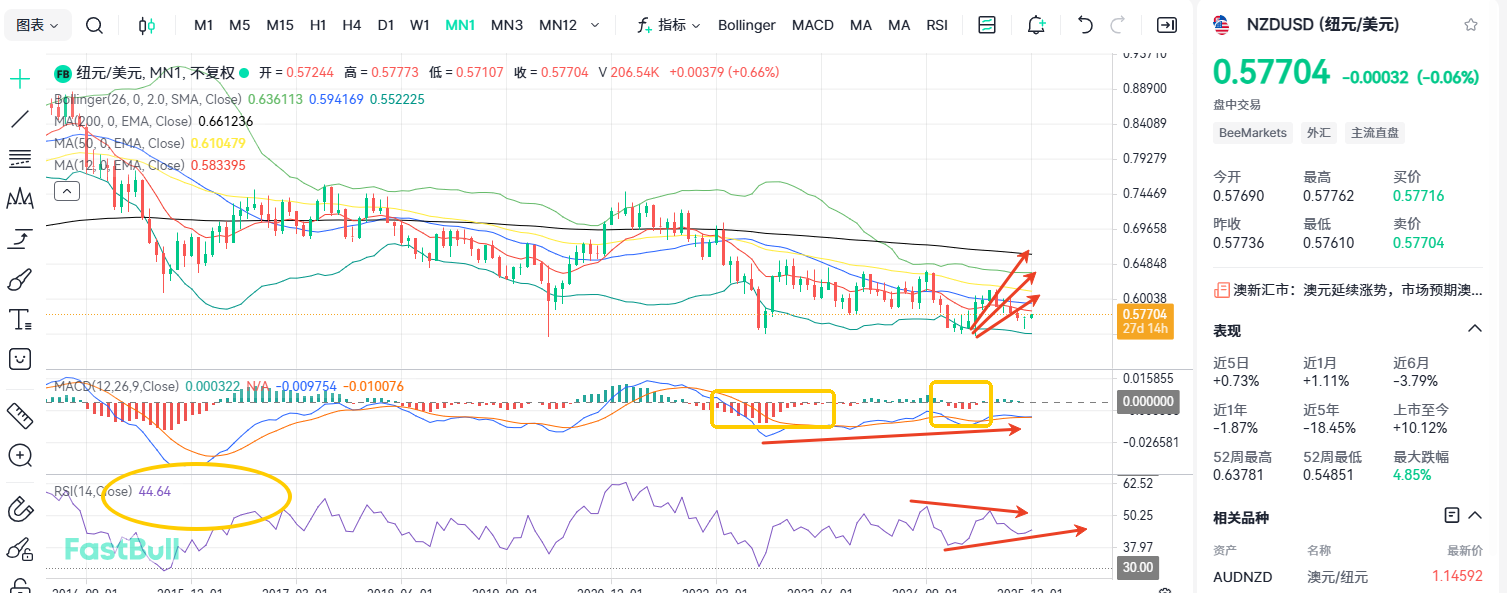
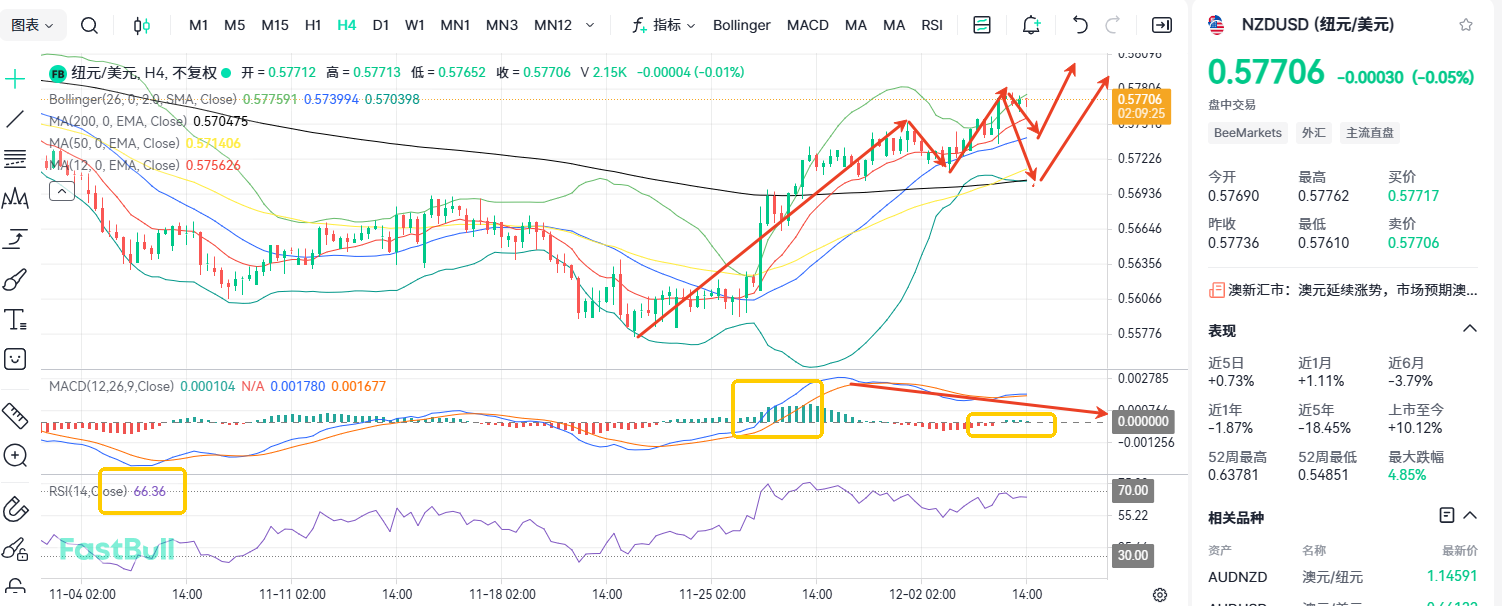
In the 1M timeframe, the Bollinger Bands are narrowing, while SMAs are flattening, suggesting a potential trend reversal. Last month formed a doji candlestick pattern, followed this month by a bullish upward open, with a likely rebound toward the EMA50 at approximately 0.61. The MACD momentum shows weakening bearish divergence, and the RSI is at 44, reflecting prevailing bearish sentiment. However, the absence of lower lows suggests a bullish divergence, indicating a continuation of the upward correction. In the 4H timeframe, the Bollinger Bands are expanding upwards, with SMAs diverging upwards, and the MACD has formed a golden cross without the MACD line and signal line retracing near the zero-axis. This indicates a bullish trend, although the upward momentum is waning, leading to a short-term sideways consolidation. The RSI stands at 66, with market participants predominantly buying. If the price remains sustainably above 0.57, there is a high probability of a rally toward approximately 0.583. It is recommended to go long at the lows in the short term.
Trading Recommendations
Trading Direction: Buy
Entry Price: 0.574
Target Price: 0.61
Stop Loss: 0.566
Support: 0.57, 0.566, 0.55
Resistance: 0.58, 0.583, 0.61