Fundamentals
This week, the Canadian dollar will be influenced by November's labor market data, which is scheduled for release on Friday. The consensus forecasts the national unemployment rate to rise from 6.9% in October to 7%. Meanwhile, the overall labor force is expected to remain unchanged. The Canadian government plans to implement capacity enhancement measures for the Trans Mountain pipeline prior to divesting its equity stake. Energy Minister Tim Hodgson stated that the federal government will only consider the sale after maximizing the pipeline's throughput through related optimization initiatives over the coming years. The Trans Mountain pipeline was acquired by the government in 2018 to support its expansion project, which ultimately cost approximately CAD 34 billion and was officially commissioned last year, increasing crude oil transportation capacity from 300,000 to 890,000 barrels per day. Former Prime Minister Trudeau repeatedly expressed that the government does not intend to hold the pipeline long-term, with plans to ultimately privatize it and gift some equity stakes to Indigenous communities along the route. Currently, Prime Minister Mark Carney's administration prefers to initiate the sale process after resolving pipeline toll disputes and completing several capacity optimization projects. Hodgson noted that these high-value "bottleneck removal" measures could boost the pipeline's total capacity to approximately 1.25 million barrels per day. Additionally, Vancouver's Fraser Ports are dredging the channel to increase vessel loading capacity, thereby maximizing the asset value for taxpayers. Currently, the tolling dispute is projected to be resolved by late 2026 or early 2027. Regarding Indigenous equity ownership, the Carney government has not yet clarified whether it will adopt the previous administration's approach. However, the latest memorandum of understanding with Alberta stipulates that future pipeline projects to the British Columbia coast must incorporate Indigenous joint ownership and be supported by federal loan guarantees.
On Tuesday, U.S. President Donald Trump indicated that he has narrowed down the Federal Reserve's potential Chairmanship candidates to a single individual, with an announcement expected in early 2026. During his remarks, he mentioned White House Adviser Hassett by name. According to Reuters, Trump stated, "I believe a potential Federal Reserve Chair has emerged. May I say that? It's a potential. I can tell you, he's a respected person. Thank you, Kevin." Simultaneously, investors are closely monitoring the upcoming November releases of U.S. ADP employment change figures and the ISM Services PMI data, which are scheduled for the North American trading session. Given that most officials, including Jerome Powell, have warned of downside risks in the labor market, U.S. private sector employment figures are expected to significantly influence market expectations regarding the Federal Reserve's monetary policy trajectory. Major investment banks have substantially increased their forecasts for a December rate cut. Institutions such as Bank of America Global Research, J.P. Morgan, and Goldman Sachs project a 25 basis point reduction, while Morgan Stanley and Standard Chartered maintain their previous forecasts. The CME FedWatch tool indicates that the market-implied probability of a rate cut has risen to 89.2%, reflecting heightened investor concern over labor market weakness and recent dovish signals from Federal Reserve officials.
Technical Analysis
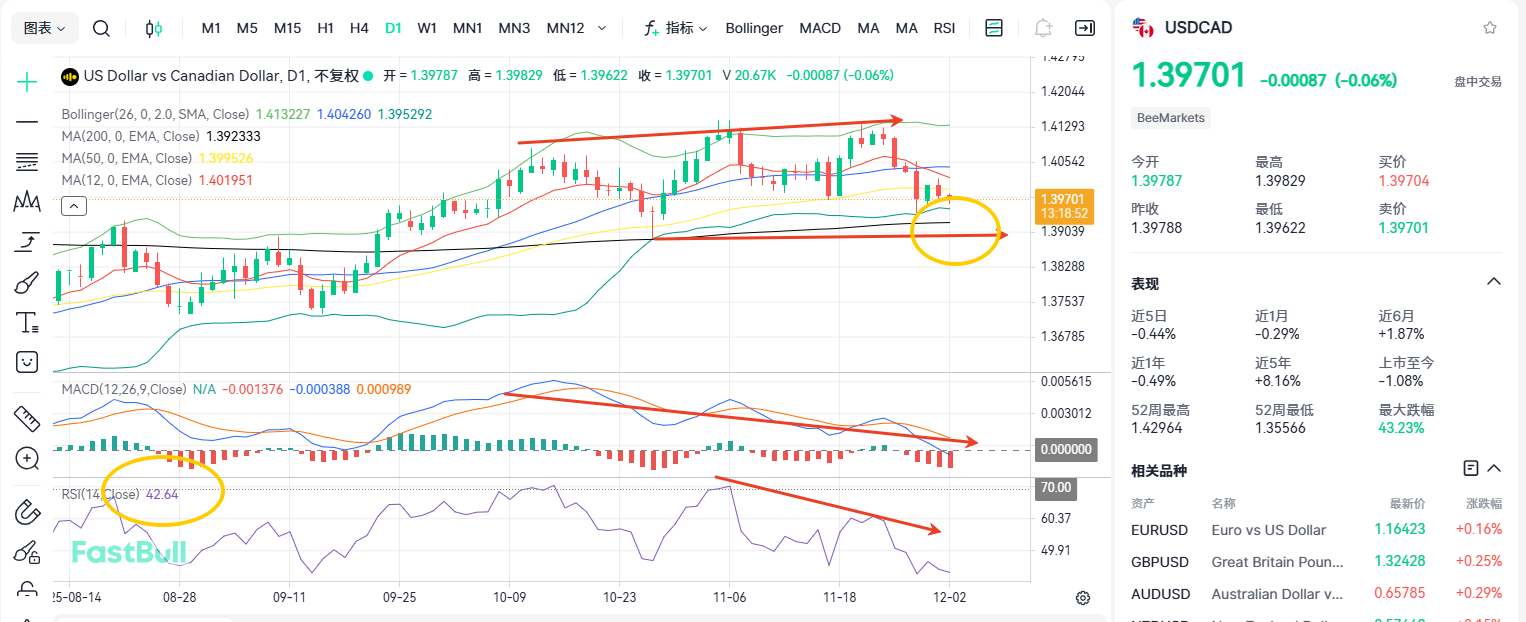
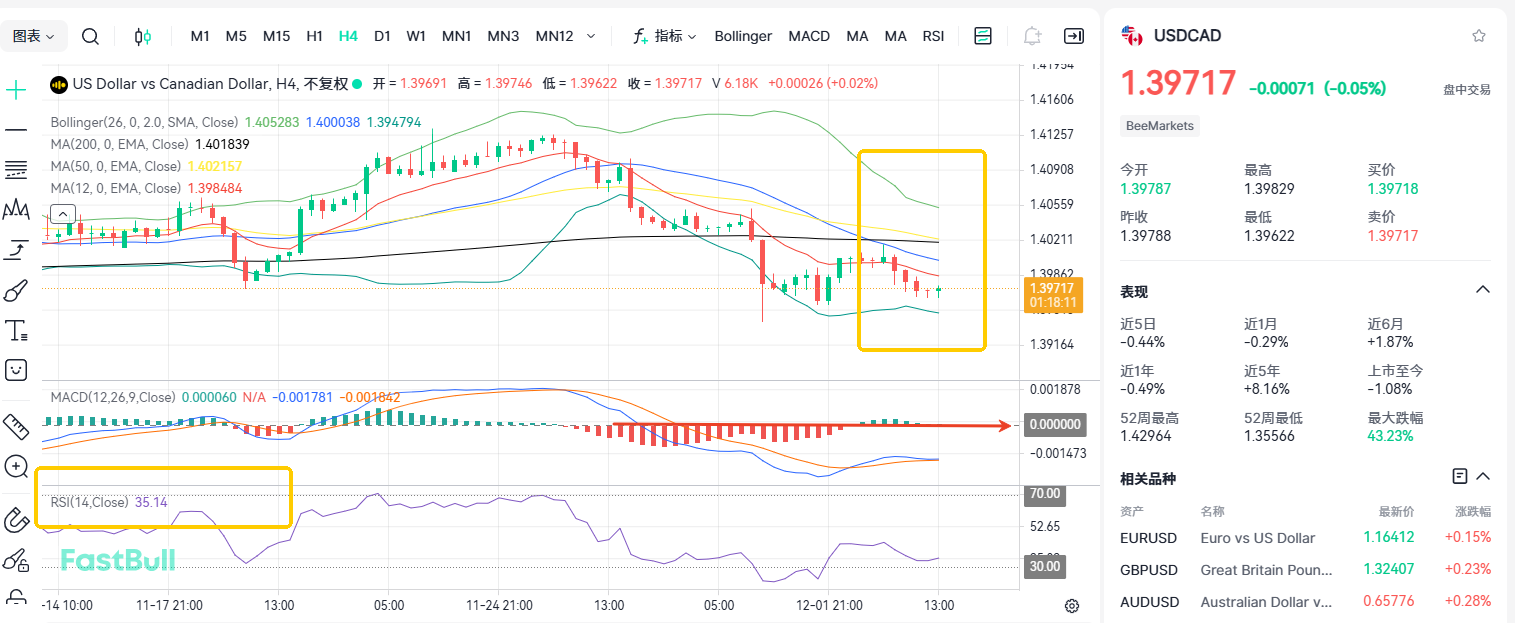
In the 1D timeframe, the Bollinger Bands are narrowing, indicating decreasing volatility. The short-term EMA12 has reversed downward, with prices oscillating between the EMA50 and the lower Bollinger Band. The MACD momentum is weakening; the MACD line and signal line have produced a death cross, suggesting a high probability of price decline toward the EMA200, around 1.392. The RSI stands at 42, reflecting strong market bearish sentiment and suggesting the short-term correction is ongoing. In the 4H timeframe, the Bollinger Bands are expanding downward. Following the MACD golden cross, the MACD line and signal line are retracing toward the zero-axis; however, they still remain some distance apart, indicating the correction has not yet concluded. Support levels are identified at the lower Bollinger Band and key round numbers, specifically around 1.394 and 1.39. The RSI is at 36, entering oversold territory. Therefore, it is recommended to go short at the highs.
Trading Recommendations
Trading Direction: Sell
Entry Price: 1.399
Target Price: 1.386
Stop Loss: 1.41
Support: 1.393, 1.39, 1.386
Resistance: 1.414, 1.42, 1.44