Fundamentals
Markets expect coordinated intervention measures between the U.S. and Japan. Japanese Prime Minister Sanae Takaichi warned last week that officials are prepared to take necessary steps to address speculative and highly abnormal market volatility. On the other hand, yen upside may be limited because the weaker-than-expected Tokyo CPI has reduced expectations for an imminent BoJ rate hike. According to data released Friday by Japan's Statistics Bureau, Tokyo CPI rose 1.5% YoY in January, the lowest growth rate since March 2022, down from 2.0% in the previous month. Meanwhile, Tokyo's core CPI YoY growth slowed to 2.0% in January, the lowest since October 2024, down from 2.3% in December and below the market forecast of 2.2%. This report reinforced market expectations that the BoJ will remain cautious about further rate hikes. In domestic politics, Prime Minister Sanae Takaichi's Liberal Democratic Party (LDP) is widely expected to perform well in the House of Representatives snap election scheduled for February 8. Preliminary results based on interviews conducted by Nikkei and a joint poll with Yomiuri Shimbun suggest the LDP is expected to gain seats and cross the majority threshold of 233 out of 465 House seats, significantly higher than its pre-election tally of 198. Currently, the ruling coalition of the LDP and Nippon Ishin no Kai holds only a narrow majority in the House and remains in the minority in the Upper House. Takaichi called the snap election to seek clearer public endorsement for her expansionary fiscal policies, but this policy direction has raised market concerns over a potential increase in Japanese government bond issuance, pushing bond yields higher. Although the campaign is still in its early stages, the LDP's overall momentum remains strong.
In financial markets, Japanese authorities are tackling yen depreciation pressure in a different way from before. With rare U.S. backing, Japan’s top currency official has adopted a strategy of “tactical silence” and restrained communication rather than frequent FX intervention. Atsushi Mimura, Vice Minister for International Affairs at the Ministry of Finance, who took office in 2024, has deliberately reduced public statements, making limited remarks themselves a policy signal and increasing market difficulty in judging whether and when Japan might intervene. Analysts note that without deploying large-scale intervention funds, Japan has pushed USD/JPY down by roughly 7 yen, regarded as a highly efficient operation. Recently, the yen has experienced several notable appreciations, including one following reports of unusual interest rate checks by the New York Fed, sparking speculation of a long-unseen joint U.S.–Japan intervention. Although the U.S. denied direct intervention, America's involvement in related rate checks is viewed as a significant breakthrough.
According to Bloomberg, Trump said Thursday evening that he would announce his nominee to succeed Jerome Powell as Fed Chair on Friday morning. Earlier reports indicated former Fed Governor Kevin Warsh met with Trump at the White House, after which Warsh emerged as a leading candidate. Traders will closely watch developments and their potential impact on Fed independence and interest rate prospects. The Wall Street Journal reported Thursday that Trump reached an agreement with Senate Democrats that could avert a government shutdown and buy more time to negotiate limits on government immigration policies. Market anxiety eased after the news broke. However, it remains unclear how quickly—or even if—the House will take up the funding bills once passed by the Senate. The shutdown deadline is midnight Friday. If market worries resurface, especially regarding Fed independence and the risk of a U.S. government shutdown, the dollar's rebound may prove short-lived, and these concerns could continue to weigh on the US dollar.
Technical Analysis
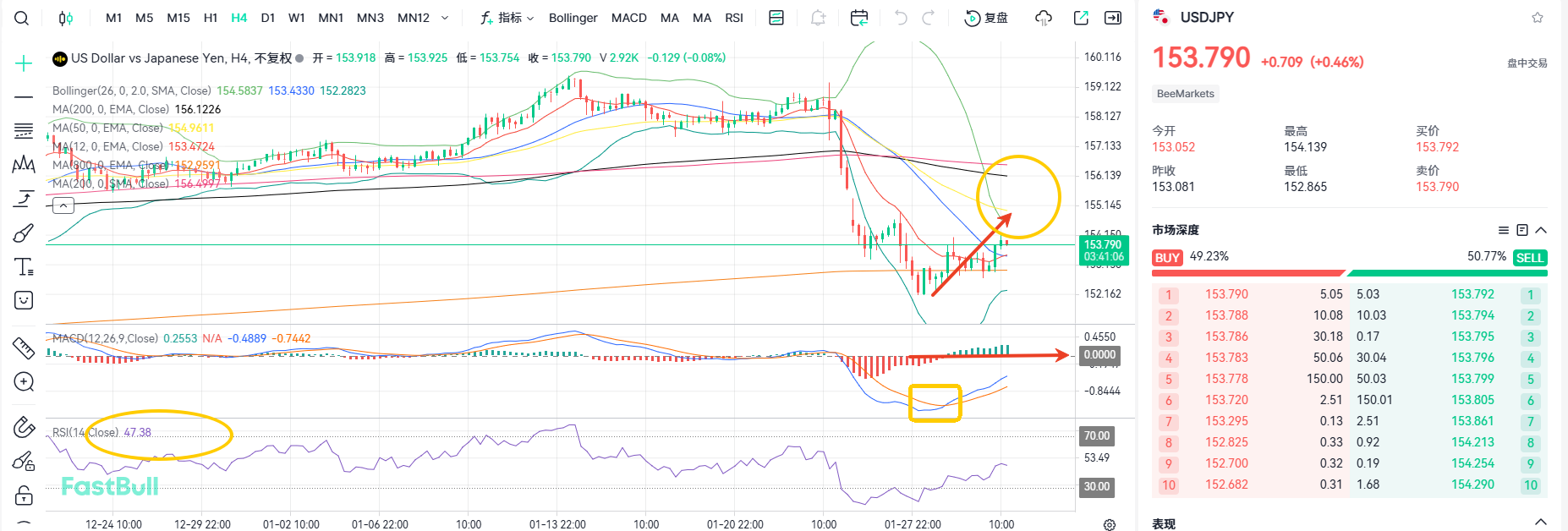
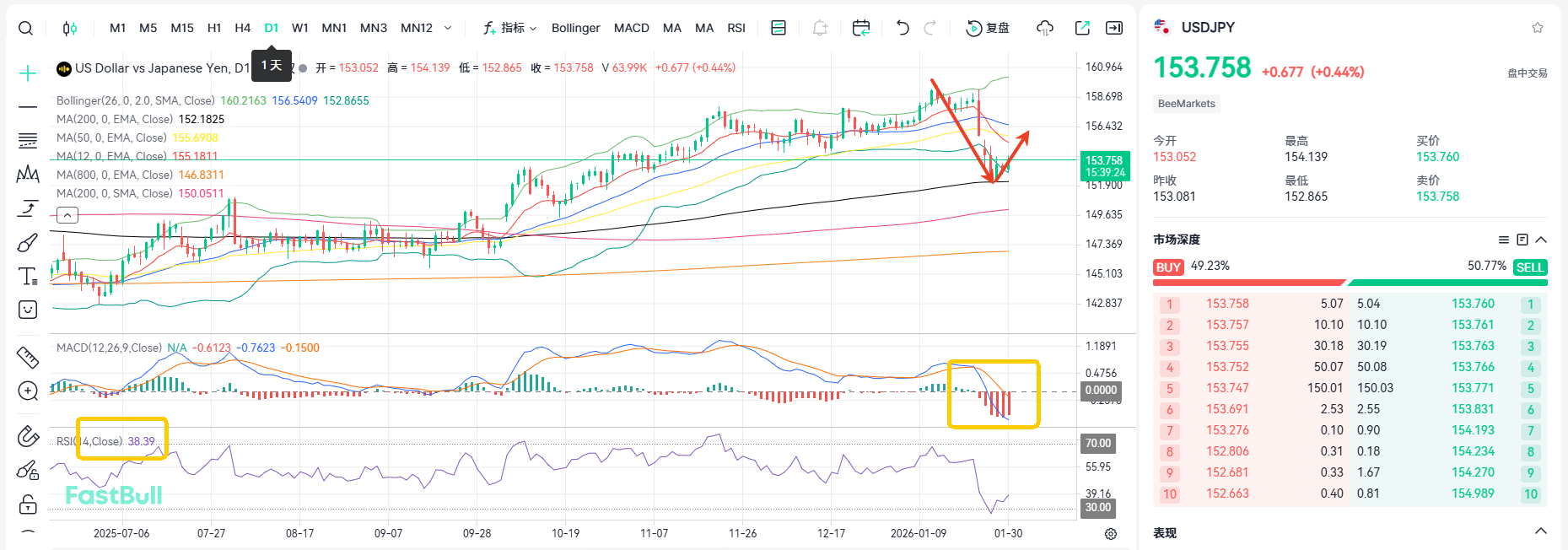
From a daily chart perspective, USD/JPY's Bollinger Bands are opening downward, moving averages are diverging lower, and price is falling strongly along the Bollinger Lower Band. After MACD formed a death cross, upward momentum clearly weakened. Besides, the MACD and signal lines have moved below the zero axis, indicating the market has entered a bearish trend. In the short term, price has stabilized and rebounded near the EMA200, potentially returning to around the EMA12 and the Bollinger Middle Band at 155.2 and 156.5, respectively. RSI is at 38, signaling an oversold zone where investors are mainly in sell mode.
Trading Recommendations:
Trading direction: Buy
Entry Price: 153.4
Target Price: 160
Stop Loss: 149.5
Support: 152/150/149.5
Resistance: 160/161/162