Fundamentals
Gold is not a simple momentum commodity. It is a weight-based market that pretends to trade like a virtual asset. Supply does not change at will — you cannot ring a bell and summon new gold supply next quarter. When demand accelerates, prices do not soar in celebration; instead, rationing occurs. Prices rise because the market must increase the price per ounce to slow the influx of buyers. This is once again basic supply-and-demand dynamics at work. Rather than viewing gold as a stock whose valuation climbs, imagine it as a narrow bridge where a convoy of vehicles rushes onto it simultaneously. Price increases are not due to euphoria but are an inevitable result of structural stress under heavy load. Sometimes the bridge charges high tolls to limit traffic; sometimes, due to mispricing, leverage accumulates until the bridge collapses without warning, hurling overloaded vehicles off its surface. The most direct way to understand such congestion is to look at actual trading volume rather than market sentiment. Central banks are the true price setters — they write the checks that determine market direction. History provides ironclad proof. Gregory Shearer and his team at J.P. Morgan asked the right question, measuring not in dollars but in tons. Their argument is simple yet powerful: gold supply does not respond to artificial adjustments. In the short term, gold supply is inelastic, meaning that when demand accelerates, prices are forced into rationing mode. Unless the latent demand from investors and central banks cools, market sentiment cannot rebalance; instead, prices will rise enough to reduce the tonnage of gold that existing capital can purchase. In their framework, this clearing price is far higher than most expect. Calculations show gold needs investor and central bank demand of roughly 380 tons per quarter to sustain upward momentum — a threshold that has barely changed even if traced back to 2010. Viewed differently, the implication is striking. Assuming nominal quarterly demand is just over $100 billion, gold prices would need to approach $8,000 or even $8,400 to compress demand below the historical breakeven point. Shearer makes clear this is not a complete model — it ignores jewelry demand, scrap supply, and potential shifts in official sector psychology. But the signal is unambiguous: rising prices degrade market liquidity, yet the current structure has not reached the breaking point. As long as central banks and large investors continue injecting funds on such a scale, gold will not peak. It remains in rationing mode. That said, this does not mean gold prices must fall to that level. Markets are not contracts of fate. It does mean the current rally is not a self-destructing tower propped up solely by euphoria. As prices climb, market pressure indeed grows — jewelry demand falls, global scrap supply rises. But the structural pillars of this rally have not yet snapped under their own weight. The conclusion is simple yet deeply unsettling: gold is expensive not because it looks expensive, but because central banks remain massive buyers of gold and are indifferent to price.
On the dollar side, Kevin Warsh's nomination as the next Fed Chair is a core factor supporting the dollar and a major force suppressing the New Zealand dollar's movement. On Friday, U.S. President Trump officially confirmed that Warsh will succeed Powell when his term ends in May. Although investor sentiment calmed slightly after the announcement, expectations of a tighter policy stance continued to lift the dollar, helping it hold key support levels. In terms of policy inclination, Warsh previously advocated shrinking the Fed's balance sheet. Recently, he voiced support for lowering market borrowing costs, but markets widely believe he remains cautious on inflation. CME FedWatch shows markets pricing in at least two rate cuts in 2026, yet Warsh's high sensitivity to inflation risks during his time as Fed Governor leads the market to anticipate a potentially hawkish policy path. Moreover, internal Fed policy disagreements further strengthen the dollar's short-term support. Atlanta Fed President Bostic has long resisted rate cuts and stated last week that the current size of the Fed's balance sheet is "about right," providing another positive catalyst for the dollar and cementing its strength. Data-wise, U.S. manufacturing activity unexpectedly expanded in January, posting the fastest growth since 2022, driven by robust increases in new orders and output. According to data released Monday, the ISM Manufacturing PMI jumped from 47.9 the previous month to 52.6, well above the expected 48.5. A reading above 50 signals economic expansion, and the latest figure exceeded all survey forecasts from economists. Key sub-indices showed: New Orders Index at 57.1 (previous 47.7), a nearly 10-point surge; Production Index also strengthened significantly — both showing the fastest growth in nearly four years. Employment Index at 48.1 (expected 46, previous 44.9) hit a one-year high, indicating manufacturing employment is still falling but at a slower pace. Prices Paid Index at 59, a four-month high (expected 59.3, previous 58.5), signaling manufacturers see little relief from elevated input costs. Order backlogs expanded for the first time since 2022. Export orders also increased.
Technical Analysis
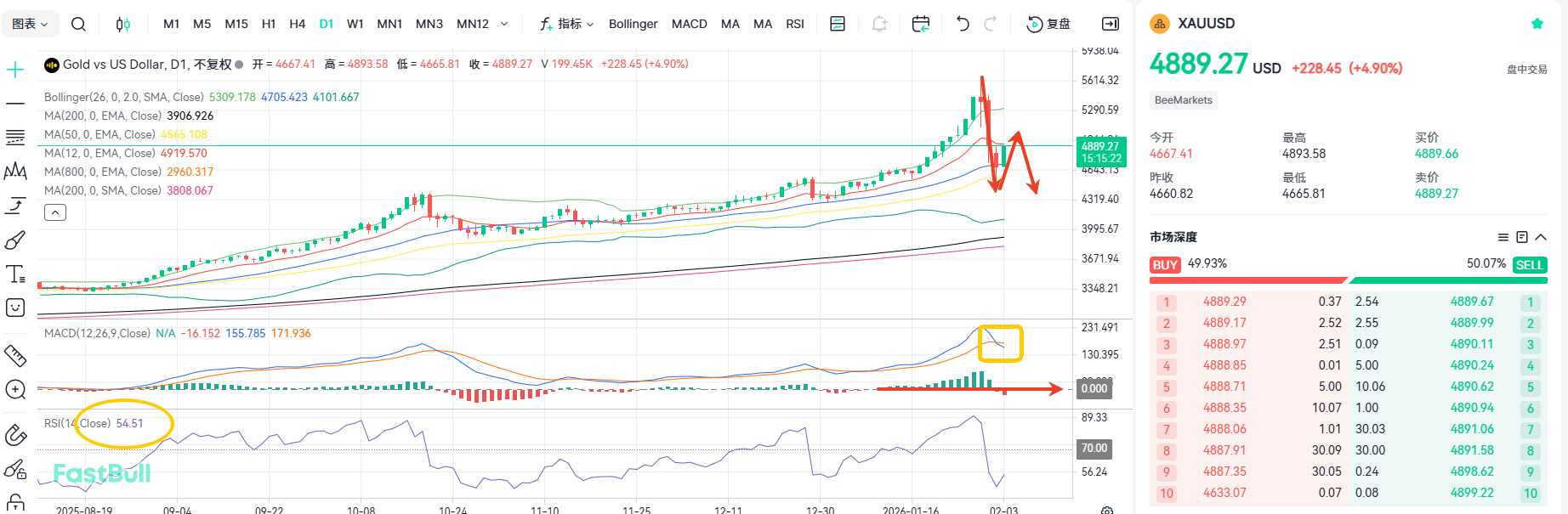
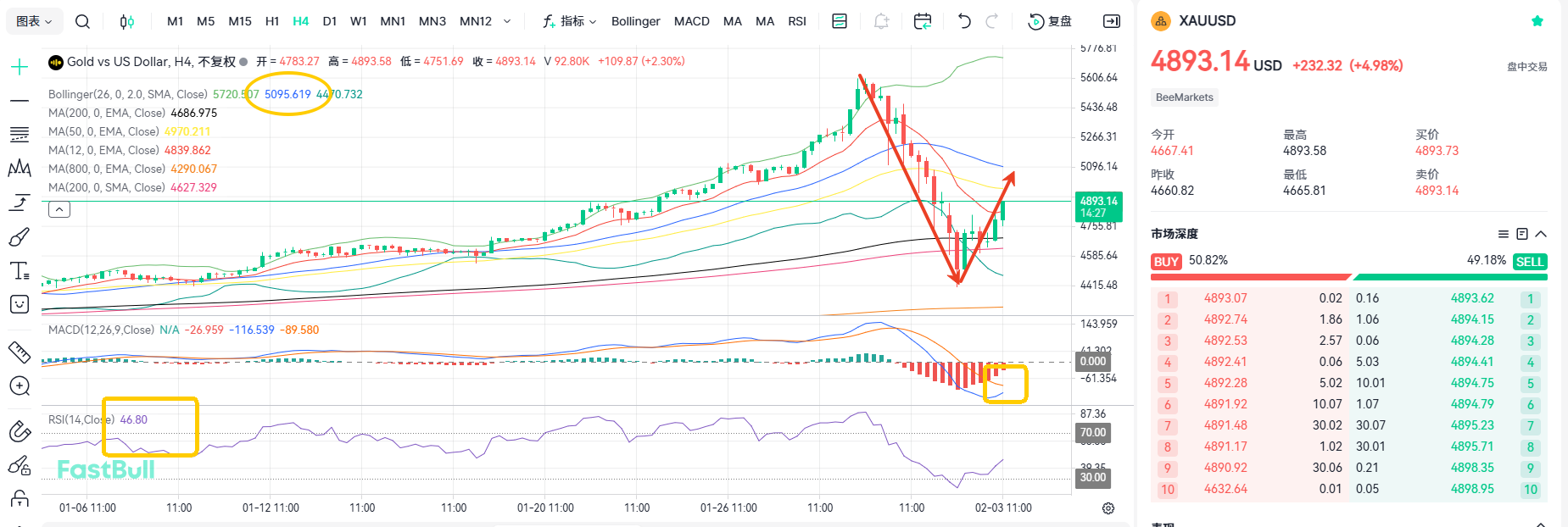
Based on the 4-hour chart, gold shows a bullish engulfing pattern, suggesting a rebound is likely. It will probably retrace to near the Bollinger Middle Band and EMA50 levels of 5,095 and 4,969, respectively. MACD is about to form a golden cross — if it materializes, the rebound will continue; otherwise, prices may fall again. The RSI stands at 46, indicating that sellers currently dominate. The daily chart exhibits that Bollinger Bands are narrowing and moving averages are flat. After a bearish evening star pattern, prices continued lower with a large bearish candle — the short-term downtrend is not over. MACD shows a high-level death cross, with the MACD and signal lines pulling back toward the zero axis but still far away, indicating the decline is incomplete. Support lies at 4,100 and 3,900. RSI is at 54, reflecting strong market indecision. It is better to sell now and buy later.
 Trading Recommendations:
Trading direction: Sell
Entry price: 5050
Target price: 4300
Stop loss: 5200
Support: 4500/4200/4100
Resistance: 4900/5100/5200