It has been a session of remarkable complexity for the Euro, and for those of us who track the single currency's fortunes across multiple crosses, Thursday delivered a rich tapestry of competing forces — surging inflation figures, cautious central bank communication, geopolitical breakthroughs, and a Swiss National Bank quietly wrestling with its own set of uncomfortable realities. The net result, as of time of writing, is an Euro that is holding its ground and in certain crosses pushing meaningfully higher, even as the full weight of the day's data and event risk has yet to fully crystallize.
EUR/CHF trades around 0.9230 at the time of writing, virtually unchanged on the session but having staged a notable recovery from an intraday low of 0.9198 struck in the hours following the release of revised Eurozone inflation data for March. That intraday reversal — a 32-pip swing from low to current levels — may look modest on a percentage basis, but it is technically and fundamentally meaningful, and I believe it tells us something important about where the balance of power currently sits between the Euro and the traditionally defensive Swiss Franc.
The primary market catalyst on Thursday was the release of revised Eurozone HICP inflation figures for March, and the numbers were sufficiently surprising to force a reassessment of the near-term ECB policy outlook across trading desks. According to the revised data, the Eurozone Harmonized Index of Consumer Prices rose by 1.3% month-on-month in March — accelerating sharply from a 0.6% rise in February and beating the preliminary estimate of 1.2%. On an annual basis, headline inflation was revised higher to 2.6%, marking the highest reading since July 2024 and a significant jump from the 1.9% registered in February.
These are not trivial numbers. A 2.6% annual headline rate exceeds the ECB's 2% target and does so in a direction — upward revision — that policymakers find particularly uncomfortable to explain away. The composition of the inflation print provides important context, however. Core inflation — which strips out energy, food, alcohol, and tobacco — was revised slightly lower to 2.3% year-on-year from the preliminary estimate of 2.4%, and also came in below February's 2.4% reading. That divergence between a rising headline and a slightly softer core is the fingerprint of energy-driven inflation, and it confirms what markets have long suspected: the Middle East conflict's disruption to global oil and gas supply chains is now flowing directly into Eurozone consumer price dynamics.
For the European Central Bank, this creates a genuinely awkward policy dilemma. On one hand, the headline rate is rising and now sits meaningfully above target — a fact that hawks within the Governing Council will use to argue for prompt rate action. On the other hand, the softness in core inflation suggests that the underlying demand-driven inflationary pressures that central banks are best equipped to address through interest rate policy remain relatively contained. The ECB is, in the bluntest terms, being asked to raise rates in response to a supply-side shock that monetary policy cannot directly influence — a situation that carries significant downside risks for growth if misjudged.
ECB President Christine Lagarde set the tone for the Governing Council's current disposition earlier this week when she stated that the central bank needs to remain "completely agile" on interest rates, while being careful to emphasize that there is no institutional bias toward tightening. It was a carefully choreographed message — enough to keep market expectations for rate hikes alive without formally committing to a timeline that could prove embarrassing if the geopolitical situation evolves in unexpected directions.
The market, however, has made up its own mind. According to data compiled by Reuters, financial markets are currently pricing in two 25-basis-point rate hikes from the ECB this year, with the probability of an April move remaining limited but a June hike now almost fully priced in by investors. That is a remarkable shift in expectations from just a few months ago, when the dominant market narrative was one of ongoing ECB easing and the single currency's challenge was finding reasons to appreciate rather than to depreciate.
Thursday's inflation revision will not have made Lagarde's communication task any easier. With headline CPI at 2.6% and rising — and with the ECB Monetary Policy Meeting Accounts from the March 19 meeting due for release later in the day — the Governing Council will find it increasingly difficult to maintain a posture of studied neutrality in the face of mounting inflationary evidence. The accounts themselves are expected to provide a window into how policymakers were assessing inflationary persistence at that meeting, and any language suggesting concern about second-round effects — in particular, the risk of energy price increases feeding into wages and services inflation — would likely be interpreted as a green light for market participants to price in even earlier tightening.
Not everyone within the Governing Council is ready to move quickly, however. ECB policymaker François Villeroy de Galhau, Governor of the Bank of France, pushed back on Thursday against expectations of an April rate hike, stating that it is "premature" to focus on such action at the next meeting and that the ECB needs a "critical mass of data" before taking any decision. He was careful to add that there is no predetermined path for interest rates — a reminder that the ECB's data-dependency mantra cuts both ways and that the eventual pace of tightening remains genuinely uncertain. From my perspective, Villeroy de Galhau's comments represent the voice of institutional caution, but they are increasingly fighting a rearguard action against both the data and market pricing. June looks like the realistic pivot point, and I expect subsequent ECB communications in the coming weeks to gradually prepare the ground for exactly that.
Layered on top of the inflation story is a geopolitical development of potentially enormous consequence — one that has given the Euro a meaningful boost across multiple crosses in recent sessions. Reports citing comments from a top aide to Ukrainian President Volodymyr Zelenskyy have suggested that Kyiv may be approaching a peace agreement with Moscow, a development that sent shockwaves of optimism through European financial markets, which have been weighed down by the economic costs of the conflict since its escalation.
Adding further credibility to the diplomatic momentum, Moscow declared a 32-hour ceasefire for Orthodox Easter, and a senior Kremlin official affirmed that peace could be achieved today if President Zelenskyy makes the political decision to pursue it — while adding that Russia seeks a lasting peace rather than a temporary ceasefire. These statements are, of course, inherently political and must be treated with appropriate skepticism. Peace negotiations in this conflict have been declared imminent before, only to collapse under the weight of mutual mistrust and incompatible territorial demands.
Nevertheless, the market reaction has been real and measurable. The Euro is one of the primary beneficiaries of any reduction in the geopolitical risk premium that has been embedded in European asset prices since the conflict's escalation. A credible peace agreement would represent a transformative positive shock for the Eurozone economy — reducing energy price pressures, restoring business and consumer confidence, and removing the structural headwind that has suppressed investment across the region for years. EUR/JPY's rally from 182.00 to 186.50 in just a matter of weeks reflects, in part, markets beginning to price in that scenario, even if only tentatively. The 186.88 year-to-date high now looks very much within reach.
On the other side of the EUR/CHF equation, the Swiss National Bank's meeting minutes released Thursday offered a characteristically measured and cautious assessment of Switzerland's economic outlook — one that has grown notably more uncertain in the wake of the Middle East conflict and its global ramifications. The SNB expects Swiss GDP growth of approximately 1% in 2026 and 1.5% in 2027, acknowledging that activity could remain subdued in the near term — a modest but not alarming growth profile that nonetheless reflects the headwinds facing the broader European economy, with which Switzerland is deeply integrated.
Perhaps more market-relevant was the SNB's observation that the recent appreciation of the Swiss Franc has tightened monetary conditions — a signal that policymakers are watching the currency's strength with some unease. The Franc's traditional role as a safe-haven asset means that periods of global uncertainty tend to attract capital flows into CHF, which in turn strengthens the currency, compresses import prices, and creates disinflationary pressure that runs counter to the SNB's price stability objectives. The Bank acknowledged that inflation is expected to rise temporarily due to higher energy prices before declining again in the medium term, and it considered the current policy stance appropriate — language that effectively rules out any near-term policy adjustment, at least on the basis of Thursday's minutes.
The market reaction to the SNB minutes was muted — there was no immediate sharp move in the Franc following their release — which tells its own story. Traders had already broadly anticipated a cautious, hold-oriented SNB message, and the absence of any hawkish surprise gave the Euro room to gradually recover versus the Franc through the day's session, pushing EUR/CHF back from its 0.9198 intraday low toward the current 0.9230 level.
Stepping back and assessing the totality of Thursday's developments, I find myself cautiously constructive on the Euro across multiple crosses. The inflation revision to 2.6% removes the ECB's ability to remain indifferent to rising prices and makes a June rate hike a near-certainty in my assessment, providing the Euro with an interest rate differential tailwind that was absent just months ago. The Russia-Ukraine peace narrative, while fragile, introduces an asymmetric upside risk for EUR that the market is only beginning to price in. And the SNB's hands-off posture on the Franc reduces the risk of active Swiss intervention that might otherwise cap EUR/CHF gains.
The risks, as always, are real. A breakdown in peace negotiations would reverse sentiment rapidly. An ECB that over-tightens into a slowing economy risks damaging growth precisely when the Eurozone needs it most. And the geopolitical situation in the Middle East remains the dominant global risk factor — one that can re-price every asset class simultaneously with a single headline.
For now, however, the Euro is fighting on multiple fronts — and winning. EUR/JPY eyeing 186.88, EUR/CHF recovering from intraday lows, and a central bank that is, perhaps for the first time in years, gaining rather than losing credibility on the inflation front. It is not yet time to declare a structural Euro bull market, but the foundation for one is being carefully — and perhaps inadvertently — laid.
Technical Analysis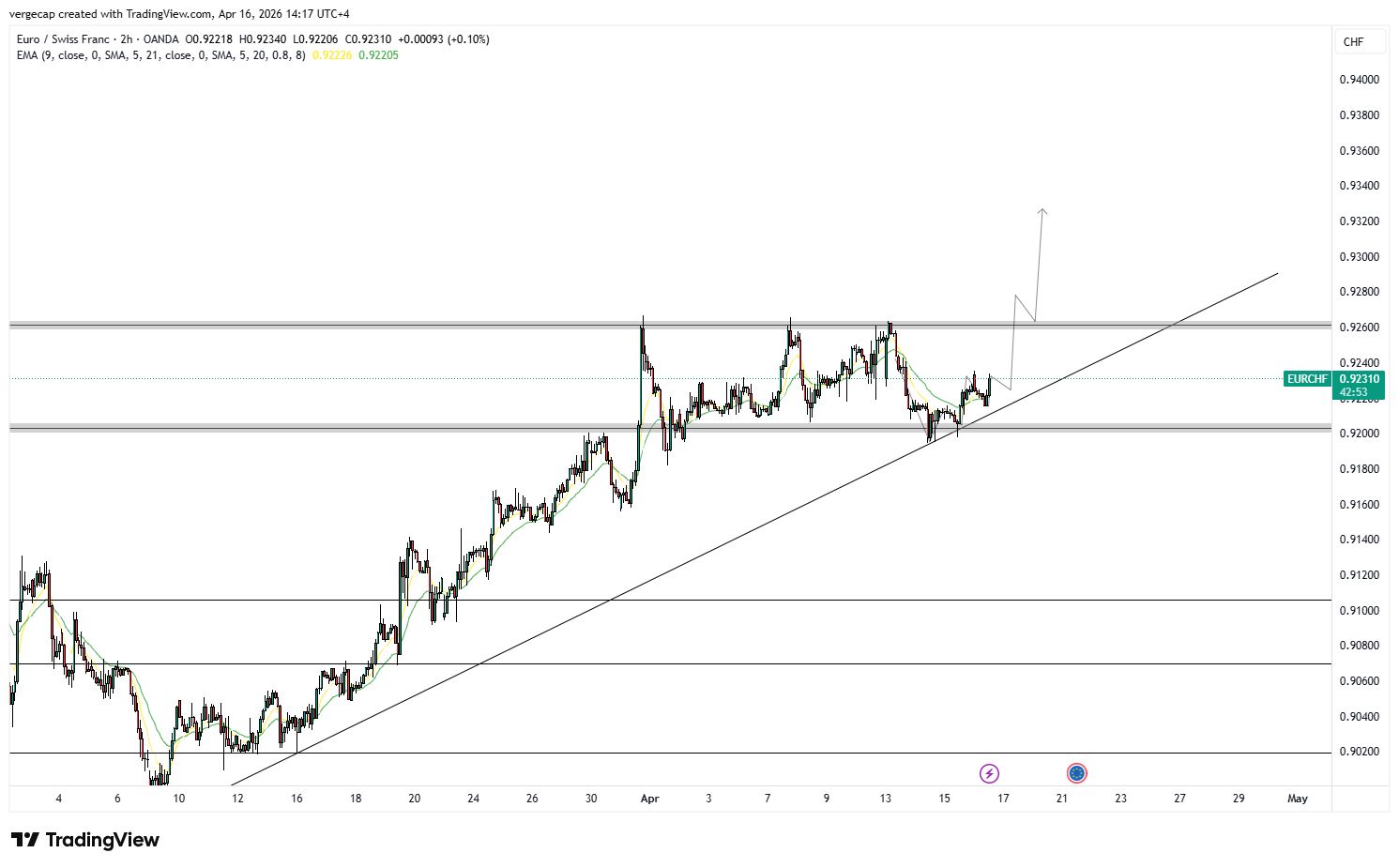
EUR/CHF remains entrenched within a well-defined and structurally sound bullish trend on the 2-hour chart, underpinned by a rising trendline that has been intact since the mid-March lows near 0.9020. The pair has covered an impressive amount of ground since that trough — rallying over 240 pips in a broadly impulsive fashion — and despite a recent pullback from the 0.9260–0.9280 resistance ceiling, the overall architecture of the chart continues to favor the bulls so long as critical support levels hold.
Price currently trades at 0.92310, sitting just above a cluster of dynamic support formed by the 9-period EMA at 0.92226 and the 21-period SMA at 0.92205 — two moving averages that are running in near-perfect lockstep and whose convergence at this juncture is highly significant. The fact that price has rebounded from a recent dip to the 0.9200 horizontal support zone and is now sitting above both moving averages is an encouraging sign for the bullish case, suggesting that sellers who pushed the pair down toward the trendline were absorbed efficiently and that dip-buyers are beginning to reassert control.
The ascending trendline drawn from the March 12 lows is the single most important structural element on this chart. It has been tested on multiple occasions — most notably during the mid-March consolidation, the early April pullback, and most recently around April 15–16 — and each time it has held, producing a meaningful bounce. This repeated validation of trendline support elevates its technical credibility considerably. The trendline currently intersects near the 0.9200–0.9210 zone, which also coincides with a prominent horizontal support level visible on the chart. The layering of trendline support and horizontal support at the same price area creates what technicians call a confluence zone — a region where multiple forms of support overlap, making a breakdown significantly less likely than in areas with only a single form of support.
The 0.9200 level therefore represents the definitive line in the sand for the current bullish structure. A decisive 2-hour close below this level, particularly if accompanied by a break of the ascending trendline on a closing basis, would mark a meaningful deterioration in market structure and would shift the near-term bias to neutral at best and bearish at worst. Should such a breakdown materialize, the next downside target would be found in the 0.9160–0.9180 zone, where prior price action from late March provided a base. A sustained move below 0.9160 would bring the 0.9100 region — a major horizontal support level clearly visible on the left side of the chart — into play, signaling a more significant corrective episode rather than a routine trendline retest.
The immediate overhead obstacle for bulls is the 0.9260–0.9280 resistance band — a zone that has twice capped the pair's advance in recent weeks, most prominently during the sharp early April spike and again during the April 7–9 consolidation period. This level must be overcome on a sustained closing basis before the broader uptrend can reassert itself with conviction. A clean break and hold above 0.9280 would be the technical trigger that unlocks the next leg higher, with the projected path visible on the chart pointing toward the 0.9320–0.9340 area as the primary upside target. Beyond that, the 0.9380–0.9400 zone represents longer-term resistance and a potential medium-term objective for swing traders.
The moving average configuration supports a cautiously bullish reading. Both the 9-period EMA and 21-period SMA are sloping gently upward, running in tight formation just beneath current price — a configuration consistent with a trending market that is pausing for breath rather than one undergoing a structural reversal. The tightness of the spread between the two averages also suggests that the market is in a consolidation phase rather than a directional acceleration, reinforcing the expectation of a brief pause near current levels before the next meaningful move.
The projected path drawn on the chart itself — showing a shallow pullback toward trendline support near 0.9210 before a resumption of the uptrend toward 0.9320+ — is consistent with the technical reading and represents the base case scenario given current market structure. A clean touch of the trendline accompanied by a bullish rejection candle on the 2-hour timeframe would represent a high-quality, technically validated long entry.
TRADE RECOMMENDATION
BUY EUR/CHF
ENTRY PRICE: 0.92330
STOP LOSS: 0.9185
TAKE PROFIT: 0.9320


