Gold prices (XAU/USD) traded with a modestly positive bias during Thursday’s European session, holding above the $4,800 threshold despite paring earlier gains. The precious metal’s resilience reflects a complex interplay between persistent geopolitical risks in the Middle East and a broadly firmer US Dollar, which continues to limit the scope for a more aggressive upside move.
At the center of market attention is the evolving situation surrounding Iran, where tensions remain elevated despite renewed diplomatic optimism. The United States’ decision to enforce a naval blockade on Iranian ports—implemented following the collapse of talks in Islamabad last weekend—has intensified uncertainty across global markets. The move has heightened fears of broader disruptions in the Gulf region, particularly in the strategically critical Strait of Hormuz, a vital artery for global energy shipments.
Iran’s response has further complicated the outlook. Senior military officials have warned that Tehran could potentially halt trade flows in the Gulf if the blockade is not lifted, raising the specter of supply disruptions that could ripple through global markets. Adding another layer of complexity, Iran has tied the continuation of diplomatic engagement to an end to Israeli military operations in Lebanon, a condition that appears unlikely to be met in the near term.
Israeli Prime Minister Benjamin Netanyahu reinforced this uncertainty by signaling no commitment to a ceasefire, instead confirming that military operations would continue with an expanded security perimeter. In my view, this combination of entrenched geopolitical tensions and conditional diplomacy is creating a fragile equilibrium in financial markets—one that supports safe-haven flows but also sustains demand for the US Dollar as the world’s primary reserve currency.
This dynamic has proven to be a double-edged sword for gold. While geopolitical instability typically underpins demand for bullion, the parallel strengthening of the US Dollar—driven by its safe-haven appeal—has acted as a counterbalance, capping gains in the non-yielding asset. As a result, gold remains supported but lacks the momentum to break decisively higher.
At the same time, expectations for a potential diplomatic resolution are preventing a more pronounced risk-off environment. US President Donald Trump struck a cautiously optimistic tone, suggesting that the conflict with Iran could be nearing its conclusion. The White House has echoed this sentiment, pointing to increasing prospects for a renewed round of negotiations that could take place within days.
This shift in tone has contributed to a broader improvement in risk appetite, as evidenced by relatively subdued crude oil prices, which continue to hover near recent lows. The easing of energy price pressures has, in turn, tempered fears of a sustained inflation spike, reducing the urgency for the US Federal Reserve to maintain an aggressively hawkish stance.
Market pricing reflects this evolving outlook. According to expectations derived from the CME Group FedWatch Tool, the timeline for potential monetary easing remains skewed toward late 2026. This suggests that while rate cuts are still anticipated, they are not imminent—limiting the downside pressure on the US Dollar while simultaneously preventing a sharp rally.
In my assessment, this mixed macro and geopolitical backdrop is likely to keep gold in a state of controlled consolidation. The metal’s ability to hold near multi-week highs underscores the persistence of underlying demand, particularly as investors hedge against geopolitical tail risks. However, without a decisive deterioration in the geopolitical environment or a clear shift in Federal Reserve policy expectations, upside momentum may remain constrained.
Ultimately, gold appears to be caught between competing forces: geopolitical uncertainty providing support on one side, and a resilient US Dollar capping gains on the other. Until one of these drivers asserts clearer dominance, price action is likely to remain range-bound, with a cautious upward bias reflecting the market’s lingering sensitivity to geopolitical developments.
Technical Analysis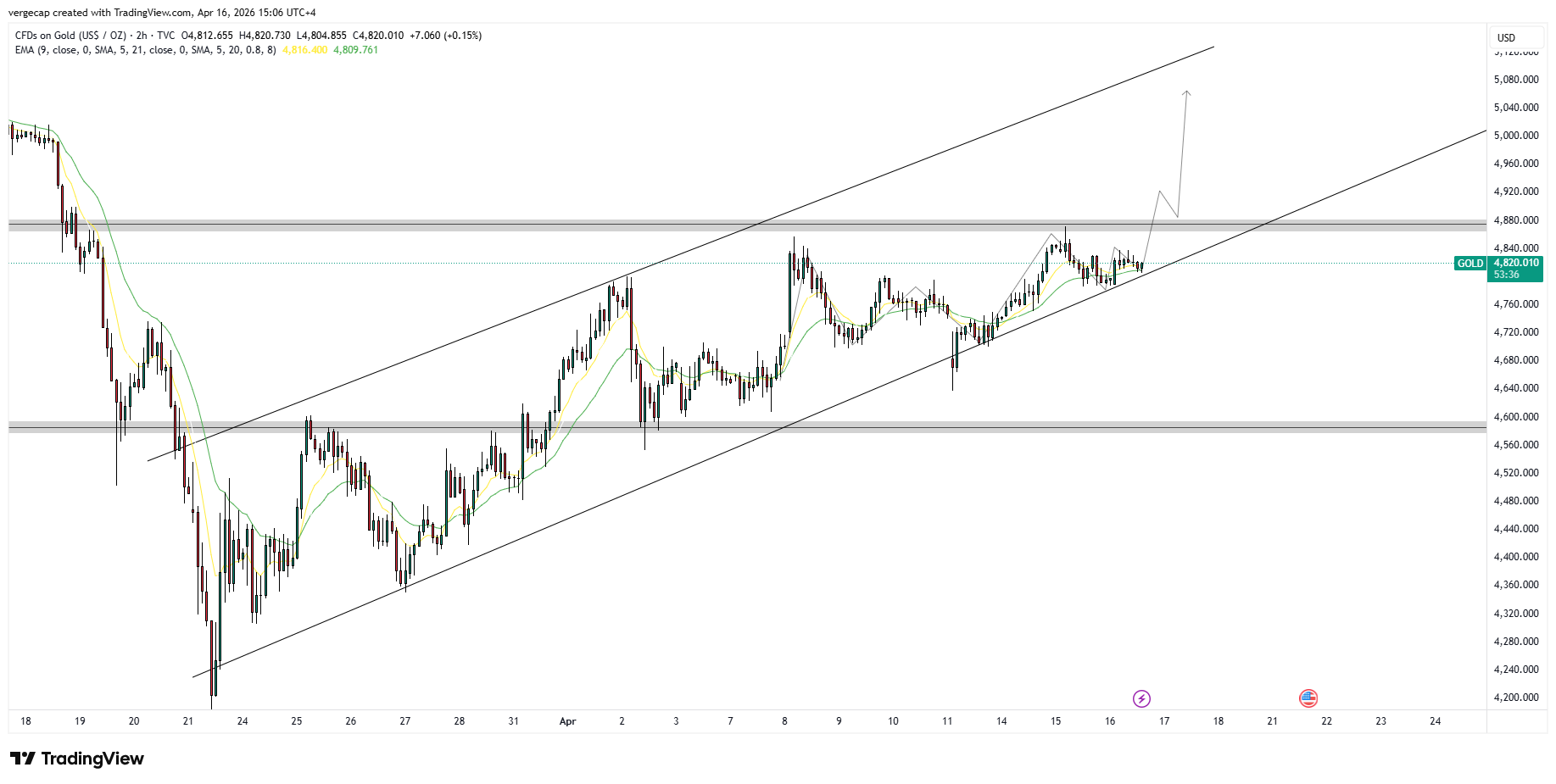
From a technical perspective, gold remains firmly embedded within a well-defined bullish structure. On the 2-hour chart, price action continues to trade inside a rising channel that has guided the metal higher since the sharp reversal from the $4,220 region in late March. The recent advance has brought XAU/USD back toward the upper portion of this ascending formation, with prices currently consolidating near the $4,820 area after an extended rally. While upside momentum has moderated in the short term, the broader structure remains constructive and continues to favor buyers.
Price is currently hovering just above the 21-period Simple Moving Average (SMA), which is positioned near $4,816 and has acted as immediate dynamic support during the latest leg higher. This moving average continues to slope upward, suggesting that near-term momentum remains positive despite the recent pause. The 50-period SMA, located around $4,808, represents a more important support layer and continues to trend higher beneath current price action, reinforcing the underlying bullish bias. As long as gold remains above these moving averages, the broader uptrend remains intact.
The $4,800 region now serves as a critical short-term support zone. This level aligns closely with the lower boundary of the ascending channel and recent consolidation lows, making it an important area for bulls to defend. A decisive break below this region, particularly if accompanied by a sustained move beneath the 50-period SMA, would signal a loss of near-term momentum and could trigger a deeper corrective move toward the $4,700–$4,720 area, where previous buying interest emerged. Should that zone fail to contain selling pressure, downside exposure could extend toward the stronger structural support near $4,560, marking a more meaningful retracement within the broader uptrend.
On the upside, bullish traders remain focused on a clean break above the $4,860–$4,880 resistance zone, which has capped recent advances. A sustained push through this barrier would confirm continuation within the rising channel and likely attract fresh momentum buying. Such a breakout could shift focus toward the psychological $5,000 level, followed by a potential extension toward $5,080, where the upper channel boundary projects over the coming sessions. A move above these levels would reinforce the longer-term bullish trend and could invite stronger speculative participation.
Momentum indicators suggest consolidation rather than exhaustion. The Relative Strength Index (RSI) appears to have eased from overbought territory and is likely stabilizing in the mid-50s to low-60s, indicating that bullish momentum has cooled without turning negative. This moderation reduces the risk of an abrupt reversal and supports the case for continued sideways-to-higher price action. Meanwhile, the Moving Average Convergence Divergence (MACD) remains above the zero line, although the histogram has begun to flatten slightly, pointing to slowing upside momentum and reinforcing the possibility of near-term consolidation before the next directional move.
Overall, gold’s technical structure remains decisively bullish as long as the metal holds above the $4,800 support region. The rising channel, upward-sloping moving averages, and resilient price action continue to support the view that dips are likely to be viewed as buying opportunities rather than signs of a trend reversal.
TRADE RECOMMENDATION
BUY GOLD
ENTRY PRICE: 4,815
STOP LOSS: 4,760
TAKE PROFIT: 5,000


