The euro is suffering its most significant one-day drop in weeks, cascading nearly a full percentage point to trade perilously close to a three-month trough against a resurgent US dollar. The single currency was last seen at $1.1585, down 0.85% on the session, having briefly flirted with the critical support level of $1.1575 during European trading hours.
This dramatic sell-off is being driven by a "perfect storm" of geopolitical panic and shifting monetary policy expectations, creating a vicious bid for the US dollar that is sweeping across global markets. The Greenback is not just winning; it is dominating, with the US Dollar Index (DXY) surging over 0.8% to breach the 99.40 handle—its highest watermark in over a month.
The primary catalyst for the risk aversion is a terrifying escalation in Middle Eastern hostilities. Market sentiment was crushed earlier today following reports that Tehran launched drone attacks on the US Embassy in Riyadh. This brazen strike is being interpreted as direct retaliation for a joint US-Israeli operation that reportedly resulted in the deaths of several top Iranian leaders, including Supreme Leader Ayatollah Ali Khamenei.
The reality of a widening conflict between the US, Iran, and Israel has shattered any semblance of investor calm. Capital is fleeing equities—with S&P 500 futures plunging nearly 1.5%—and flooding into the perceived safety of the US dollar. In times of geopolitical heat, the Greenback remains the ultimate safe haven, and right now, the demand is insatiable.
However, the dollar’s strength isn't solely a story of war; it is equally a story of interest rates. Traders are aggressively unwinding bets on a dovish Federal Reserve, dramatically repricing the outlook for the June policy meeting. According to the CME FedWatch tool, the probability that the Fed will hold interest rates steady in June has skyrocketed to 53.5%, a massive leap from the 42.7% probability seen just on Friday.
What changed? The answer lies in red-hot inflation data from the US manufacturing sector. Monday's ISM Manufacturing PMI report revealed that factory-level inflation is accelerating at a worrying clip. The Prices Paid index—a critical bellwether for future consumer inflation—soared to a blistering 70.5. This obliterated both the forecast of 59.5 and the previous month's reading of 59.0, sending shockwaves through the bond market and forcing traders to accept that the "last mile" of inflation is proving to be a steep, uphill climb.
In a cruel twist of irony, the euro's collapse is occurring even as Eurozone inflation data printed hotter than expected. The preliminary Harmonized Index of Consumer Prices (HICP) for February came in at 1.9% year-on-year, overshooting the 1.7% estimate. Even more significantly, core inflation—which strips out volatile food and energy prices—accelerated to 2.4%, defying expectations that it would hold steady at 2.2%.
One would typically expect such sticky inflation to support the euro, as it suggests the European Central Bank may need to keep policy tight. But in the current environment, the market's reaction is clear: Geopolitics and a hawkish repricing of the Fed are trumping local data. The dollar is the primary driver, and until the fog of war lifts or the US data flow cools, the EUR/USD pair appears destined to test and likely break below the 1.1575 support level.
Technical Analysis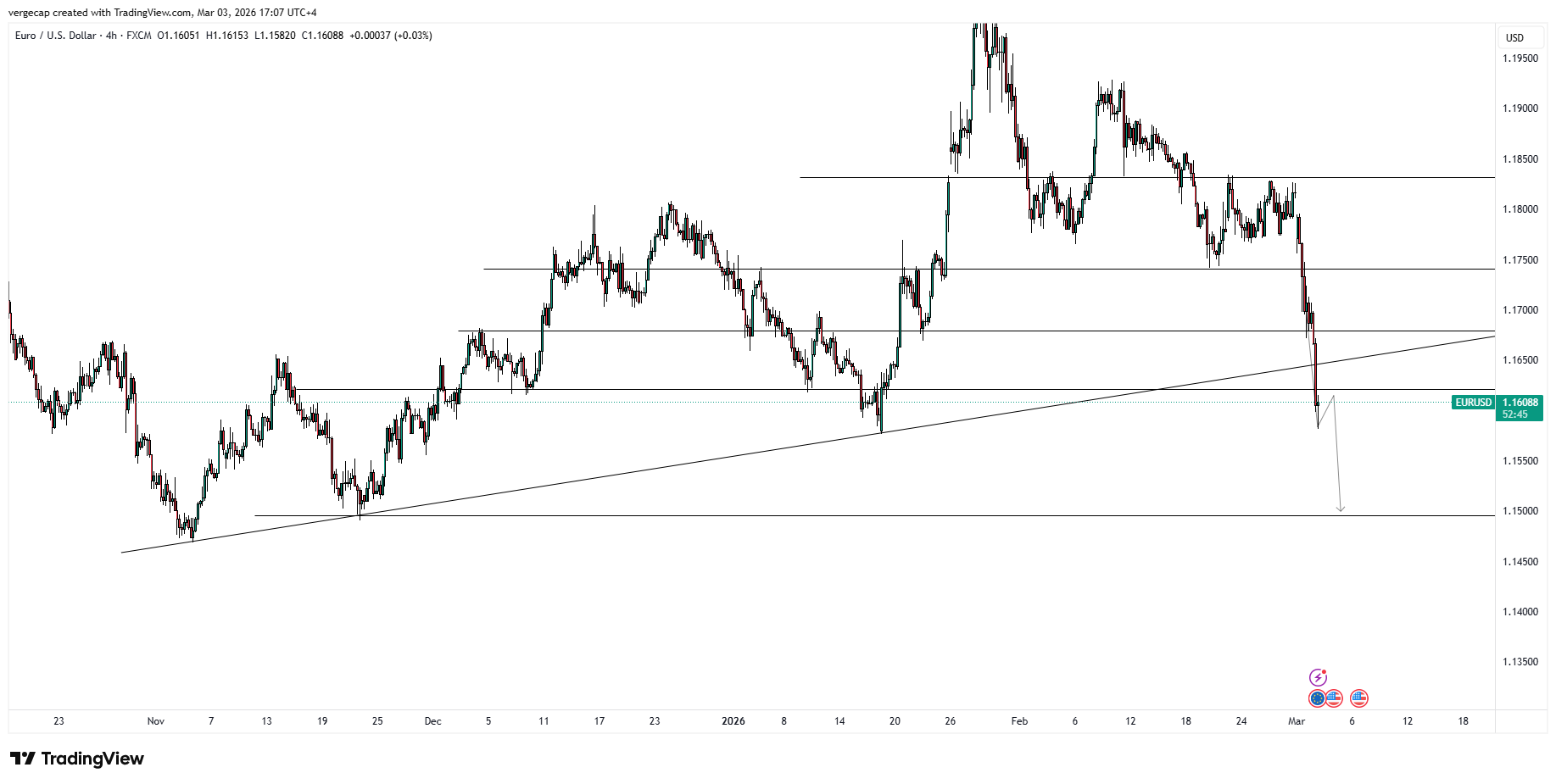
From a technical perspective, EUR/USD remains at a critical inflection point following a decisive breakdown from its broader bullish structure. On the 4-hour chart, price had been respecting a well-defined ascending trendline extending from the November lows, reinforcing a medium-term uptrend. However, the recent impulsive selloff has resulted in a clear break beneath this ascending trendline, signaling a material shift in market structure from bullish to bearish.
The pair is currently trading near 1.1608 after slicing through multiple horizontal support levels around 1.1750 and 1.1680, both of which previously acted as strong demand zones. This breakdown confirms increasing downside pressure and suggests that prior support levels are now likely to function as resistance on any rebound attempts.
Structurally, the market has transitioned into a sequence of lower highs and lower lows on the 4-hour timeframe, reinforcing the bearish bias. The sharp impulsive candle into the 1.1600 region reflects strong momentum selling rather than gradual distribution, increasing the probability of continued downside follow-through after minor corrective pullbacks.
Immediate support now sits near the 1.1500 psychological level, which aligns with a previous major horizontal demand zone visible on the chart. A sustained move below 1.1500 would confirm a broader bearish continuation pattern and could accelerate declines toward the 1.1400–1.1450 region. Such a move would represent a deeper structural correction rather than a simple pullback within an uptrend.
On the upside, bulls would need to reclaim the broken ascending trendline and establish acceptance back above 1.1680 to neutralize immediate downside pressure. A sustained move above 1.1750 would be required to meaningfully challenge the broader bearish shift and reopen the path toward the 1.1850–1.1900 resistance zone. Until then, rallies are likely to be viewed as selling opportunities within a developing downtrend.
Momentum characteristics, based purely on price behavior, indicate acceleration rather than exhaustion. The magnitude and speed of the recent decline suggest strong participation from sellers. However, given the steepness of the drop, a short-term corrective bounce toward the 1.1650–1.1680 region remains plausible before the next directional move unfolds.
Overall, the technical landscape favors downside continuation while price remains below 1.1680 and beneath the broken trendline.
TRADE RECOMMENDATION
SELL EUR/USD
ENTRY PRICE: 1.1600
STOP LOSS: 1.1755
TAKE PROFIT: 1.1500


