The Indian Rupee continued its precipitous decline on Wednesday, sliding to an unprecedented low against the US Dollar and marking its fifth consecutive session of losses. The USD/INR pair pierced the 92.67 level during Asian trading hours, a fresh all-time high that has put traders and policymakers on high alert. The currency’s relentless slide is intensifying focus on the Reserve Bank of India, with market participants widely anticipating that the central bank will step in to sell dollars from its reserves in a bid to prevent a steeper, more disorderly collapse.
The pressure on the Rupee is multifaceted, but the most immediate catalyst is the surge in global crude oil prices, fueled by escalating hostilities in the Middle East. As a nation that imports more than 80% of its crude oil requirements, India is exceptionally vulnerable to price spikes in the energy market. Each dollar increase in the price of a barrel of oil widens India’s import bill and trade deficit, forcing domestic entities to purchase more US Dollars to pay for the same volume of crude. This intrinsic demand for the Greenback naturally weighs heavily on the local currency.
Compounding the Rupee’s troubles is a pronounced shift in global investor sentiment. The intensifying geopolitical conflict has triggered a wave of risk aversion, prompting foreign institutional investors to pull capital from emerging markets. India’s equity markets have felt the pinch acutely, with overseas investors offloading more than $350 million worth of Indian stocks in a single session on Monday. This sustained foreign fund outflow erodes the capital account surplus and reduces the supply of dollars in the domestic system, adding further downward momentum on the Rupee. The uncertainty surrounding the duration and outcome of the Middle East conflict is likely to keep foreign flows volatile in the near term.
On the external front, the US Dollar is regaining its footing as a formidable force. The US Dollar Index (DXY), a key measure of the currency’s strength against a basket of six major peers, climbed for the third straight day, hovering near the 99.10 mark. This resurgence is largely attributed to shifting expectations regarding US monetary policy. Resilient economic data and, more critically, rising inflation fears—partly stoked by the same geopolitical tensions driving oil prices higher—have led markets to aggressively pare back bets on imminent interest rate cuts from the Federal Reserve.
Traders now largely believe the Fed will hold rates steady through the summer, a stark contrast to earlier hopes for a spring easing. The yield on the benchmark US 10-year Treasury note, which moves inversely to price, has climbed for two consecutive sessions and currently sits around 4.06%, reflecting this recalibration. Higher US yields make dollar-denominated assets more attractive, siphoning capital away from riskier currencies like the Rupee. All eyes are now on the upcoming US ISM Services Purchasing Managers’ Index (PMI) data due later in the North American session, which could provide further clues on the health of the world's largest economy and the future path of Fed policy.
The geopolitical landscape remains fraught with risk, directly impacting energy markets and, by extension, the Rupee. In a significant development, US President Donald Trump announced that the US Navy would provide insurance support to commercial vessels in the Gulf, following reports that Iran had effectively disrupted traffic and fired on ships in the strategic Strait of Hormuz. The strait is a critical chokepoint through which a substantial portion of the world's seaborne oil passes. Trump’s warning that US forces would escort ships if necessary underscores the heightened risk of a broader military confrontation in the region.
Adding to the volatility, reports have emerged that Israel conducted a strike on a building in Iran where clerics were gathering to select a new Supreme Leader. While unconfirmed, such an escalation would represent a dramatic turning point in the conflict. President Trump cautioned that this level of aggression could pave the way for an equally hardline leadership in Tehran, ensuring that uncertainty—the primary enemy of market stability—will remain the dominant theme for the foreseeable future. For the Indian Rupee, this translates into a "perfect storm" of headwinds: a strong Dollar, expensive oil, and fleeing foreign capital, with the RBI’s intervention likely being the only bulwark against an even steeper fall.
Technical Analysis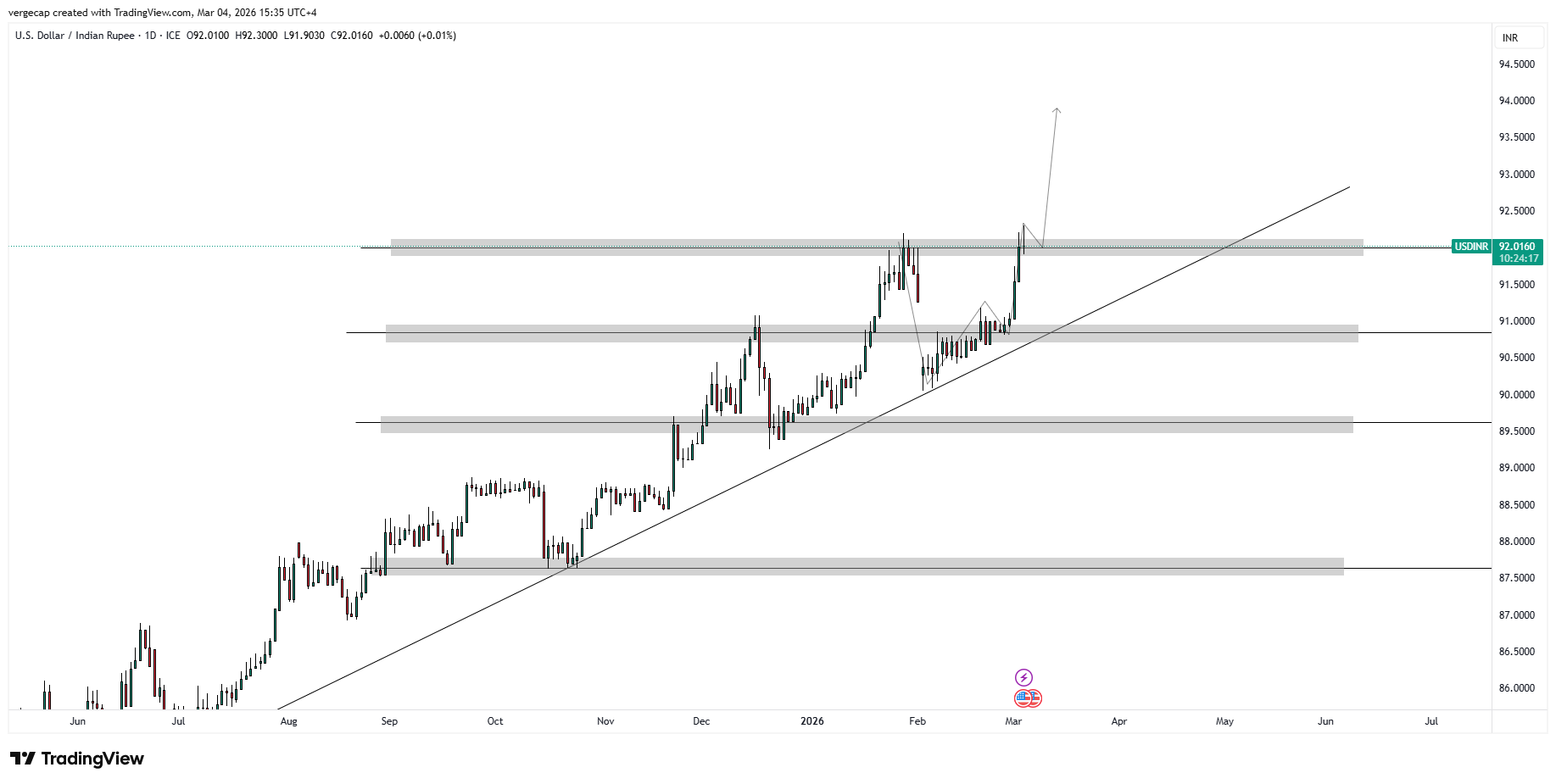
From a technical perspective, USD/INR remains entrenched in a well-defined bullish structure on the daily timeframe. Price action continues to respect a rising trendline that has guided the broader advance since mid-2025, with higher highs and higher lows clearly visible. The recent impulsive breakout above the 91.00 handle confirms continuation of this structural uptrend and signals sustained bullish momentum.
Currently, price is testing a key horizontal resistance zone around 92.00–92.20, which has previously acted as supply. This area represents the upper boundary of the most recent consolidation range and is now being challenged decisively. A successful daily close above this zone would confirm a bullish breakout and likely trigger continuation toward the 93.00 level initially, followed by the 94.00–94.50 region, which aligns with projected extension targets visible on the chart.
On the downside, immediate support is now seen near 91.00, which marks the prior resistance zone and breakout base. This level also sits close to the rising trendline support, reinforcing its technical importance. A sustained move back below 91.00 would weaken near-term momentum and open the door toward deeper retracement levels at 89.50–90.00, where prior consolidation occurred. A breakdown below 89.50 would represent a structural shift and signal a broader corrective phase rather than a routine pullback within the uptrend.
The strong impulsive candle breaking through resistance suggests bullish participation remains firm. However, the presence of minor upper wicks near the 92.20 area indicates some supply pressure at resistance, meaning follow-through confirmation is still required. As long as price remains above the ascending trendline and holds above 91.00, the path of least resistance remains to the upside.
Overall, the technical structure favors continuation higher, with consolidation above 91.00 likely serving as a base for the next leg up.
TRADE RECOMMENDATION
BUY USD/INR
ENTRY PRICE: 92.10
STOP LOSS: 90.90
TAKE PROFIT: 94.00


