The Euro posted modest gains against the US Dollar on Monday, though the single currency’s upside remained constrained as investors balanced encouraging Eurozone factory data against a resilient Greenback and a cautious global risk backdrop. At the time of writing, EUR/USD hovered near 1.1867, reflecting a market caught between improving European fundamentals and shifting expectations around US monetary leadership.
Despite upbeat economic signals from the Eurozone, the Dollar held firm, underpinned by political and policy developments in Washington. Market sentiment toward the Greenback strengthened after US President Donald Trump confirmed late last week that Kevin Warsh will succeed Jerome Powell as Federal Reserve Chair when Powell’s term concludes in May. The announcement reduced a layer of uncertainty surrounding the future direction of US monetary policy and offered investors clearer guidance on the Fed’s likely trajectory.
Warsh, a former Fed governor, is widely viewed as supportive of a leaner Federal Reserve balance sheet and has in recent months expressed openness to lower borrowing costs, particularly if inflation pressures continue to moderate. However, his reputation as a policymaker who takes financial stability and inflation risks seriously has tempered expectations of aggressive or rapid easing. For currency markets, that nuance is important: while Warsh’s appointment may ultimately lean dovish compared with Powell’s later tenure, it does not signal an abrupt pivot toward ultra-loose policy.
As a result, the Dollar has managed to maintain underlying strength, especially in an environment where risk appetite remains fragile. Broader market sentiment has been cautious at the start of the week, with investors wary of geopolitical uncertainties and a heavy schedule of major economic releases. In such an environment, the Dollar’s traditional role as a defensive asset has reasserted itself, limiting the Euro’s ability to capitalize fully on positive domestic data.
On the European side, the latest final HCOB Manufacturing PMI readings offered a modest but welcome sign that the region’s industrial downturn may be stabilizing. The Eurozone Manufacturing PMI for January was revised up to 49.5, slightly above the preliminary estimate of 49.4 and an improvement from December’s 48.8. While still below the 50 threshold that separates contraction from expansion, the upward revision suggests that the pace of decline in factory activity is easing.
Germany, the bloc’s industrial powerhouse, showed a similar pattern. The country’s Manufacturing PMI was revised to 49.1, above the initial 48.7 estimate and unchanged reading previously reported for December. Although German industry remains under pressure from weak global demand and structural challenges in key sectors, the data hint that the worst of the recent slump could be passing.
For the Euro, these figures provide a degree of fundamental support. A stabilizing manufacturing sector reduces the urgency for aggressive European Central Bank easing and reinforces the narrative that the Eurozone economy, while soft, is not spiraling into a deep recession. However, the single currency’s gains have been muted, reflecting the reality that relative growth and rate expectations still favor the United States in the near term.
Attention now shifts to the US manufacturing PMI readings due later Monday, which could further influence short-term Dollar direction. Strong US data would reinforce the view that the American economy continues to outperform its peers, bolstering the case for a more patient Fed under incoming leadership. Conversely, any signs of cooling could revive speculation that rate cuts may come sooner than currently priced.
Looking ahead, investors are likely to remain cautious as the week unfolds. The calendar features several high-impact events, including the European Central Bank’s monetary policy decision on Thursday and Friday’s US Nonfarm Payrolls report, one of the most closely watched indicators of labor market strength. Together, these releases could reshape expectations for the relative policy paths of the ECB and the Fed — and, by extension, the direction of EUR/USD.
Technical Analysis
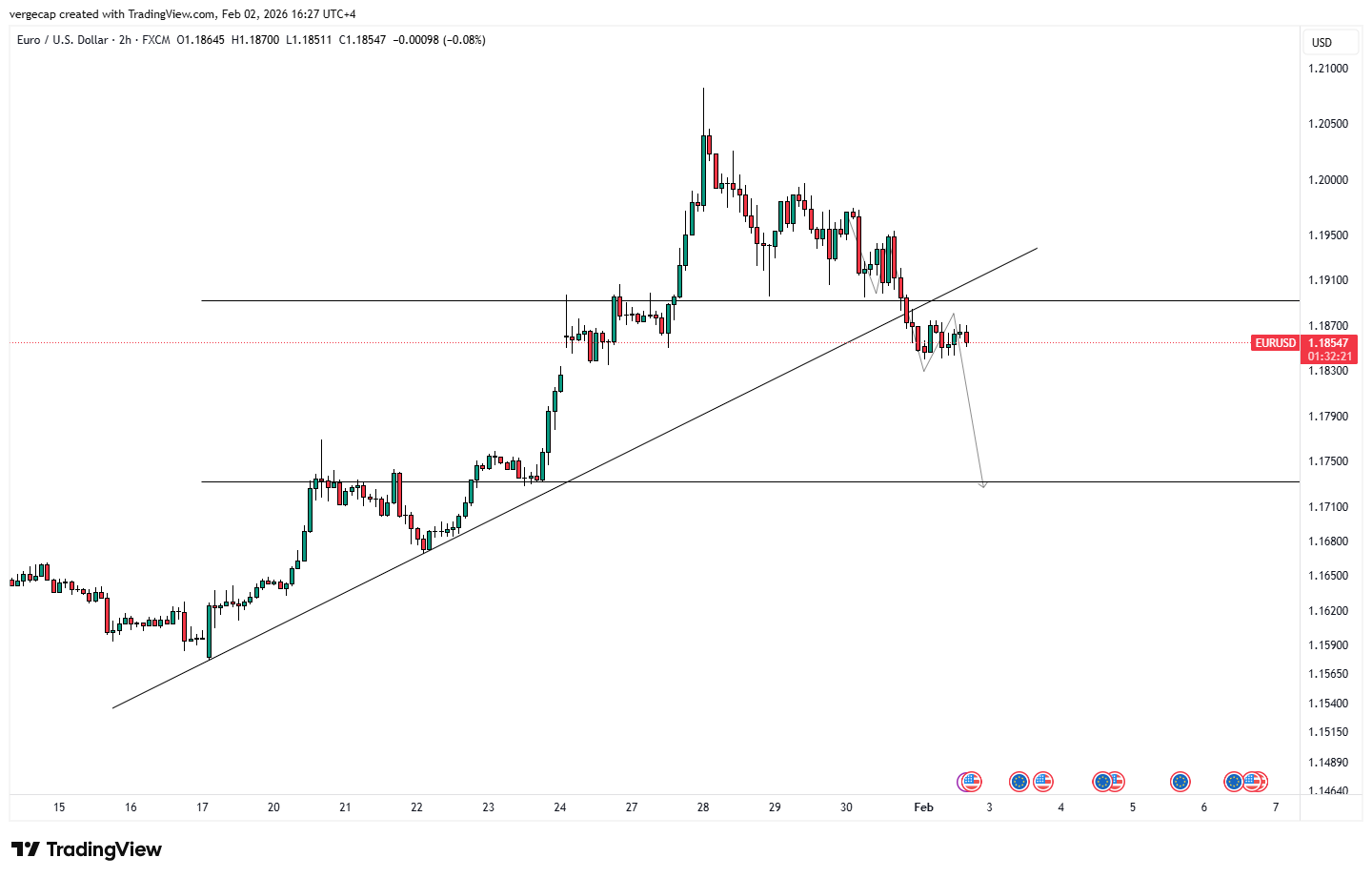
From a technical perspective, EUR/USD is transitioning from a strong bullish impulse into a corrective and consolidation phase on the 2-hour chart. The pair previously respected a well-defined ascending trendline, which guided price action from mid-January through the late-January rally. That bullish structure culminated in a sharp impulsive move higher toward the 1.2050–1.2100 region, where buying momentum clearly stalled and a rejection wick signaled distribution at higher levels.
Following that peak, price action shifted character. EUR/USD rolled over and broke decisively below the rising trendline, confirming a loss of bullish structure rather than a simple pullback. This break was followed by a retest and rejection of the trendline from below, reinforcing the idea that former dynamic support has now flipped into resistance. Since then, price has been consolidating beneath the key horizontal resistance zone around 1.1870–1.1900, which previously acted as support during the rally but is now capping upside attempts.
In the near term, the market is compressing into a tight range around 1.1850, indicating indecision and a pause before the next directional move. This type of sideways consolidation after a trendline break often acts as a continuation pattern in the direction of the break. As long as price remains below the 1.1870–1.1900 resistance band, downside risks remain elevated.
A confirmed breakdown below the current consolidation lows would likely open the door toward the 1.1750 support zone, a structurally important level marked by prior consolidation and demand during the earlier uptrend. A sustained move below 1.1750 would suggest a deeper corrective phase, potentially exposing the 1.1680–1.1700 region, which represents the next notable demand area on the chart.
On the upside, any bullish recovery would first need to reclaim 1.1870 on a sustained basis. A clean break and hold above this level would neutralize immediate bearish pressure and shift focus back toward 1.1950, though only a move back above the former trendline would restore the broader bullish structure.
Overall, market structure favors cautious-to-bearish continuation while below 1.1870, with price action suggesting distribution rather than accumulation. The current consolidation appears corrective, not constructive, unless bulls can decisively reclaim lost structure.
TRADE RECOMMENDATION
SELL EUR/USD
ENTRY PRICE: 1.1850
STOP LOSS: 1.1915
TAKE PROFIT: 1.1750