Recent weakness in precious metals prices may have been more a function of positioning and short-term narrative shifts than a meaningful deterioration in underlying demand, according to market analysts who argue that the latest adjustment has likely overshot the fundamental backdrop.
Gold and its precious metal peers have faced bouts of volatility in recent sessions, pressured by fluctuating interest rate expectations, a firmer US Dollar, and intermittent strength in global equity markets. However, a closer look at investment flows and macro drivers suggests that the core rationale for holding gold remains largely intact, with few signs of a structural shift in investor behavior.
From a thematic standpoint, the pillars that have supported gold over the past several years — geopolitical uncertainty, persistent fiscal expansion, central bank reserve diversification, and long-term inflation hedging — continue to underpin demand. Analysts note that neither official sector buyers nor institutional allocators appear to have meaningfully reduced their exposure in response to the recent pullback. Retail participation, particularly in Asia, also shows little evidence of capitulation.
This resilience in investor intent contrasts with past periods of sustained gold weakness, such as the early 1980s and the 2013 downturn. In the 1980s, gold entered a prolonged bear market amid aggressively rising real interest rates and a decisive shift toward tight monetary policy that restored confidence in fiat currencies. In 2013, the sharp selloff was triggered by expectations of Federal Reserve tapering, accompanied by large-scale ETF outflows that signaled a broad liquidation of speculative and strategic positions.
Today’s environment looks markedly different. While real yields have risen at times, they remain historically moderate, and global debt levels are significantly higher, limiting how far central banks can tighten without risking financial instability. Moreover, gold’s role has evolved beyond a pure inflation hedge into a broader portfolio diversifier and geopolitical risk buffer — functions that remain highly relevant in a fragmented global landscape.
Another key distinction lies in the behavior of official sector buyers. Central banks, particularly in emerging markets, have been steady accumulators of gold reserves in recent years as part of a longer-term diversification strategy away from the US Dollar. There is little indication that this trend has reversed. Such structural demand provides a firmer floor under prices than in previous cycles dominated by speculative flows.
China has also emerged as a critical driver of precious metal demand, both through official channels and private investment. Recent developments in the Shanghai Gold Exchange (SGE) offer an important signal in this regard. The rise in SGE premiums late last week — which reflect the difference between domestic Chinese prices and international benchmarks — points to a pickup in local buying interest. Elevated premiums typically indicate tight physical supply and robust demand from investors and jewelry consumers, reinforcing the view that underlying appetite remains strong.
In my view, the market’s recent reaction appears disproportionate to the catalysts cited. Short-term shifts in rate expectations or currency moves can certainly influence gold prices, but they do not necessarily alter the strategic case for holding precious metals in diversified portfolios. Unless there is a decisive and sustained shift toward sharply higher real yields and a stable geopolitical environment — conditions that currently seem unlikely — the broader backdrop still favors a constructive outlook.
As a result, the recent decline may prove to be more of a corrective phase within a longer-term uptrend rather than the beginning of a prolonged bear market. Investors with a strategic allocation to gold are therefore unlikely to abandon positions, and any further dips could attract renewed buying, particularly from regions where physical demand remains robust.
Techncial Analysis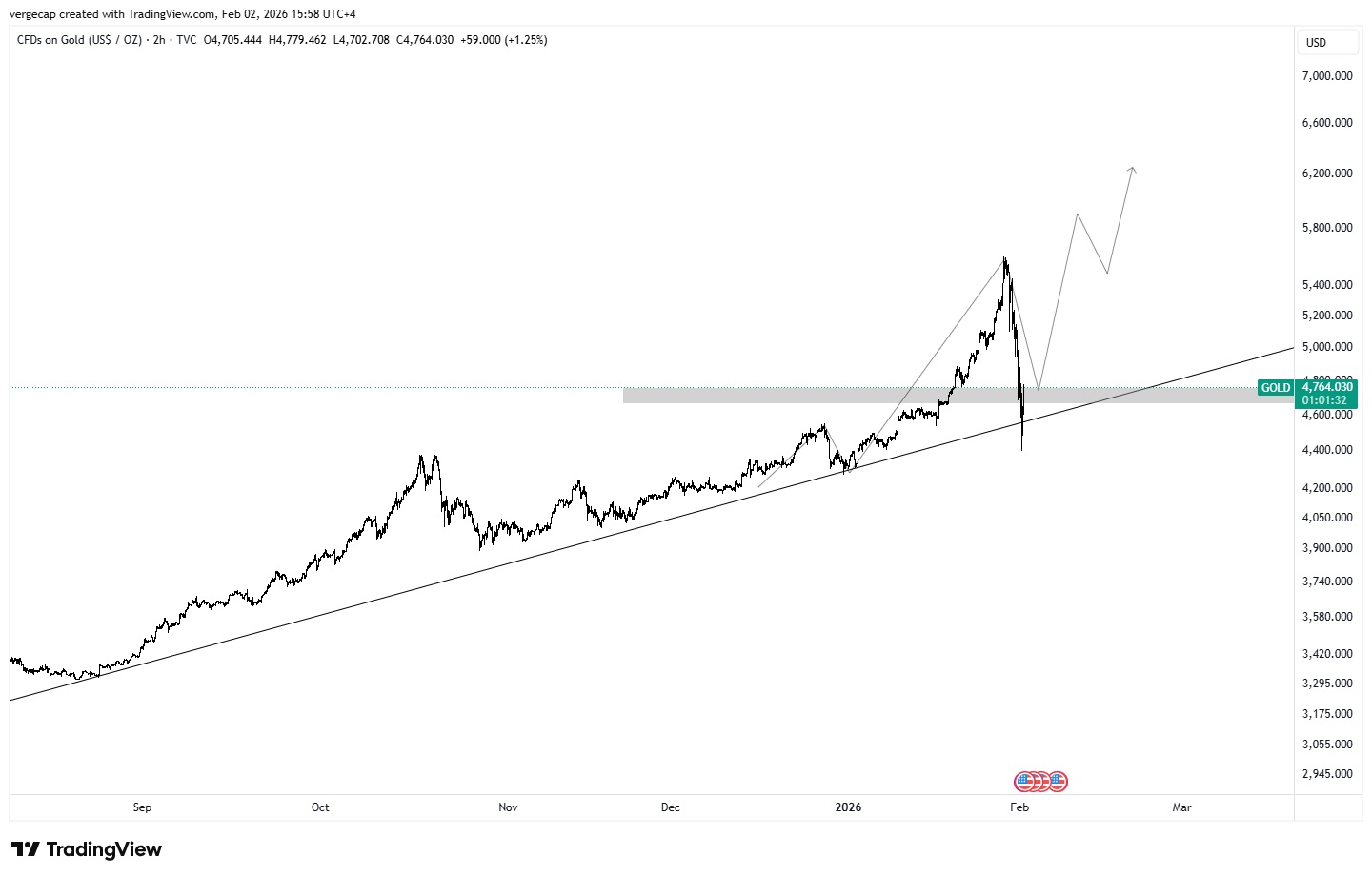
From a technical perspective, gold remains within a dominant long-term bullish structure, but the latest price action shows a sharp volatility event that has temporarily destabilized the short-term trend. On the 2-hour chart, prices had been climbing steadily along a well-defined ascending trendline, consistently printing higher highs and higher lows. That structure culminated in a steep acceleration phase that pushed gold into a near-vertical rally before an abrupt selloff drove prices back toward the rising trendline and a key horizontal support zone around $4,700–$4,750.
This grey demand area now represents a critical battlefield between buyers and sellers. It previously acted as resistance before being broken to the upside, and it is now being retested as potential support. The fact that price has reacted near the intersection of this horizontal zone and the rising trendline strengthens its technical importance. As long as gold holds above this confluence region on a sustained basis, the broader bullish structure remains intact and the recent drop can be viewed as a corrective pullback rather than a full trend reversal.
However, the violent nature of the rejection from the highs signals that near-term momentum has cooled significantly. The steep rally preceding the drop left the market stretched, and the sharp retracement suggests profit-taking and possible positioning adjustments at elevated levels. A decisive break below $4,700 would mark a clear loss of short-term structural support and expose the next downside levels near $4,550, followed by the $4,400–$4,450 region, where prior consolidation and breakout activity occurred.
On the upside, bulls will want to see a sustained move back above $4,900 to regain control of the short-term narrative. A push through that area would open the path toward a retest of the recent spike highs near $5,200. If momentum rebuilds and those highs are cleared, the broader trend extension could target the $5,600–$5,800 zone over time, in line with the prior breakout trajectory shown on the chart.
Momentum conditions now favor consolidation after an overextended move. The sharp pullback has likely helped reset previously overheated readings, reducing the immediate risk of another blow-off top but also implying that price may need time to stabilize before the next directional leg develops.
TRADE RECOMMENDATION
BUY GOLD
ENTRY PRICE: 4,760
STOP LOSS: 4,600
TAKE PROFIT: 5,200


