This is not another diplomatic headline. This is not another cancelled negotiating session or exchanged threat. If confirmed, what has just happened in the Strait of Hormuz represents the moment this conflict crossed a threshold that markets have been pricing as a tail risk for three months — and the price action speaks for itself.
Iranian state news agency Fars has reported that two missiles struck a US warship that ignored Iran's warnings and attempted to transit the Strait of Hormuz. The report — unconfirmed by US authorities at time of writing — has triggered a wave of risk aversion so immediate and so comprehensive that GBP/USD has reversed its entire session, collapsing from initial gains above 1.3600 to session lows below 1.3550 in a matter of minutes. The Pound had nothing to do with this move. This is pure Dollar safe-haven demand — and its scale tells you exactly how seriously the market is treating the Fars report even before official confirmation.
The sequence of events is critical context. President Trump announced Monday morning a plan to free vessels stranded in the Strait of Hormuz, with operations commencing immediately. The announcement carried no operational detail, no acknowledgment of the legal complexity of entering waters Iran considers sovereign, and no indication of prior coordination with Tehran. Iran's response was categorical — any US military incursion would constitute a ceasefire violation and would be met with full-strength retaliation. Not diplomatic language. Military language.
Markets had already been pricing the escalation risk cautiously following that announcement. The Fars missile report has now converted that caution into outright alarm.
Safe-haven Dollar demand is surging across the board. GBP/USD is the Sterling expression of a move that is simultaneously hitting the Euro, the Australian Dollar, the Canadian Dollar, and virtually every other risk-sensitive G10 currency. Oil is rallying sharply — because a Strait of Hormuz that was already closed for three months has now potentially become an active combat zone, a distinction that transforms the supply disruption from a diplomatic instrument into a physical security crisis with no clear resolution timeline regardless of what happens at the negotiating table.
For the Bank of England and every other central bank already wrestling with Hormuz-driven inflation, the prospect of oil surging further from already uncomfortable levels makes the higher-for-longer rate environment that has defined 2026 even more entrenched.
Sterling's week was already complicated before the first missile report crossed the wires. The UK calendar is thin on Monday with no significant domestic data, leaving the Pound entirely exposed to global risk dynamics. The week ahead — US ADP on Wednesday, Nonfarm Payrolls on Friday, and a succession of Fed speakers led by New York Fed President John Williams today — was already set to be Dollar-centric following last week's hawkish FOMC meeting where three members dissented against an easing bias. That hawkish Fed backdrop combined with a geopolitical shock of this magnitude is about as hostile an environment for Sterling as it is possible to construct in a single session.
If the Fars report is confirmed by US sources, GBP/USD below 1.3550 is not the bottom — it is the opening move. The pair would face pressure toward 1.3400–1.3450 as the geopolitical risk premium is materially repriced. Oil would surge toward $115–$120. And NFP week would be entirely dominated by a conflict story with no clear resolution pathway.
If the report proves inaccurate, the snapback would be swift and significant as the panic premium unwinds. That binary outcome — confirmation or retraction — is the only thing that matters in the next hour of trading. Everything else is noise.
The market has made its initial call. GBP/USD below 1.3550 says the market believes what it read.
Technical Analysis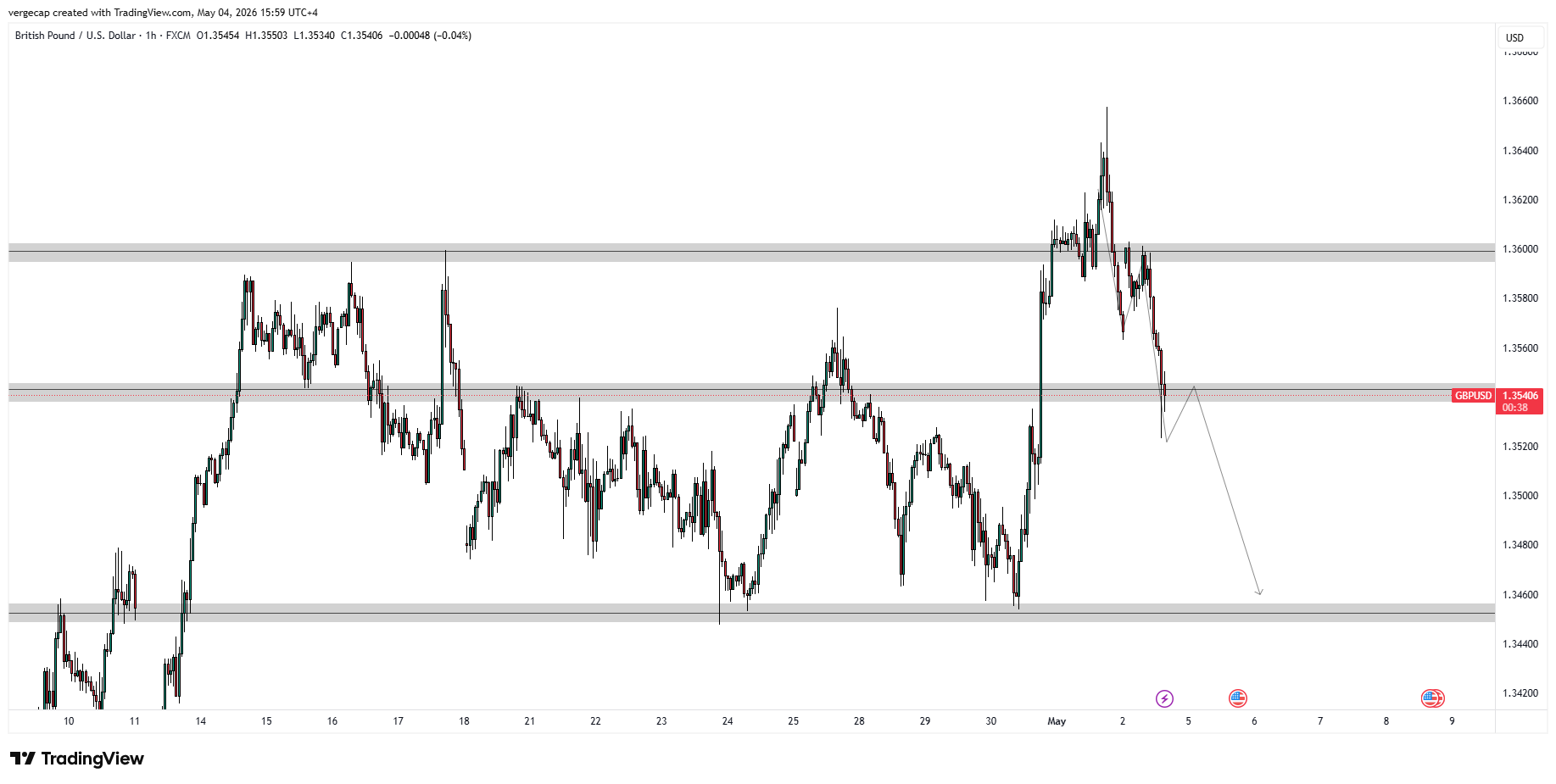
Price action in GBP/USD is beginning to show early signs of exhaustion following a strong impulsive rally, with the pair now transitioning into a corrective phase as sellers regain short-term control. On the 1-hour chart, the sharp bullish leg that pushed prices toward the 1.3640–1.3660 region has been firmly rejected, marking a clear lower high and signaling fading upside momentum.
The rejection from the 1.3600–1.3620 supply zone is particularly significant, as this area has previously acted as a strong resistance ceiling. The failure to sustain gains above this region, followed by a sequence of bearish candles, suggests that buyers are losing conviction and that a deeper pullback may be underway.
In the near term, GBP/USD is testing the 1.3540–1.3550 zone, which is now acting as immediate support. This level is pivotal for short-term direction. A sustained break below it would confirm a shift in structure from bullish to neutral-bearish, opening the door for further downside toward the 1.3500 psychological level. Below that, the next key demand zone comes in around 1.3450–1.3460, which aligns with previous consolidation and could serve as a magnet for price if selling pressure accelerates.
The broader structure suggests a potential lower high formation after the recent peak, which increases the likelihood of a retracement toward deeper support levels. The projected path on the chart also indicates a corrective move unfolding, with interim bounces likely to be capped below the 1.3580–1.3600 region.
On the upside, bulls would need to reclaim the 1.3600 level decisively to invalidate the current bearish bias. A sustained move back above this zone would suggest that the recent pullback is merely a temporary correction within a broader uptrend, potentially reopening the path toward the 1.3650 highs and beyond.
Momentum dynamics further support the case for consolidation-to-downside movement. The sharp rally has been followed by increasingly choppy and overlapping price action, typically indicative of distribution rather than accumulation. This shift in behavior reinforces the view that the market is entering a corrective phase rather than preparing for an immediate continuation higher.
From my perspective, the near-term bias has tilted bearish, particularly as long as price remains capped below the 1.3600 resistance zone. The inability to hold recent highs, combined with emerging lower highs, suggests that sellers are gradually gaining control.
TRADE RECOMMENDATION
SELL GBP/USD
ENTRY PRICE: 1.3540
STOP LOSS: 1.3600
TAKE PROFIT: 1.3460


