The US Dollar is quietly reasserting itself to open the week — and the reason has nothing to do with economic data. The Dollar Index has climbed back above 98.00 after bouncing from Friday's 97.70 lows, driven by a White House announcement that landed over the weekend with the potential to fundamentally reshape the trajectory of the US-Iran conflict.
President Trump announced a plan to free vessels stranded in Iranian waters, with operations commencing Monday. Details were characteristically sparse — no operational specifics, no timeline clarity, no acknowledgment of the military complexity involved. Tehran's response, however, was anything but vague. Iran warned that any US military incursion into its waters constitutes a ceasefire violation and pledged to retaliate with "full strength." Two words that carry the full weight of a government that has already fired on commercial shipping, seized vessels, and closed the Strait of Hormuz for three consecutive months.
What has changed materially on Monday is the nature of the threat environment. For weeks, the dominant dynamic has been diplomatic — proposals submitted, talks cancelled, ceasefires extended and threatened. That pattern, however uncertain, operated within a framework where both sides acknowledged some interest in negotiation. Trump's vessel operation introduces something qualitatively different — US military assets potentially entering contested waters against explicit Iranian opposition and a stated willingness to use force. That is not diplomatic tension. That is operational risk. And markets price operational risk with a speed and severity that diplomatic uncertainty rarely generates.
The Dollar's recovery above 98.00 is the safe-haven expression of that repricing. Risk appetite has deteriorated measurably since the announcement. The Euro and the Yen — both beneficiaries of recent cautious diplomatic optimism — are absorbing selling pressure as the geopolitical calculus darkens.
WTI is trading just below $100 per barrel at time of writing. Trump's vessel announcement has immediately been interpreted by energy markets as reducing rather than increasing the probability of a near-term Hormuz reopening, and prices have responded accordingly. Three months of closure have already demonstrated crude's capacity to trade well above $100 — Brent briefly approached $114 last week — and the reemergence of acute military risk around the waterway gives the energy market fresh justification for pricing in a prolonged supply disruption.
Above $100 oil, the conversation in central bank boardrooms shifts qualitatively — from managing elevated energy costs to managing an energy crisis. That distinction matters for every major central bank currently navigating the impossible dilemma of supply-side inflation they cannot control through interest rate policy.
Beneath Monday's geopolitical noise, the week's most consequential scheduled event is already shaping market positioning. Friday's Nonfarm Payrolls arrive in the context of a Federal Reserve that exited last week's meeting wearing a measurably more hawkish complexion than markets anticipated.
Three FOMC members dissented against including an easing bias in the policy statement. In the context of Fed communication, where dissent is deployed deliberately and sparingly, three dissenters on a single issue represents a significant internal shift. It signals that a meaningful minority of the committee believes hinting at eventual rate cuts — even abstractly — is inappropriate given an inflation environment shaped by three months of $100-plus oil. That dissent moves the scenario of a rate hike from theoretical to discussable, and it provides the Dollar with genuine interest rate differential support that is independent of the geopolitical safe-haven dynamics also lifting the Greenback today.
Friday's payrolls will be observed through this newly hawkish lens. A strong print validates the dissenters' concerns and could push DXY toward 99.00. A weak number reopens the easing debate and likely reverses much of this week's Dollar recovery. The range of plausible outcomes has rarely felt wider or more consequential.
The Greenback's recovery above 98.00 is fundamentally justified by three converging forces — acute Iran escalation risk, oil approaching $100, and a Fed with three hawkish dissenters. Together they create conditions for a more sustained Dollar recovery attempt. Whether that materialises depends on two things: what actually happens in the Strait of Hormuz this week, and what the US labour market tells us on Friday.
Both answers are unknown. Both carry enormous consequences for every Dollar pair.
Technical Analysis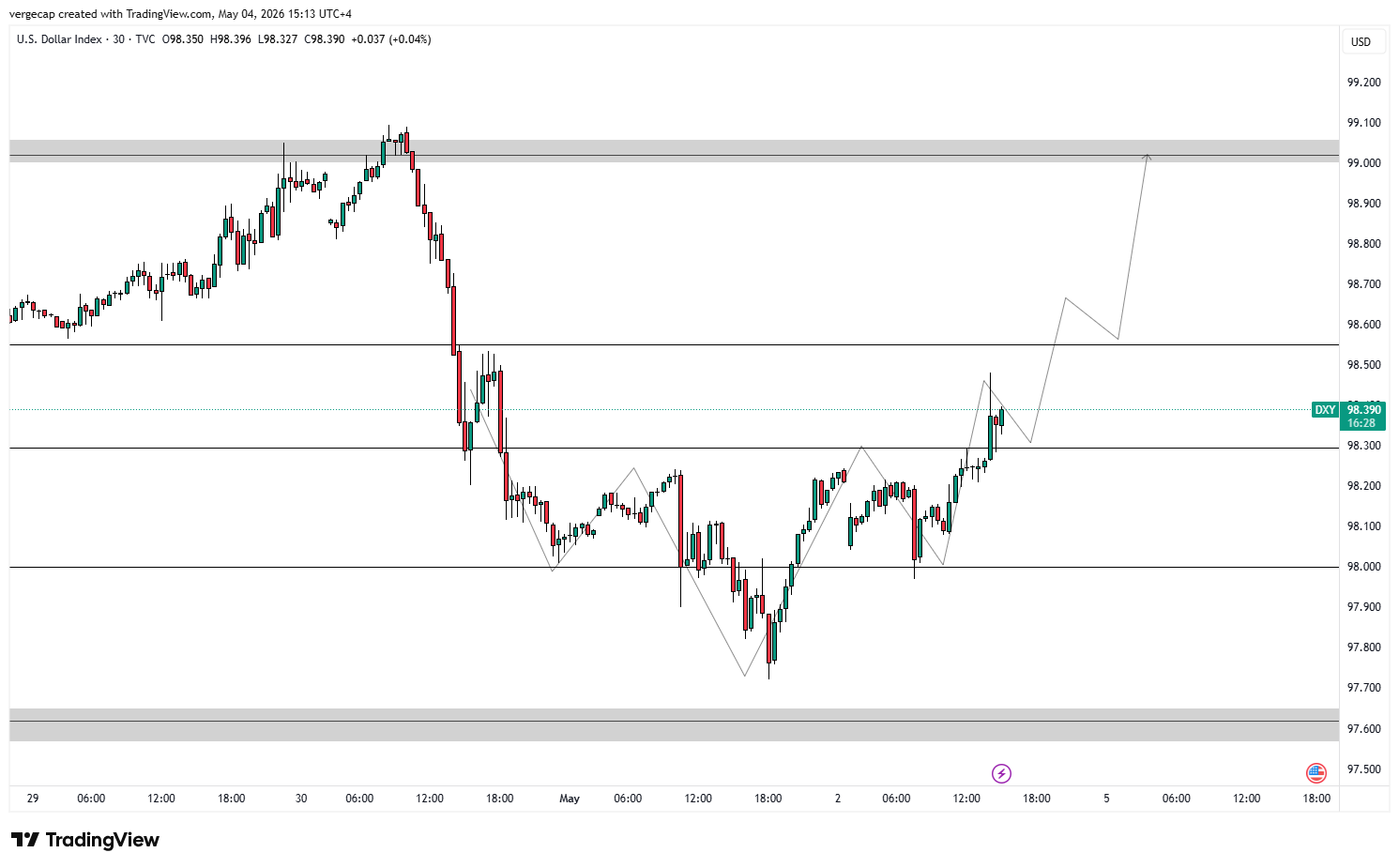
Price action on the U.S. Dollar Index (DXY) suggests the market is attempting to stabilize after a sharp corrective decline, with early signs of a potential recovery structure beginning to emerge. On the 30-minute chart, the index has transitioned from an impulsive bearish leg into a more constructive sequence of higher lows, indicating that selling pressure is gradually fading while buyers begin to reassert control in the near term.
The recent selloff found a firm base around the 97.70–97.60 support zone, an area that previously acted as a demand region. The strong reaction from this level, characterized by a sharp rejection and subsequent higher lows, reinforces its importance as a key structural floor. As long as price action remains above this zone, the broader recovery bias remains intact.
In the near term, the index is consolidating above the 98.20–98.30 region, which has now transitioned into immediate support following multiple tests. This level is acting as a pivot point for short-term direction. Holding above it keeps the current bullish recovery scenario alive, while a sustained break below would suggest that the rebound lacks conviction and could expose the index to another leg lower toward the 98.00 handle and potentially back toward the 97.60 support zone.
To the upside, resistance is clearly defined around the 98.60 level, followed by a more significant supply zone near 99.00–99.10. This upper region aligns with previous breakdown levels and represents a critical barrier for bulls. A decisive break and sustained move above 99.00 would signal a more meaningful shift in market structure, opening the door for a continuation toward higher levels and effectively confirming a short-term trend reversal.
The sequence of price swings also hints at the formation of a developing bullish structure, with the market carving out higher highs and higher lows after the initial bottom. However, momentum remains somewhat tentative, suggesting that this is still a recovery phase rather than a fully established uptrend.
From a momentum perspective, the market appears to be in a rebuilding phase rather than exhibiting strong directional conviction. The sharp selloff has been followed by choppier, corrective price action, which typically precedes either continuation or reversal depending on how price reacts at key resistance levels.
In my view, the broader structure still leans cautiously bullish in the short term, but confirmation is required. The index needs to break and hold above the 99.00 zone to validate a sustained recovery. Failure to do so, especially if accompanied by a break below 98.20, would shift the bias back to the downside and reintroduce the risk of a deeper retracement.
TRADE RECOMMENDATION
BUY DXY
ENTRY PRICE: 98.40
STOP LOSS: 97.80
TAKE PROFIT: 99.00


