The British Pound found itself caught in a tug-of-war on Thursday, edging marginally higher against a resilient US Dollar but softening across the broader basket of major currencies as investors digested a crucial slowdown in UK wage growth just hours before the Bank of England’s latest monetary policy announcement.
As of the European morning session, GBP/USD was trading modestly higher by roughly 0.1%, hovering near the 1.3270 handle. However, the slight gain against the greenback belies the underlying pressure on Sterling, which faces a critical juncture as the central bank navigates a complex landscape of cooling domestic labor data against the backdrop of sticky global inflation drivers.
Data released by the Office for National Statistics (ONS) provided the first major catalyst of the day, revealing that UK wage growth is finally showing tangible signs of moderation. The closely watched measure of Average Earnings excluding bonuses eased to 3.8% year-on-year in the three months ending January. This figure fell short of the 4.0% forecast and marked a significant cooldown from the previous reading of 4.1%. When including bonuses, the metric dropped to 3.9% from 4.2%.
For a Bank of England that has been hyper-focused on domestically generated inflation, particularly wage-driven service sector pressures, this deceleration is welcome news. It alleviates, to some degree, the fear that the economy is trapped in a wage-price spiral. The softer print suggests that the tightness in the labor market, while still present, is beginning to ease. This was further corroborated by the ILO Unemployment Rate, which held steady at 5.2%, defying expectations of a rise to 5.3% and indicating that the economy is absorbing workers without stoking excessive pay demands.
This cooler wage picture sets the stage for a nuanced policy announcement from the BoE at 12:00 GMT. The central bank is universally expected to maintain the status quo, leaving the Bank Rate unchanged at 3.75%. The decision is projected to be carried by a solid 7-2 majority, with the dissenting votes likely coming from those still concerned about underlying price pressures.
Yet, the decision is far from a straightforward "dovish hold." While the domestic jobs data provides cover for the BoE to remain patient, the external environment is turning hostile. The recent spike in crude oil prices, exacerbated by escalating geopolitical tensions in the Middle East, threatens to import inflation just as the UK is getting a handle on its homegrown variety. This supply-side shock poses a dilemma for policymakers: rising energy costs could keep the Consumer Price Index (CPI) elevated for longer, delaying the final descent back to the 2% mandate.
Market participants will therefore be laser-focused on the accompanying policy statement and the tone struck by Governor Andrew Bailey at the press conference. Will the bank emphasize the progress shown by the slowing wage data, signaling a peak in the tightening cycle? Or will it lean hawkishly, highlighting the new risks emanating from the energy markets and reiterating that it is "higher-for-longer" regarding rates? The composition of the vote and any forward guidance on quantitative tightening will be critical in determining whether Sterling can hold its ground or suffers a post-announcement sell-off.
Compounding the Pound’s delicate position is the renewed vigor of the US Dollar. The Greenback is trading broadly firm on Thursday, buoyed by a clear signal from the Federal Reserve that the prospect of near-term interest rate cuts is rapidly fading.
Following the Fed’s decision to hold rates steady in the 3.50%-3.75% range for a second consecutive meeting, Chair Jerome Powell delivered a stark message to markets anticipating an imminent easing cycle. "If inflation progress stalls, rate cuts will not follow," Powell stated emphatically, acknowledging that the disinflationary process has hit a "bumpy" patch. His remarks effectively pushed back against the more dovish market pricing that had been prevalent just weeks ago.
This transatlantic divergence in monetary policy expectations is creating a powerful headwind for the GBP/USD pair. While the BoE is being forced to weigh the risks of an economic slowdown against inflation, the Fed is firmly anchored in a holding pattern, underpinning Dollar demand.
Technical Analysis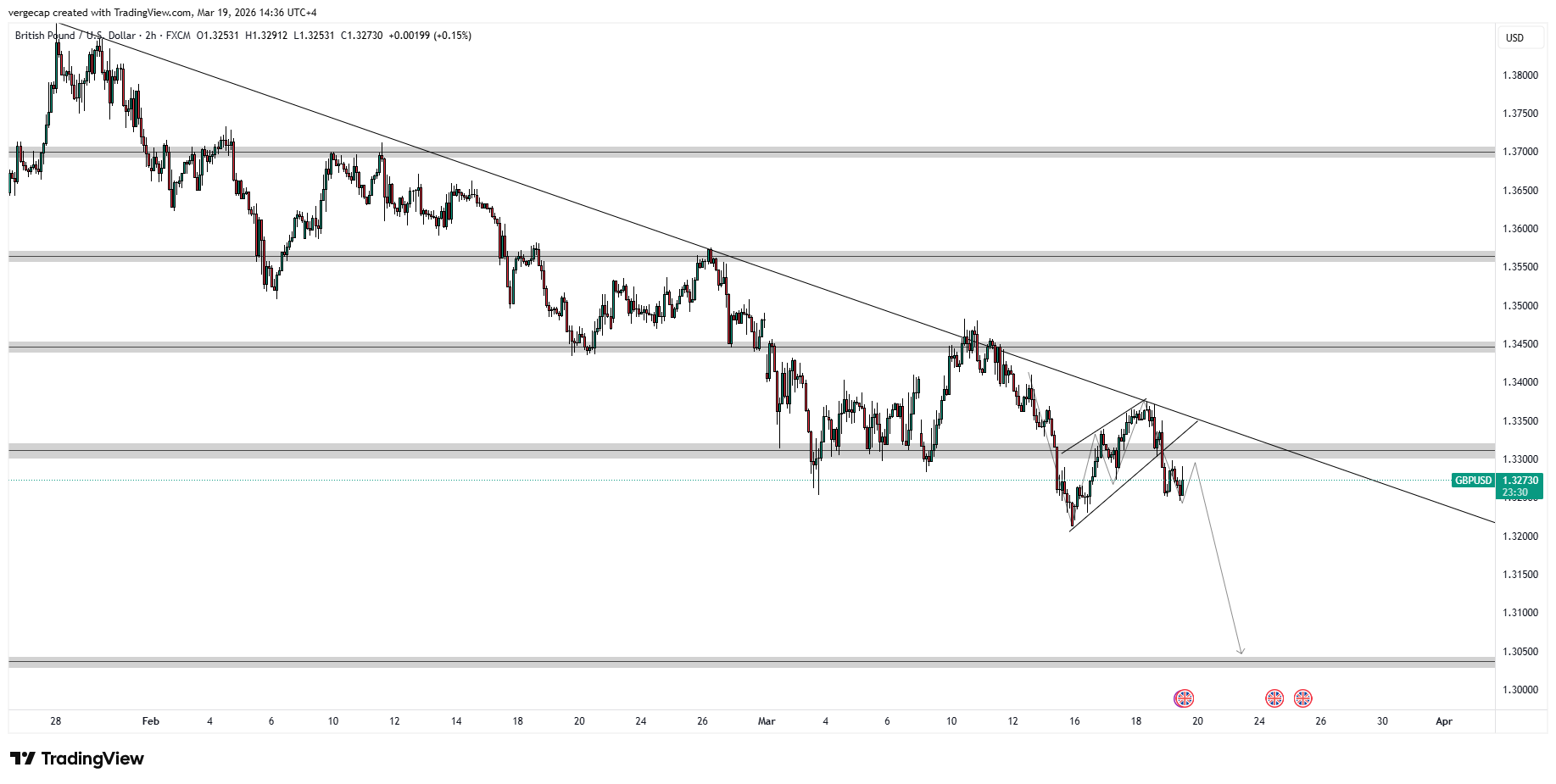
From a technical perspective, GBP/USD remains entrenched in a well-defined bearish structure. On the 2-hour chart, price action continues to respect a descending trendline that has capped rallies since late February, reinforcing the broader downtrend. Recently, price formed a short-term ascending corrective channel (a bear flag), which has now broken to the downside—suggesting continuation rather than reversal.
Price is currently trading below a key horizontal support-turned-resistance zone around 1.3300–1.3330, which aligns closely with the breakdown area of the flag pattern. This level is now acting as a near-term cap, limiting bullish recovery attempts. The repeated rejection from this zone further confirms bearish control in the short term.
A series of lower highs and lower lows remains intact, with the most recent rejection occurring near the confluence of the descending trendline and prior structure resistance around 1.3350–1.3380. This confluence zone represents a critical barrier—any sustained move above it would be required to invalidate the current bearish bias.
On the downside, immediate support is seen near 1.3200, with a more significant demand zone located around 1.3050–1.3000, as highlighted on the chart. A decisive breakdown below 1.3200 would likely accelerate selling pressure and open the path toward this lower demand area. The projected move on the chart suggests a potential extension into this zone, aligning with the prevailing bearish momentum.
Momentum structure supports this outlook. Price behavior indicates weak bullish retracements and impulsive bearish legs, characteristic of a trending market. The lack of strong bullish follow-through after each bounce suggests sellers remain in control, and rallies are being sold into rather than accumulated.
If price were to reclaim and hold above 1.3380, this would signal a potential shift in structure, possibly triggering a deeper corrective move toward 1.3450. However, until that occurs, the path of least resistance remains to the downside.
TRADE RECOMMENDATION
SELL GBP/USD
ENTRY PRICE: 1.3270
STOP LOSS: 1.3385
TAKE PROFIT: 1.3050


