The gold market found itself caught in a vicious tug-of-war on Thursday, ultimately succumbing to the gravitational pull of a surging US Dollar before finding shaky footing on the $4,700 floor. Spot gold (XAU/USD) tumbled to its lowest point since February 6 during early European dealing, underscoring the profound shift in market sentiment following the Federal Reserve’s latest policy salvo.
The catalyst for the initial sell-off was the Fed’s updated "dot plot" and economic projections, which landed like a hammer blow on the non-yielding metal. While the market had been bracing for a cautious outlook, the details revealed a central bank far more concerned about entrenched inflation than a slowing economy. The Fed’s preferred inflation gauge, the PCE, was revised sharply higher for the year, with policymakers explicitly citing the cascading risk of elevated energy prices stemming from the ongoing Iran conflict. This isn't just theoretical; the US Labor Department’s Producer Price Index (PPI) data released Wednesday provided the empirical evidence, surging 0.7% month-on-month in February and accelerating to a blistering 3.4% year-on-year—the fastest pace since February 2025.
This inflationary stickiness forced Chairman Jerome Powell and his colleagues to recalibrate the entire rates trajectory. The "dot plot" now pencils in just one rate reduction for the remainder of this year, with another single cut pushed all the way out to 2027. Growth projections for 2026 were also upgraded, painting a picture of an economy running hot enough to keep the Fed on the back foot. For gold, which offers no interest, this was a nightmare scenario. US Treasury yields surged, and the Dollar Index (DXY) preserved Wednesday’s robust gains, sucking the momentum out of the bullion rally.
Just as it seemed gold was on an express elevator to $4,600, the geopolitical landscape shifted seismically, forcing a recalculation. Reports emerged that Israeli strikes had targeted Iran’s South Pars natural gas field, the world's largest, marking a significant broadening of the conflict’s frontlines. The immediate consequence was a series of attacks on energy infrastructure within Persian Gulf states, rattling nerves in a region that supplies a fifth of the world’s oil.
The rhetoric from Washington intensified the panic. Former President Donald Trump issued a stark warning hinting at a potential large-scale US military response targeting energy infrastructure, a move that would send shockwaves through global supply chains. Compounding the tension, sources indicate the Trump administration is actively exploring a significant expansion of its military campaign against Iran, including the potential deployment of thousands of additional US troops to reinforce operations in West Asia.
This toxic cocktail of escalating military action and threats to the world’s energy lifeline forced traders to pivot. The risk-off sentiment flared, driving capital back toward traditional havens. Gold, which had been bleeding out on dollar strength, saw a fresh bid enter the market as it approached the $4,700 psychological level. This created a floor under the price, preventing a total collapse for the session.
The market is now bracing for the next wave of volatility. Later in the session, traders will parse policy updates from the Swiss National Bank (SNB), the Bank of England (BoE), and the European Central Bank (ECB). While the Fed has set the hawkish tone, any dovish surprises from Europe could further amplify dollar strength, capping gold’s recovery attempts.
On the data front, the US will release its usual Weekly Initial Jobless Claims alongside the Philly Fed Manufacturing Index. A resilient labor market and robust manufacturing data would only reinforce the Fed's higher-for-longer stance, keeping dollar bulls in the driver’s seat.
Technical Analysis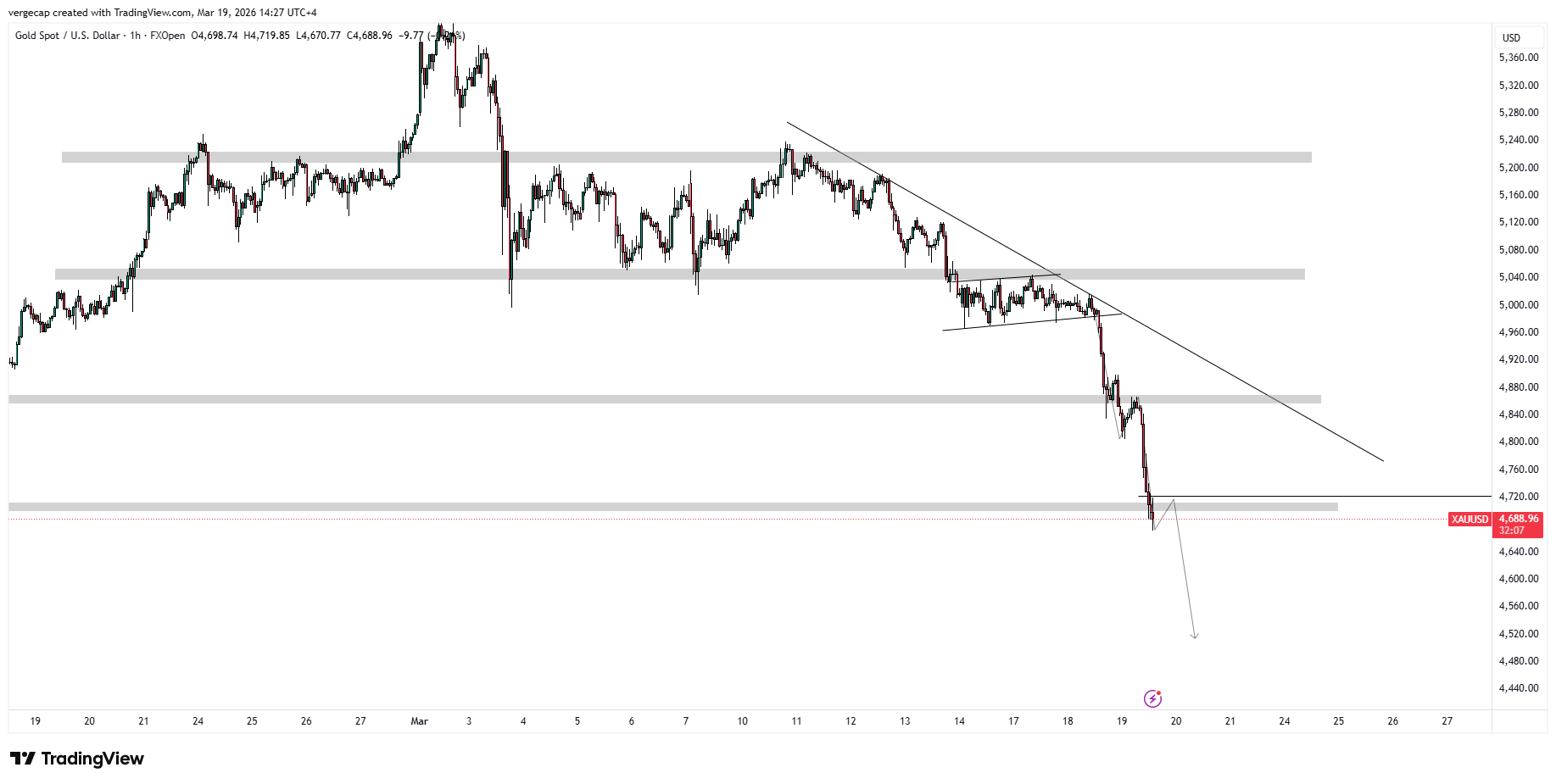
From a technical perspective, gold has transitioned into a firmly bearish structure following a decisive breakdown from a descending continuation pattern. On the 1-hour chart, price action had been compressing within a tightening range beneath a descending trendline, forming a bearish pennant-like structure. The eventual breakdown below this formation triggered an impulsive sell-off, confirming continuation of the broader downtrend and signaling a clear shift in momentum toward sellers.
The sharp decline has driven prices through multiple key support zones, most notably the $5,000–$5,040 region, which previously acted as a consolidation base. This level has now flipped into resistance, reinforcing the bearish bias. Price is currently attempting a minor corrective bounce near the $4,680–$4,720 support zone; however, this appears to be a weak retracement within a strong downward impulse rather than a reversal signal.
The descending trendline from recent highs remains intact and continues to cap upside attempts, suggesting that any short-term rallies are likely to face selling pressure. As long as price remains below the $4,880–$4,920 resistance zone and the broader descending structure, the path of least resistance remains to the downside.
A sustained break below the $4,650 level would confirm continuation of bearish momentum and expose the next downside target around the $4,500–$4,520 region, as indicated by the projected move on the chart. This level aligns with a broader support zone and would represent a logical area for price to seek stabilization after the current sell-off.
On the upside, bulls would need to reclaim the $5,000 psychological level to challenge the bearish outlook. A move above this level, particularly if accompanied by a break of the descending trendline, could shift short-term sentiment and open the door toward $5,200. However, given the strength of the recent breakdown, such a scenario remains unlikely in the near term.
Momentum indicators reinforce the bearish outlook. The Relative Strength Index (RSI) is likely trading near oversold territory but has not yet shown clear divergence, suggesting that selling pressure remains dominant. Meanwhile, the Moving Average Convergence Divergence (MACD) is firmly below the zero line and expanding, indicating strong bearish momentum and supporting expectations for further downside continuation.
TRADE RECOMMENDATION
SELL GOLD
ENTRY PRICE: 4,680
STOP LOSS: 4,920
TAKE PROFIT: 4,520


