It was a session that reminded even the most seasoned traders of the ruthless calculus governing modern financial markets: when real yields speak, even war must listen. Gold (XAU/USD) unraveled spectacularly on Thursday, shedding over 4.5% of its value in a single session—a violent unwind that sliced through technical support levels as if they were mere lines in the sand.
The numbers tell a story of a market caught in a perfect storm. After briefly kissing the $4,867 level, the metal entered a freefall that saw it touch a low of $4,588 by the North American close. This wasn’t merely profit-taking; it was a mass exodus. The catalyst? A synchronized shift in the global monetary policy narrative that rendered the zero-yielding bullion suddenly toxic.
Let’s start with the Federal Reserve. While the central bank’s decision to hold the fed funds rate steady in the 3.50%-3.75% range was widely expected, the details buried in the Summary of Economic Projections (SEP) were anything but dovish. The so-called "dot plot" revealed a policymaking body that is in no hurry to ease. The median projection now anticipates just one rate cut in 2026, with an additional cut not arriving until 2027. Crucially, the Fed’s economic outlook has turned decidedly hawkish: core inflation is now projected to end 2026 at 2.7%, up from 2.5%, while the unemployment rate is expected to hold steady at a remarkably low 4.4%. This is not the backdrop of a central bank preparing to ride to the market’s rescue.
If the Fed’s projections laid the groundwork, the US labor market data served as the executioner. The Department of Labor’s latest report on Initial Jobless Claims for the week ending March 14 delivered a gut punch to any remaining rate-cut optimists. Claims dipped to 205K, defying estimates that called for a rise to 215K. In a labor market this tight, with employers holding onto workers, the notion of the Fed pivoting to ease policy amid sticky inflation becomes a fantasy.
The reaction in the bond market was immediate and brutal. The benchmark US 10-year Treasury note yield rocketed nearly three basis points to 4.289%. For gold, which offers no yield, the opportunity cost of holding it versus a risk-free Treasury bill has now become prohibitive. When yields rise at this velocity, the structural outflows from gold-backed exchange-traded funds (ETFs) tend to accelerate, and Thursday’s price action suggests that process is well underway.
Interestingly, the US Dollar Index (DXY) failed to capitalize on the hawkish Fed narrative, falling 0.7% to 99.52. At first glance, this divergence would typically offer gold a lifeline, but the selling pressure in bullion was so intense that even a weaker dollar couldn’t staunch the bleeding. Instead, the dollar’s weakness appeared to be a function of capital rotating into other safe havens—namely the Japanese Yen (JPY) and Swiss Franc (CHF)—driven by a geopolitical backdrop that remains highly volatile.
In a normal market environment, the escalation of hostilities between the US-Israel alliance and Iran would have gold trading firmly above the $5,000 handle. Yet Thursday proved that macroeconomics is currently the heavyweight champion.
The geopolitical pulse quickened significantly after Iran launched attacks on Qatari gas facilities. The implications for global energy markets are severe. QatarEnergy’s CEO issued a stark warning, revealing that two out of 14 LNG trains and one of two gas-to-liquids facilities were damaged. The potential declaration of force majeure on long-term LNG contracts—with warnings of disruptions lasting up to five years for key clients in Italy, Belgium, Korea, and China—sent shockwaves through energy markets and reignited fears of a global inflation spike.
This energy shock is precisely why central banks are digging in their heels. Earlier in the week, the Bank of England (BoE) and the European Central Bank (ECB) joined the Bank of Japan (BoJ) and the Fed in maintaining a hawkish hold. Sources cited by Bloomberg indicate the ECB is even eyeing a potential rate hike, not a cut. The message from policymakers across the developed world is unified: we will not ease into an energy-driven inflation shock.
Perhaps the most telling data point of the day came not from a government agency but from Prime Market Terminal. Despite the Fed’s SEP showing a single cut in 2026, the money markets are now trading a different reality altogether. Traders have fully priced out any hope of a rate cut in 2026, with the first easing cycle now not expected until the first half of 2027.
This is a profound shift. For the better part of the last year, markets were pricing in a soft landing followed by swift rate cuts. That narrative is officially dead. The new regime is one of "higher for longer" morphing into "higher indefinitely."
Technical Analysis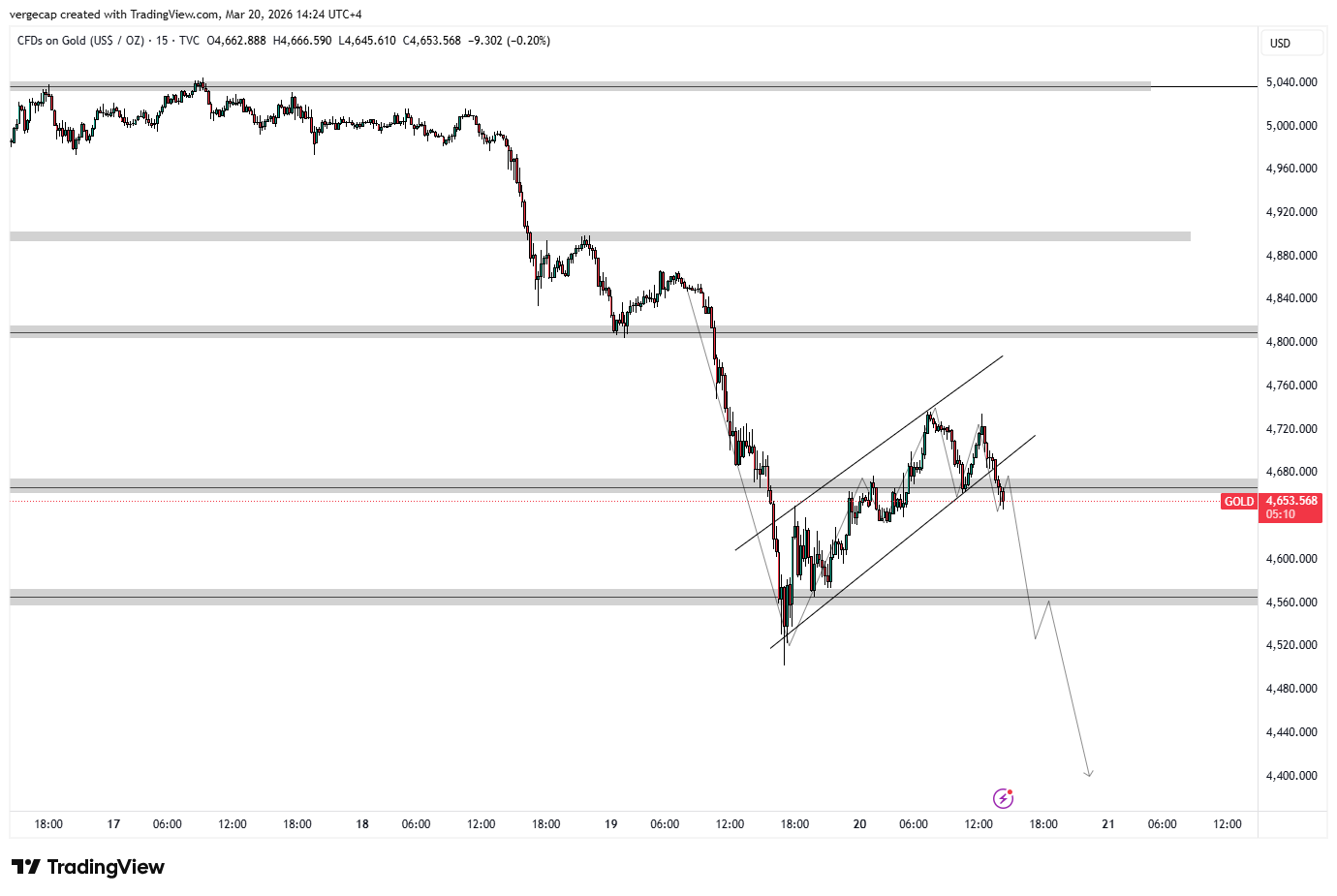
From a technical perspective, gold (XAU/USD) remains under pressure within a broader bearish structure. On the 15-minute chart, price action shows a sharp impulsive decline followed by a corrective phase that has developed into a rising (ascending) channel, typically a bearish continuation pattern. Price is currently breaking down from this channel, signaling a potential resumption of the dominant downtrend.
The recent pullback into the 4,700–4,730 region was rejected, forming a lower high within the channel and aligning with a previously established supply zone. This reinforces the bearish bias, as sellers continue to defend key resistance levels. The structure of lower highs and lower lows remains intact, confirming that downside momentum has not been invalidated.
A critical near-term level lies around 4,650–4,680, which price is currently testing. A sustained break below this support zone would confirm bearish continuation and likely accelerate downside momentum. In such a scenario, immediate targets would extend toward the 4,550–4,560 support region, which previously acted as a reaction base. A decisive break below this level would expose the 4,400 psychological region, signaling a deeper continuation of the bearish trend.
On the upside, any recovery attempts are likely to face resistance at 4,700, followed by stronger supply near 4,800, where prior consolidation and breakdown originated. A sustained move above 4,800 would be required to invalidate the bearish structure and shift the bias back toward neutral or bullish conditions. Until then, rallies are likely to be viewed as selling opportunities.
Momentum-wise, the price action reflects corrective exhaustion rather than trend reversal. The failure to sustain higher highs within the ascending channel, combined with the breakdown attempt, suggests weakening bullish momentum. This aligns with typical continuation behavior following a strong impulsive sell-off.
TRADE RECOMMENDATION
SELL GOLD
ENTRY PRICE: 4,660
STOP LOSS: 4,740
TAKE PROFIT: 4,450


