The British pound is taking a breather in early trade on Friday, settling at 1.3403 after a sharp rally in the previous session, as markets continue to dissect the Bank of England’s latest policy decision through the lens of a rapidly escalating geopolitical landscape. While the headline decision to hold rates was widely expected, the shifting composition of the Monetary Policy Committee (MPC) and the central bank’s stark acknowledgment of the inflationary threat posed by the Iran conflict have fundamentally altered the calculus for sterling going forward.
For a currency that has spent much of the year grappling with the weight of a slowing domestic economy, the pound’s initial pop higher was a clear signal that traders are now prioritizing inflation over growth—at least for the moment. The BoE’s decision to stand pat was not the story; the story was the unanimity behind it and the ominous guidance that followed.
In a development that caught even some seasoned London traders off guard, the MPC voted 9-0 to keep rates unchanged. This unanimous stance marks a dramatic departure from February’s deeply divided 5-4 vote, suggesting that the hawks who were once clamoring for tightening have now coalesced around a singular view that the next move is far from certain. But this is not a dovish consolidation. Sources familiar with the committee’s discussions indicate that several members explicitly left the door open for future hikes—a rhetorical shift that would have been unthinkable just a month ago.
The catalyst for this hawkish tilt is as clear as it is unsettling: the Iran conflict. The BoE’s accompanying statement made explicit what many in the market had begun to fear. With crude oil prices spiking on fears of a broader regional conflagration, the Bank now estimates that inflation could accelerate to 3.5% in the coming quarters. More critically, the regulator warned of the risk that inflation expectations could become “entrenched” in the economy—a scenario that would force the central bank to sacrifice economic growth to quell price pressures even as the real economy shows signs of fragility.
A Market PivotThe market’s reaction has been swift. Until recently, the consensus in the swaps market was heavily skewed toward rate cuts in the second half of the year. That pricing has been aggressively unwound. Over the past 48 hours, the odds of a rate cut have shriveled as traders price in a higher-for-longer scenario, fueled by the realization that energy-led inflation is back with a vengeance.
However, this is not a straightforward bullish case for sterling. The pound finds itself caught in a familiar tug-of-war. On one hand, the diminished scope for policy easing provides a floor for the currency; on the other, the BoE is being forced to consider tighter policy just as the domestic economic engine sputters.
The latest labor market data underscores this precarious balance. Wage growth, which had been a persistent headache for the BoE, finally showed signs of cooling, slowing to its lowest rate since late 2020. Unemployment held steady at 5.2% , with employment showing tentative signs of stabilization. In a vacuum, these figures—particularly the easing wage pressures—would have justified a softer, more dovish rhetoric. They suggest the labor market is no longer overheating.
But we do not operate in a vacuum. The geopolitical reality has rendered traditional domestic data points almost secondary. Elevated energy prices, driven by supply fears emanating from the Middle East, are now the dominant variable. The BoE’s calculus appears to be that the transmission of these external shocks into core inflation poses a greater immediate threat than the lagged effects of a cooling jobs market.
Technical Analysis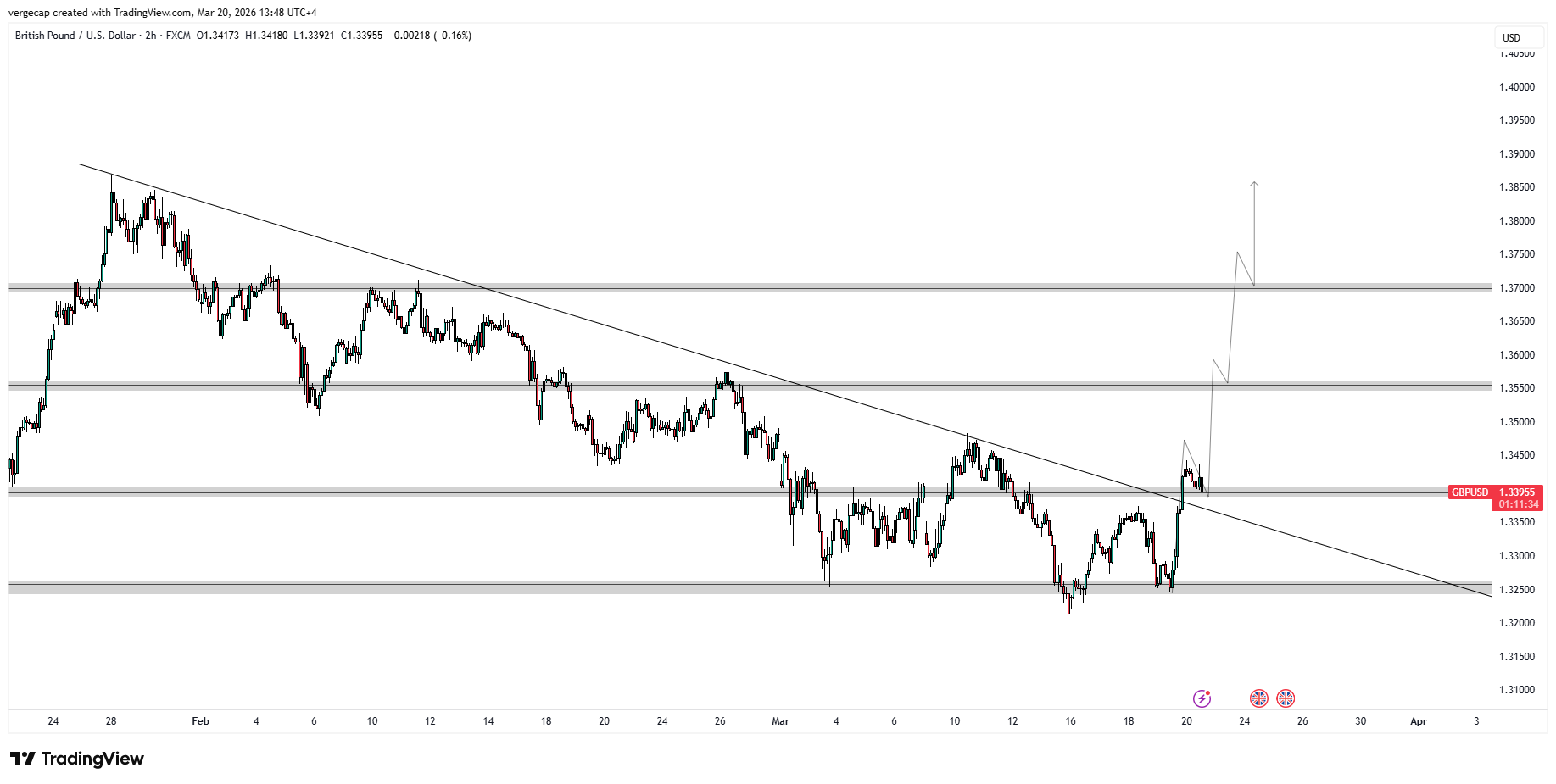
From a technical perspective, GBP/USD appears to be transitioning out of a prolonged bearish structure as price tests a major descending trendline that has capped rallies for several weeks. On the 2-hour chart, the pair has been trading within a clear downtrend characterized by a series of lower highs and lower lows, with the descending trendline acting as dynamic resistance throughout the decline.
Recently, price has staged a strong rebound from the 1.3250–1.3270 support zone, an area that previously acted as a demand region and triggered buying interest. This rebound has pushed GBP/USD back toward the 1.3380–1.3400 pivot level, which aligns closely with the descending trendline resistance. This confluence area represents a critical inflection point for the market.
If buyers manage to produce a decisive breakout above the descending trendline and sustain a move above the 1.3400 level, it would signal a potential shift in market structure from bearish to neutral or even bullish in the near term. Such a breakout would likely encourage momentum-driven buying and expose the next resistance zone near 1.3550, followed by the 1.3700 region, where a major supply area is visible on the chart.
However, failure to break above the trendline could lead to another rejection, keeping the broader bearish structure intact. In that scenario, GBP/USD may rotate lower again toward the 1.3300 level, with further downside risk extending back to the 1.3250 support zone. A sustained break below this region would confirm continuation of the broader downtrend and could open the door toward deeper losses.
From a structural standpoint, the market is currently compressing beneath key resistance while building higher lows in the short term, suggesting that momentum is gradually shifting. This type of setup often precedes a breakout, particularly when price approaches the apex between a trendline and horizontal resistance.
Momentum indicators likely support a stabilization phase. The Relative Strength Index (RSI) is expected to be recovering toward the midline after previously dipping into weaker territory, reflecting improving bullish momentum without yet reaching overbought conditions. Meanwhile, the Moving Average Convergence Divergence (MACD) is likely beginning to turn higher and approach the zero line, indicating a gradual shift in momentum following the recent rebound.
TRADE RECOMMENDATION
BUY GBP/USD
ENTRY PRICE: 1.3420
STOP LOSS: 1.3280
TAKE PROFIT: 1.3700


