Fundamentals
From a monetary policy perspective, expectations for further interest rate cuts by the Bank of England are intensifying significantly. During his Tuesday testimony before the Treasury Committee, Governor Andrew Bailey delivered a distinctly dovish signal, stating that a March rate cut is "a real open question," while also noting that recent data has shown less easing in services price inflation than the Bank had previously anticipated. This rhetoric aligns with the Bank's February meeting minutes, where the Monetary Policy Committee's unexpected 5-4 vote to hold rates steady saw four members vote for a cut, with Bailey himself the pivotal swing vote. The Bank's latest Monetary Policy Report explicitly states that the base rate is "likely to fall further" if inflation pressures continue to recede. Schroders senior economist George Brown observed that the close vote signals the question is not "if" the Bank will cut, but "when," adding that a forthcoming window of temporary disinflationary pressure should provide sufficient cover to justify one or two further base rate cuts. Market expectations for a cut are being priced in rapidly; money market data currently suggests traders assign a roughly 75% probability to a March rate cut. BNP Paribas UK and Europe economist Dani Stoilova expects the next interest rate cut to possibly arrive in March, followed by an extended period of pause from the central bank. She also warns that risks concerning the fiscal trajectory have not dissipated, especially against a backdrop of heightened political uncertainty, and will need to be addressed in future budgets. Politics are also exerting pressure on the pound. In a February 26 by-election in the Greater Manchester region, the Labour Party suffered an unexpected defeat, with a Green Party candidate winning a seat previously held by Labour. This outcome underscores the governance challenges facing Prime Minister Starmer and has fueled market concerns over political stability. ING analysts note that the coming weeks will see a flurry of political hotspots, from the aftermath of this week's by-election to challenging local elections. HSBC's foreign exchange analysis suggests that the yen, Canadian dollar, and New Zealand dollar should remain stable for now, as the US dollar could weaken, while the pound may face greater downward pressure. Option pricing shows that risk reversal indicators have moved further in favor of pound depreciation this month, indicating that the pound's path of least resistance is downward.
Escalating tensions in the Middle East are boosting safe-haven demand and strengthening the US dollar. Markets are awaiting the ISM Manufacturing PMI data scheduled for release later today. A joint US-Israeli military strike against Iran has triggered an unprecedented regional escalation. The office of Israeli Defense Minister Katz stated that Israel launched a "preemptive" strike against Iran. Subsequently, US President Trump announced that US forces had initiated a "large-scale, sustained military operation" against Iran, codenamed "Epic Fury", with the objective of "leveling" Iran's missile industry and ensuring it cannot acquire nuclear weapons. Israeli Prime Minister Netanyahu stated that the ultimate goal of the operation is to overthrow the Iranian regime. According to Israeli media reports, Israeli and American assessments over the past 24 hours concluded it is "no longer possible" to reach an agreement with Iran through negotiations. During the initial strikes, multiple government sites in Iran were attacked, including areas near the office of Supreme Leader Khamenei in central Tehran, as well as the Presidential Palace, and the Ministry of Intelligence and National Security. Iran's Fars News Agency confirmed multiple powerful explosions in central Tehran. The Associated Press reported that the vicinity of Khamenei's office was also struck. Following the attacks, Israel and Iran successively announced the closure of their airspace, with Israel declaring a nationwide state of emergency. In a separate economic development, the US Producer Price Index (PPI) for January rose more than expected, primarily due to businesses passing on higher import tariff costs to consumers, signaling that inflationary pressures may intensify further in the coming months. Data released last Friday by the U.S. Bureau of Labor Statistics showed that the Producer Price Index (PPI) for final demand rose 0.5% month-over-month in January. The December increase was revised downward to 0.4%. Economists surveyed by Reuters had forecast a 0.3% gain. Service prices advanced 0.8% monthly, driving the overall PPI increase. This stemmed from a 2.5% rise in trade services prices, which measures margins for wholesalers and retailers. Within that category, wholesale margins for professional and commercial equipment surged 14.4%, indicating businesses are passing tariff costs to consumers. Additionally, price increases occurred in retail for clothing, footwear, and accessories; wholesale for chemicals and related products; bundled wired telecommunications access services; retail for health, beauty, and optical products; and retail for food and alcohol.
Technical Analysis
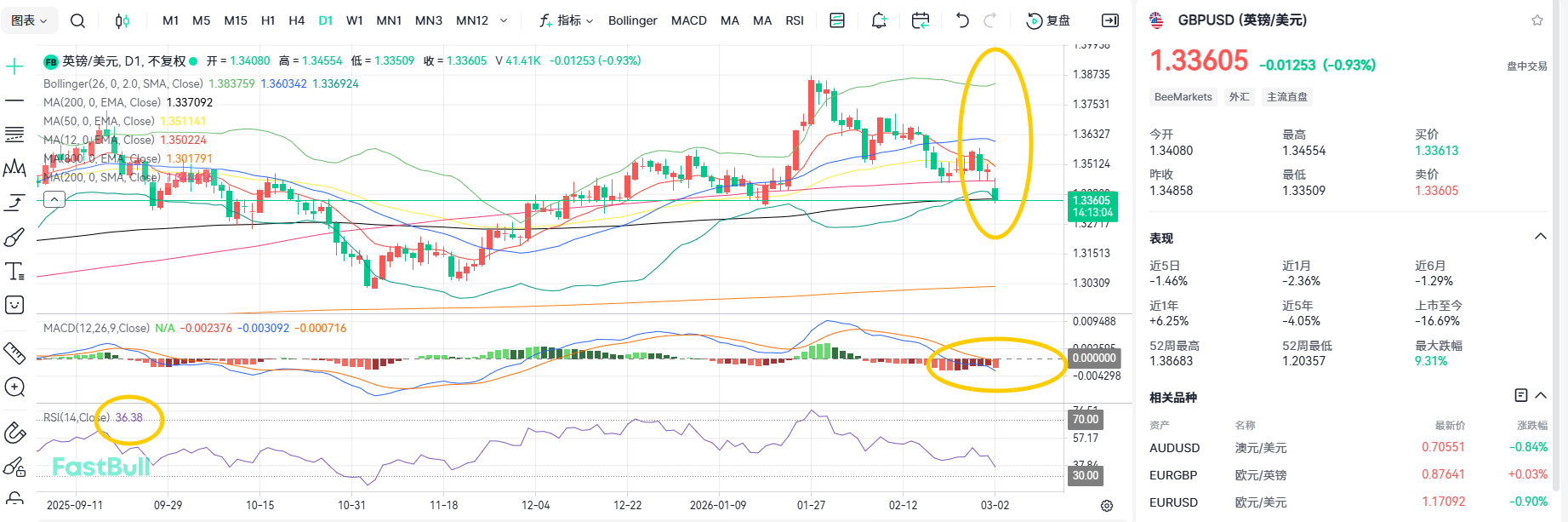
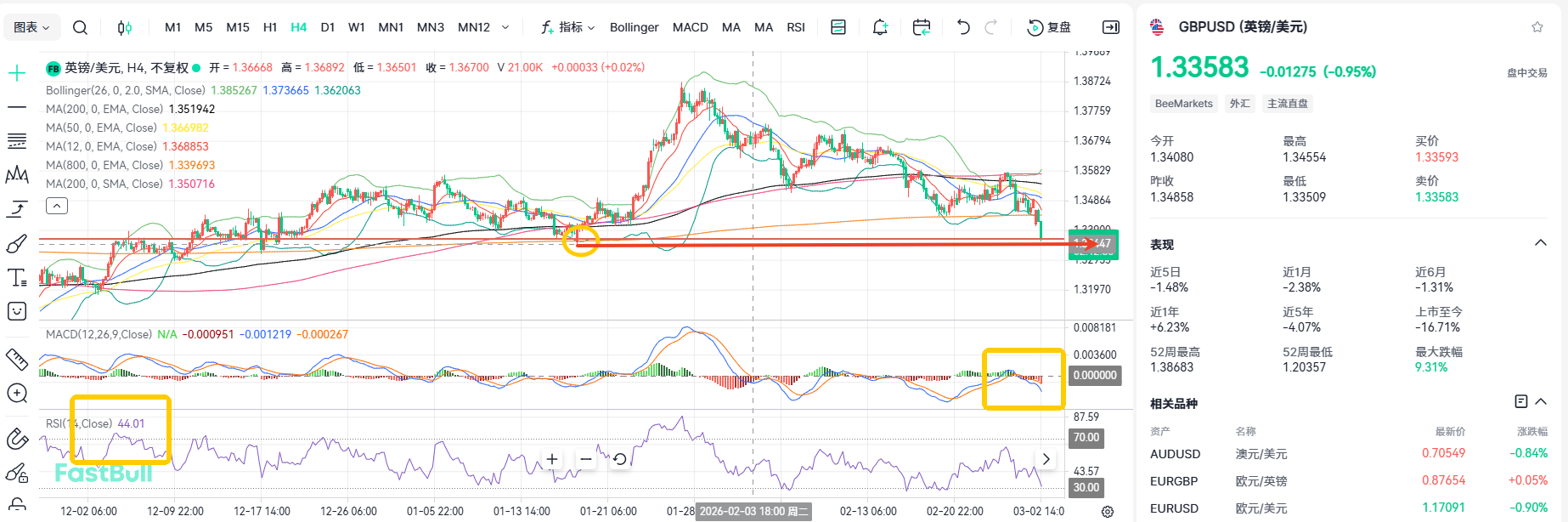
In the 1D timeframe, the GBPUSD has broken below both the lower Bollinger Band and the EMA200, indicating that the short-term downtrend is not yet complete. Potential downside support lies at the key psychological levels and near the EMA800, specifically around 1.33 and 1.30. The Bollinger Bands are beginning to widen and point downwards, with the moving averages also diverging lower, confirming a shift into a bearish structure. Following a MACD death cross, both the MACD line and signal line have now broken below the zero line and have formed a 'death kiss' pattern, reinforcing the bearish trend. The RSI reading of 36 has entered oversold territory, reflecting a dominant selling bias among market participants. In the 4H timeframe, the Bollinger Bands are widening downwards, and the moving averages are fanning out lower. Price action is oscillating downward along the EMA12 and the lower Bollinger Band. The short-term downtrend is likely to continue, with a high probability of testing the key psychological level of 1.33. The MACD's MACD line and signal line have returned below the zero line after the death cross. An RSI reading of 44 signals prevailing market pessimism. Overall, the GBPUSD is approaching short-term support, making a technical rebound highly probable. Therefore, the trading strategy would be to consider a long position first, followed by a short position.
Trading Recommendations
Trading Direction: Buy
Entry Price: 1.334
Target Price: 1.38
Stop Loss: 1.3
Support: 1.32, 1.3, 1.28
Resistance: 1.38, 1.4, 1.41