Fundamentals
A survey released Thursday indicates that confidence within the UK's business and professional services sector improved markedly this quarter, concluding over a year of decline; however, consumer-facing firms remain downbeat. The Confederation of British Industry's (CBI) quarterly services survey shows optimism among business and professional services firms surged from -50 in November to -3 in February, its highest reading since August 2024. In contrast, optimism in consumer services remains deeply negative at -45, edging up only slightly from November's -47. "With little sign of improvement in consumer services, overall momentum is likely to remain weak, weighing on the outlook for investment and jobs," said Charlotte Dendy, Head of Economic Surveys and Data at the CBI. Separate data from the British Retail Consortium (BRC), also released Thursday, showed consumer confidence climbed to its highest level since June 2025, yet the path to economic recovery remains uncertain. "While the renewed confidence is encouraging, it is still fragile. Sluggish growth and rising unemployment continue to exert a heavy drag on the economy," noted Helen Dickinson, Chief Executive of the BRC. The Bank of England earlier this month downgraded its 2026 GDP growth forecast from 1.2% to 0.9%. Chancellor Rachel Reeves is slated to present the latest forecast updates from the Office for Budget Responsibility on Tuesday. Current unemployment stands near a ten-year high, and wage growth has cooled from the rapid pace of recent years. Nevertheless, PMI data suggests a pickup in business activity since the start of the year, and inflation is projected to fall back to target in April, offering some relief from cost-of-living pressures. Reeves's previous budget statement dealt a heavy blow to business confidence, particularly following her announcement of a significant rise in the jobs tax in October 2024. Although Reeves has indicated no plans for new tax reforms in Tuesday's announcement, the CBI reports that businesses remain concerned about new employment legislation potentially making it harder to dismiss staff and guaranteeing hours for some part-time workers.
Recent U.S. labor market data reinforced a resilient picture, with inflation remaining above the policy target, further cementing market expectations that the Federal Reserve will hold off on rate cuts before May. The U.S. Dollar Index extended its rebound pattern observed since late January, putting broad pressure on non-U.S. currencies over the near term. Data showed that seasonally adjusted initial jobless claims for the week ending February 21 rose by 4,000 to 212,000, coming in below economists' consensus forecast of 215,000. Although the figures were likely impacted by the Presidents' Day holiday, the total remained below year-ago levels, signaling no material loosening in labor market conditions. Concurrently, continuing claims for the week ending February 14 fell by 31,000 to 1.833 million. As this period corresponds with the February unemployment rate survey window, the Chicago Fed's model projects the jobless rate to hold steady at 4.28%, rounding to 4.3%—essentially unchanged from January—which further corroborates labor market robustness. Carl Weinberg, Chief Economist at High Frequency Economics, noted that the current U.S. labor market is characterized by low hiring and low firing, with no sign of the typical layoff surge seen at the onset of a recession, indicating overall structural stability. Nancy Vanden Houten, Lead U.S. Economist at Oxford Economics, highlighted that subdued hiring rates remain the primary underlying concern; however, sustained declines in continuing claims suggest firms are not expanding layoffs, pointing to a labor market gradually working through prior uncertainties. While the U.S. Supreme Court previously struck down tariff measures enacted under emergency statutes, the subsequent implementation of a baseline 10% global tariff with select goods at 15% has nonetheless introduced near-term operational headwinds for corporations. Analysts broadly assess that the macroeconomic impact of these trade policy adjustments remains contained. Beyond trade policy, the rapid proliferation of artificial intelligence technology has emerged as a significant factor driving workforce reductions within the tech sector and a broader contraction in labor demand. This has intensified consumer concerns regarding job security. The Conference Board's February survey indicates the proportion of respondents perceiving jobs as "hard to get" rose to a five-year high, while the median duration of unemployment approaches a four-year peak. Employment pressure is particularly acute for recent graduates; this cohort faces amplified challenges as their exclusion from eligibility criteria for relief programs renders a portion of this labor market stress unquantified in official data.
Technical Analysis
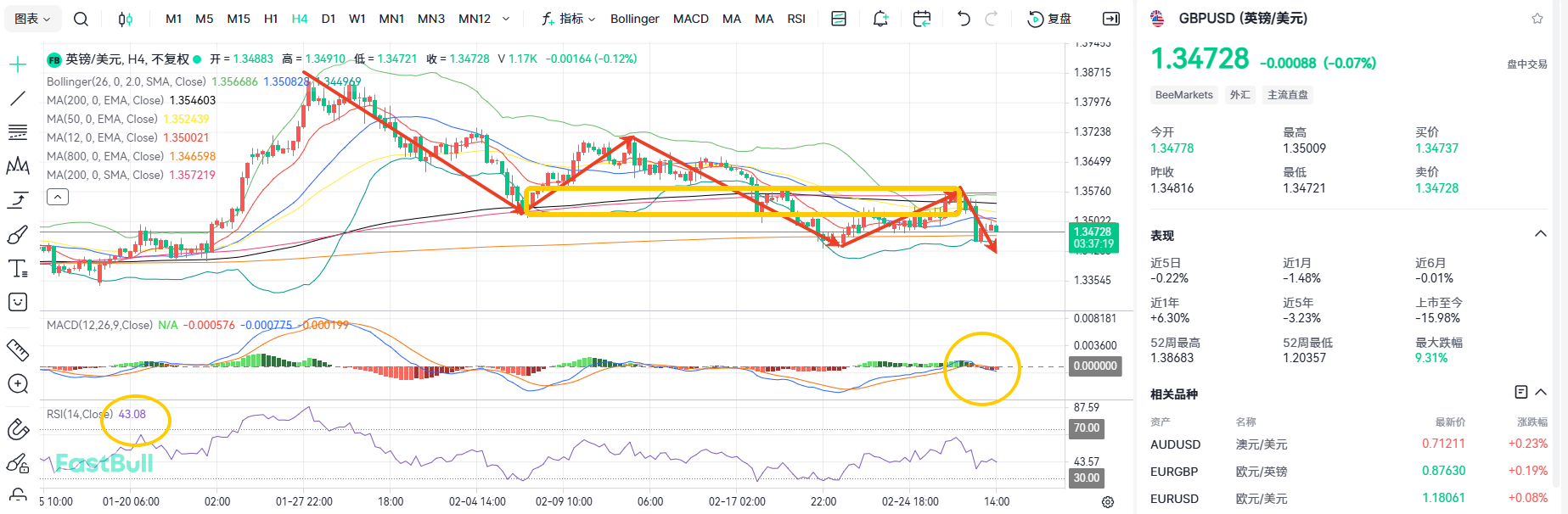
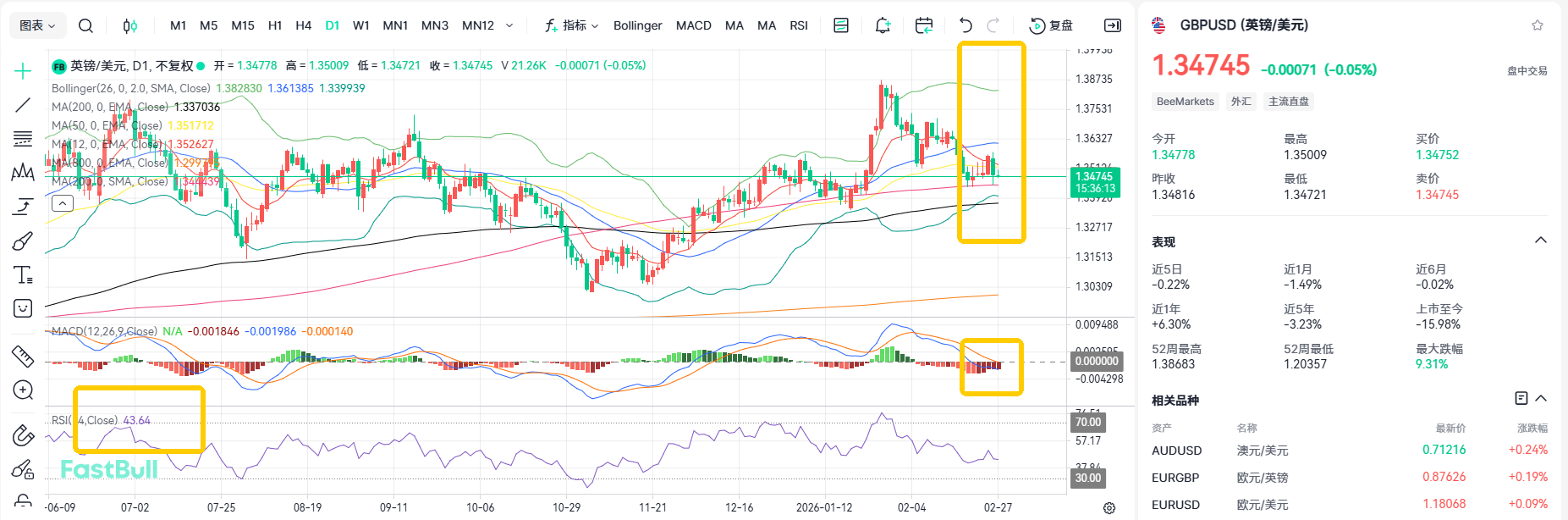
In the 1D timeframe, GBPUSD has once again breached below both the Bollinger Band midline and the EMA50, indicating that the near-term downtrend is not complete. Price is likely to decline further toward key psychological levels and the EMA200, approximately at 1.34 and 1.337. The narrowing of the Bollinger Bands and flattening moving averages suggest consolidation is underway, with a potential breakout imminent. The MACD shows a death cross, with the MACD line and signal line having pulled back toward the zero line before breaking below it, now forming a bearish 'kiss of death' pattern. This confirms the shift into a bearish trend. The RSI reading of 43 reflects prevailing selling pressure among market participants. In the 4H timeframe, the Bollinger Bands are contracting, moving averages are flattening, and price is oscillating lower near the EMA12 and the Bollinger midline. The downtrend is expected to continue, with a high probability of a move toward the previous low and the nearby psychological level around 1.334 and 1.34. Following a MACD death cross, the MACD line and signal line have retreated below the zero line. The RSI reading of 43 indicates prevailing market pessimism. The trading strategy is to sell on rallies.
Trading Recommendations
Trading Direction: Sell
Entry Price: 1.348
Target Price: 1.29
Stop Loss: 1.38
Support: 1.34, 1.3, 1.28
Resistance: 1.38, 1.4, 1.41