The EUR/JPY currency pair has come under renewed selling pressure, retreating toward the 183.60 region after briefly surging above the 187.50 mark earlier in the week—its highest level in nearly two weeks. The pullback reflects a complex interplay of monetary policy signals from the Eurozone and escalating intervention risks in Japan, both of which are reshaping short-term positioning in the cross.
From the European side, the European Central Bank (ECB) delivered a widely anticipated decision to leave interest rates unchanged at its April policy meeting. The main refinancing rate remains at 2.15%, while the marginal lending facility stands at 2.40% and the deposit rate at 2.00%. While the decision itself offered little surprise, the accompanying communication struck a more nuanced tone, highlighting a delicate balancing act between persistent inflation pressures and a softening growth outlook.
The ECB acknowledged that recent economic data has broadly aligned with its projections, but policymakers were quick to flag rising risks on both sides of the mandate. On one hand, inflation risks remain tilted to the upside, driven largely by elevated energy prices amid ongoing geopolitical tensions in the Middle East. On the other, downside risks to economic growth are becoming increasingly pronounced, raising concerns about the durability of the Eurozone recovery.
Crucially, the central bank reiterated its commitment to a data-dependent, meeting-by-meeting approach, avoiding any forward guidance that could lock it into a predetermined policy path. While long-term inflation expectations remain relatively well anchored, the noticeable uptick in short-term expectations underscores the challenges facing policymakers. In my view, this cautious stance is limiting the Euro’s upside potential, as markets struggle to price a clear direction for future rate adjustments.
Adding to the mixed backdrop, incoming macroeconomic data from the Eurozone has painted an uneven picture. Germany, the bloc’s largest economy, reported a modest but better-than-expected GDP expansion of 0.3% in the first quarter, offering a glimmer of resilience. However, this was offset by a rise in the unemployment rate to 6.4%, signaling underlying fragility in the labor market. Meanwhile, inflation across the Eurozone accelerated more than anticipated, with the Harmonized Index of Consumer Prices (HICP) rising 3% year-on-year in April, reinforcing concerns that price pressures may remain sticky.
On the Japanese side, the narrative is being increasingly dominated by the threat of direct intervention in currency markets. Finance Minister Satsuki Katayama has intensified verbal warnings, suggesting that authorities are approaching the point of taking decisive action to stabilize the Yen. These comments come in the wake of USD/JPY breaching the psychologically significant 160.00 level—a threshold historically associated with intervention by Tokyo.
The mere prospect of intervention has been enough to trigger bouts of volatility across Yen pairs, including EUR/JPY, as traders begin to unwind crowded short-Yen positions. However, despite the rhetoric, the Yen’s fundamental backdrop remains weak. Interest rate differentials continue to heavily favor higher-yielding currencies, as the Bank of Japan maintains a relatively accommodative stance compared to its global peers.
Compounding the pressure on the Yen is Japan’s vulnerability to rising energy costs. As a major importer of oil, the recent surge in crude prices—driven by geopolitical disruptions in the Middle East—poses a direct threat to the country’s trade balance and broader economic outlook. This dynamic limits the effectiveness of intervention threats, as structural headwinds continue to weigh on the currency.
Technical Analysis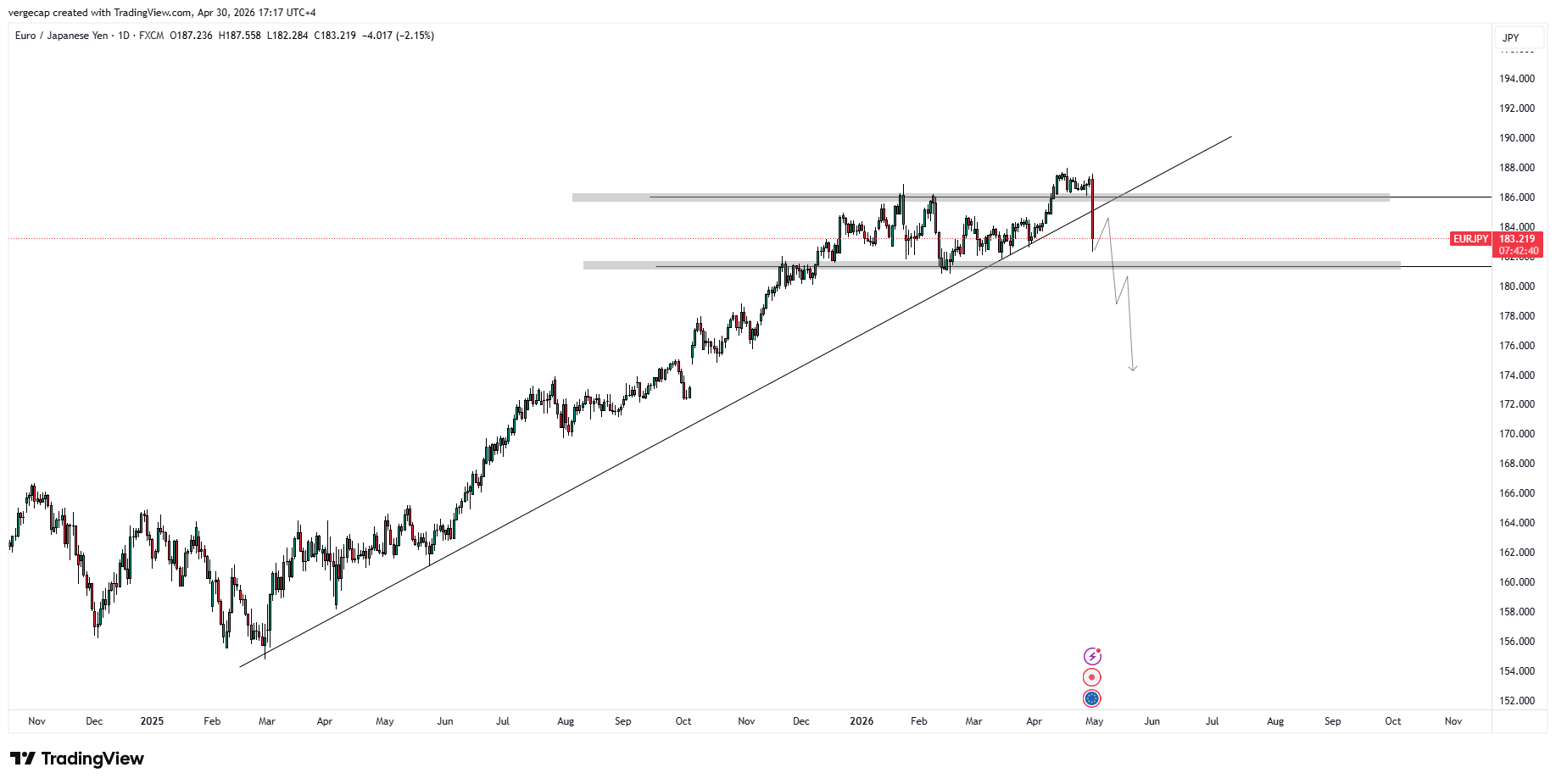
EUR/JPY is beginning to show signs of fatigue after an extended multi-month rally, with recent price action highlighting a loss of upside momentum near key resistance levels. On the daily chart, the pair had been advancing steadily along a well-respected ascending trendline, supported by a consistent structure of higher highs and higher lows. However, the latest rejection from the 186.00–187.50 zone suggests that bullish conviction is starting to weaken.
The sharp pullback toward the 183.00 region reflects a decisive shift in short-term sentiment, with sellers stepping in aggressively after the failed breakout attempt. This move places immediate focus on the 181.00–182.00 support zone, a region that has previously acted as a demand base and now coincides closely with the ascending trendline. This confluence makes it a pivotal area for near-term direction.
A sustained hold above this support would keep the broader bullish structure intact, potentially setting the stage for another attempt to break higher. However, the inability to maintain traction above resistance raises the probability of a deeper corrective phase. If price decisively breaks below the trendline and slips under the 181.00 handle, it would signal a structural shift, opening the door for a move toward 178.00, with further downside risk extending to the 174.00 region.
On the upside, bulls need to reclaim control above 186.00 to reassert dominance. A confirmed breakout above 187.50 would likely trigger renewed momentum buying, exposing higher targets toward the 190.00 psychological level and potentially beyond, in line with the broader trend continuation pattern.
Momentum dynamics point to cooling rather than outright reversal. The recent rejection suggests overbought conditions have unwound, with momentum indicators likely drifting back toward neutral territory. This reduces the risk of an immediate sharp selloff but reinforces the view that the market may enter a consolidation or corrective phase before establishing its next directional move.
From my perspective, this is a classic inflection point. The longer-term uptrend is still technically valid, but the market is clearly testing its foundation. Whether buyers defend the trendline support or sellers force a breakdown will determine whether this is merely a pause—or the beginning of a broader correction.
TRADE RECOMMENDATION
SELL EUR/JPY
ENTRY PRICE: 183.20
STOP LOSS: 186.20
TAKE PROFIT: 178.50


