Fundamentals
Since the start of the year, silver prices have surged by over 99%. In October, constrained silver supply drove prices to $50 per ounce. Analysts at the time attributed this to a temporary shift in metal holdings. Last spring, due to tariff concerns, large amounts of silver flowed into the U.S., causing a shortage in London. According to Bloomberg, the amount of freely circulating silver (silver not locked in ETFs or other funds) plummeted from a high of 850 million ounces to just 200 million ounces — a drop of 75%. Metals Focus estimated that the silver supply at one point fell as low as 150 million ounces. Unprecedented silver demand in India pushed the market to the brink of collapse. As gold prices repeatedly hit new highs, Indians turned to silver, further intensifying pressure on London's silver supply. Eventually, as metal flowed back from New York to London, the market adjusted and pressure eased. However, after a brief pullback, silver prices resumed their upward trend. According to an analyst at ANZ Group, recent sell-offs in London's stock market have caused global supply shortages, and the impact of this shortage is still ongoing. The problem is not that London lacks enough silver, but that there is not enough silver anywhere. Bloomberg reports that recent inflows of silver into London have worsened supply tightness elsewhere. Silver inventories in warehouses related to the Shanghai Futures Exchange have fallen to their lowest level in nearly a decade. Meanwhile, silver lease rates have risen, reflecting strong demand and limited metal availability. This issue cannot be solved simply by moving metal from one warehouse to another. The crux is that demand has exceeded supply for years. Metals Focus reports that silver is on track for a fifth consecutive year of structural market deficit. After hitting record highs in 2024, industrial demand is expected to fall about 2% due to price pressures, leading to an overall demand decline of around 4%. Yet with the silver mine output flat, production remains insufficient to meet market needs. Metals Focus forecasts that gold demand this year will exceed supply by 95 million ounces. This would bring the cumulative market gap over the past five years to 820 million ounces, equivalent to the average annual output of mines in one year. Since 2010, the cumulative silver supply shortfall has exceeded 580 million ounces. Even with higher prices, mined supply is unlikely to grow quickly enough to close the gap. Silver mine output peaked in 2016 at 900 million ounces and has since declined by an average of 1.4% annually until last year. Output is projected to reach 814 million ounces in 2023. It appears we will have to rely on drawdowns in above-ground silver stocks to cover the deficit for at least the next few years. Expectations that the Federal Reserve will continue easing monetary policy are also boosting silver prices. The U.S. recently added silver to its list of strategic minerals, which could intensify demand pressures and supply shortages. The director of gold and silver at Metals Focus said, "There's definitely going to be far more tightness in the silver market.” Bloomberg notes that, due to fears of a sudden spike in U.S. metal prices, some traders are reluctant to ship metal out of the U.S., and if global markets tighten further, there is little hope for relief. There are also concerns that the U.S. may impose tariffs on silver to protect the domestic supply. These fundamental supply–demand dynamics should continue to support silver prices at least in the medium term.
According to the CME FedWatch tool, the probability of the Fed cutting rates by 25 basis points in December is as high as 89%, up from about 63% a month ago. Fed expectations dominate market movements. New York Fed President Williams stated that Fed policy is still "slightly restrictive," suggesting room to move toward neutral. Lower rate expectations reduce the relative return on U.S. assets, and when traders grow more confident in easing, the dollar index typically comes under pressure. Wall Street institutions are largely aligned in their forecasts. Bank of America currently leans toward a December cut, citing soaring unemployment, weak private-sector hiring, and Powell's reluctance to alter the dovish pricing stance. Such consensus tends to bolster market confidence and prompt investors to further unwind dollar positions. Fiscal uncertainty exacerbates dollar weakness. A $4.1 trillion tax reform plan, tariff uncertainties, and questions about Fed independence are dampening foreign investor appetite for U.S. assets, reducing the capital inflows that normally support the dollar.
Technical Analysis
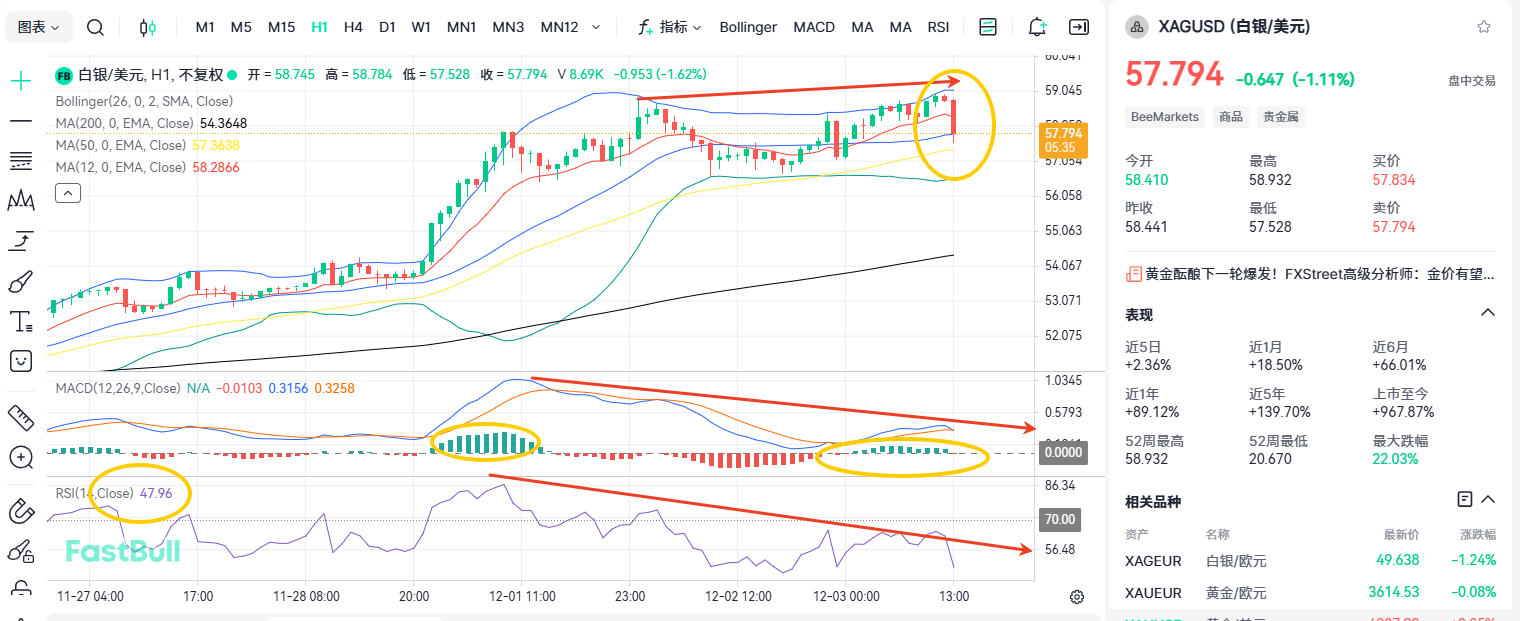
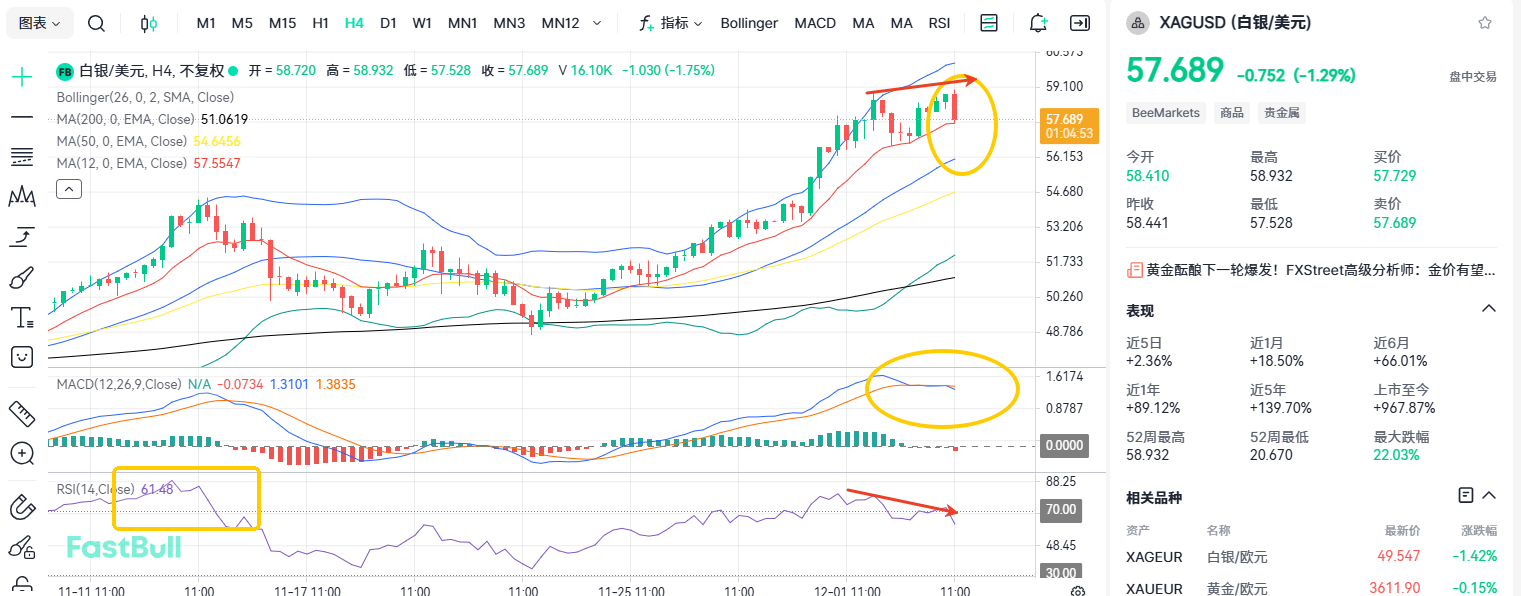
As shown in the 1H chart, the Bollinger Bands are narrowing, and the moving averages are flattening. After being pressured by the upper band, silver is oscillating near the middle band. MACD shows a death cross, and upward momentum is gradually weakening — a sign of bearish divergence indicating further declines. RSI is at 47, signaling market hesitation. Support lies near EMA50 and the Bollinger lower Band at approximately 57.3 and 56.5, respectively. Regarding the 4-hour chart, Bollinger Bands are expanding upward, moving averages are diverging upward, and the bullish trend remains intact. However, a large bearish candle has pulled the price back to EMA12. If this level is breached, the trend could reverse. MACD shows a death cross as well, while the RSI is at 61. However, successive highs are getting lower, potentially signaling a turning point. Selling at highs is recommended.
Trading Recommendations:
Trading direction: Sell
Entry price: 58
Target price: 50
Stop loss: 60
Support: 55/53/50
Resistance: 59/60/65