In the often-predictable world of currency trading, it is the clash of narratives that breeds volatility, and the GBP/JPY cross is currently ground zero for a compelling policy dissonance. The Pound Sterling, acting as both protagonist and barometer of global risk sentiment, is holding a commanding position just shy of its weekly highs against the beleaguered Japanese Yen. As of this writing, the pair trades at 211.65, a level that encapsulates a Wednesday rebound from the 210.00 support—a recovery fueled not by UK developments, but by clarifying rhetoric from Washington that has effectively short-circuited the Yen’s fledgling recovery narrative.
The week’s drama began with a rumor that sent shockwaves through the Tokyo markets: whispers of a potential coordinated intervention to prop up the historically weak Yen. This specter, which triggered a sharp but fleeting JPY recovery last week, was authoritatively laid to rest by none other than US Treasury Secretary Scott Bessent. In a Wednesday interview with Bloomberg, Bessent delivered a one-two punch of dollar policy. First, he explicitly denied any plans for market intervention to support JPY stability. More significantly, less than 24 hours after former President Donald Trump publicly praised a weakening dollar, Bessent forcefully affirmed the current administration’s commitment to a "strong Dollar policy." The message was unequivocal and immediately digestible for traders: do not expect a US backstop for the Yen’s woes. This single interview provided the jet fuel for the GBP/JPY’s rebound, demonstrating the outsized influence of US political and fiscal commentary on global FX flows.
This American intervention—verbal, not market-based—effectively offset what should have been a supportive domestic development for the Yen. The released minutes from the Bank of Japan’s latest monetary policy meeting revealed a governing board increasingly tilting toward hawkishness. There was noted “general agreement” that the potent combination of persistent inflationary pressures, the Yen’s profound weakness exacerbating import costs, and sustained wage growth indeed “justify further monetary tightening.” This language marks a subtle but critical shift from the BoJ’s decades-long ultra-dovish dogma, theoretically constructing a fundamental floor for the Yen. Yet, in the face of a resolute US Treasury, these minutes read like a theoretical exercise, their impact muted by the stark reality of a widening interest rate chasm and a lack of immediate action.
The immediate test for the BoJ’s thesis arrives later today with the release of the advanced Tokyo Consumer Price Index (CPI), a leading indicator for national trends. The data presents a critical dilemma. While the BoJ minutes speak of rising pressures, the hard data tells a moderating story: consumer inflation in Japan’s capital cooled to 2.0% year-on-year in December from 2.7% in November. The market consensus for January’s core reading suggests a further moderation. A print confirming this cooling trend could severely undermine the hawkish narrative embedded in the minutes, stripping the Yen of one of its few remaining domestic supports and inviting renewed selling pressure. The currency is caught between the BoJ’s forward-looking guidance and the market’s rear-view mirror data analysis.
On the other side of the pair, the Pound draws strength from a more immediate and visceral source: sticky inflation. Data earlier this week revealed UK shop price inflation surged in January to its highest level in nearly two years, driven by stubbornly rising food prices and elevated fuel costs. For traders and the Bank of England alike, this is a potent signal. It directly boosts expectations for a hotter-than-anticipated Consumer Price Index reading for January when it is published later this month. In the current environment, "hot" UK data translates directly into support for Sterling, as it fiercely entrenches the argument against any near-term monetary easing from the BoE. While the Federal Reserve and the European Central Bank openly debate their first rate cuts, the UK’s inflation dynamics suggest its central bank will be among the last to pivot. This relative interest rate advantage provides a structural tailwind for the Pound against funding currencies like the Yen.
Technical Analysis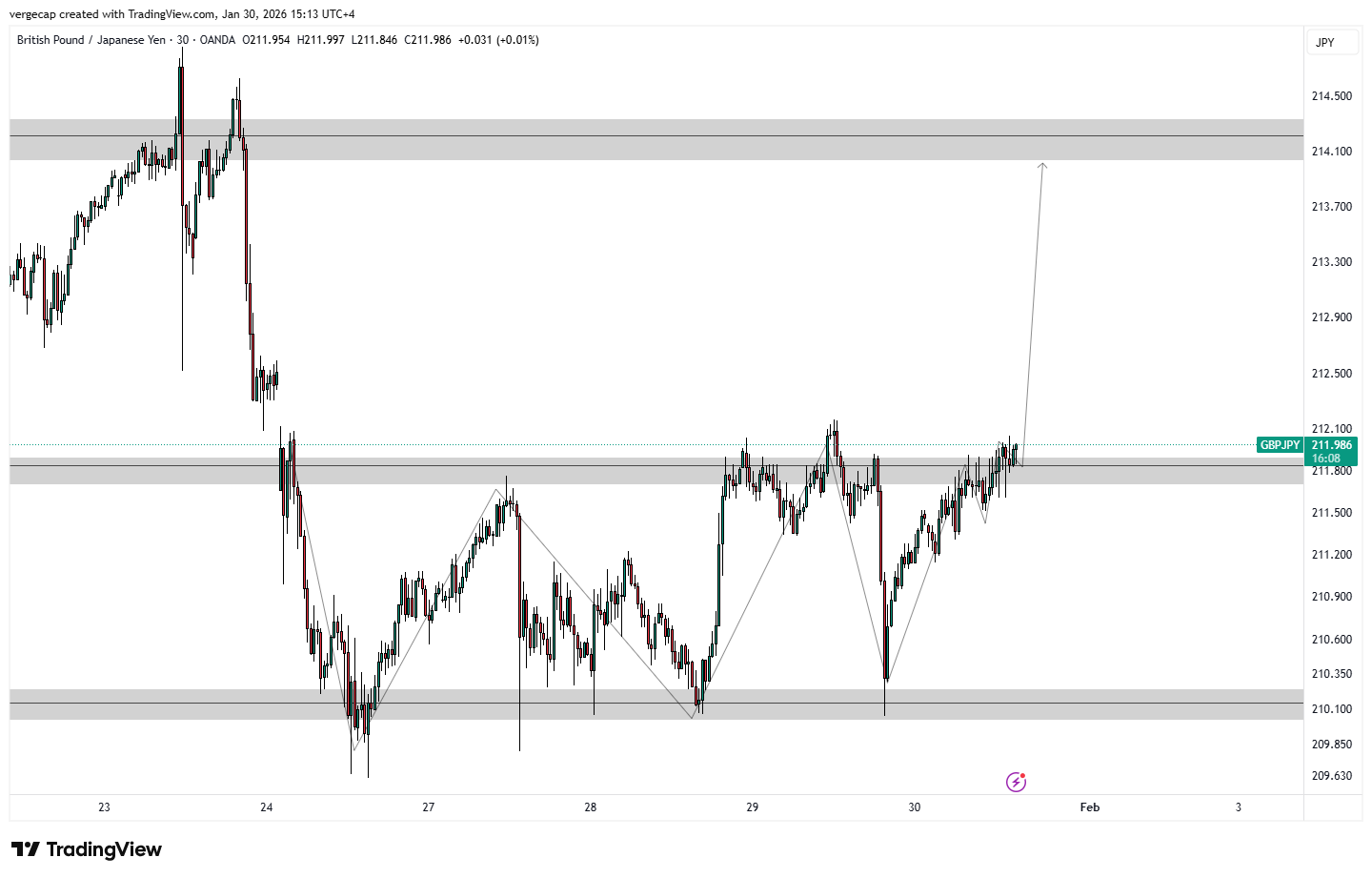
From a technical perspective, GBPJPY remains entrenched within a well-defined bullish structure, consolidating near recent highs following a significant uptrend. On the 30-minute chart, prices are trading in a tight range just below the key 212.000 psychological level, with the current session showing a high of 211.997, a low of 211.846, and a close at 211.986 (+0.01%). This narrow price action indicates a period of equilibrium and compression as the market gathers momentum for its next directional move.
The broader structure is bullish, characterized by a series of higher highs and higher lows from the lows near 209.000 in late January. The immediate price action is testing the upper boundary of its recent range. The key near-term support is now established at today's low of 211.846, which aligns with the previous session's consolidation. A decisive break below this level could trigger a short-term pullback toward the more significant support zone between 211.300 – 211.500, an area that represents a prior resistance-turned-support and a critical level for maintaining the near-term bullish bias. A sustained move below 211.300 would signal a deeper corrective move, initially targeting the 210.500 – 210.800 zone.
On the upside, the immediate resistance and primary bullish target is the psychological 212.000 handle, which the price has tested but not yet decisively broken. A sustained push and a 30-minute close above 212.000 would confirm the resumption of the bullish impulse and likely invigorate momentum buying. Such a breakout would shift focus decisively toward the next resistance levels at 212.500 and 213.000, with a clear path toward the 214.000 area visible on the chart.
Momentum indicators suggest consolidation rather than exhaustion. The minimal positive close and extremely tight range reflect a cooling in bullish momentum, reducing the risk of an immediate sharp reversal. This type of price action supports the case for continued sideways-to-higher movement as the market builds a base for the next leg up. The compression also indicates that a volatility expansion is imminent, with the breakout direction likely to dictate the short-term trend.
TRADE RECOMMENDATION
BUY GBPJPY
ENTRY PRICE: 212.050 (On a sustained 30-minute close above 212.000)
STOP LOSS: 211.600
TAKE PROFIT: 213.200


