The British Pound recovered from earlier losses against the Japanese Yen on Friday, with GBP/JPY climbing back toward the 214.15 region after briefly slipping to an intraday low of 213.59, as investors reassessed the monetary policy outlook in both the United Kingdom and Japan amid escalating geopolitical uncertainty and diverging inflation dynamics.
Sterling found renewed support after Bank of England Governor Andrew Bailey delivered a notably hawkish message during remarks in Iceland, signaling that policymakers remain cautious about easing monetary conditions too quickly despite signs of economic softness in the UK economy.
Bailey acknowledged that weakening domestic activity and uncertainty surrounding the ongoing Iran-related geopolitical shock have complicated the Bank’s policy path. However, he stressed that tolerating temporarily elevated inflation remains the more appropriate strategy in the current environment, particularly after policymakers previously removed anticipated rate cuts from the table in response to mounting external risks.
The comments reinforced market expectations that UK interest rates may remain restrictive for longer than previously anticipated, supporting the Pound across major currency pairs.
According to Bailey, the Bank of England has already tightened policy “considerably,” suggesting officials remain focused on preventing a second wave of inflationary pressures driven by energy markets and supply disruptions tied to Middle East tensions. He further emphasized that policymakers would continue monitoring developments in the region “very closely” and stand ready to adjust policy if required.
The remarks were interpreted by markets as a signal that the BoE is unlikely to pivot dovish in the near term, particularly if geopolitical instability continues to threaten global energy prices and inflation expectations.
While the Pound strengthened on the back of the BoE narrative, the Japanese Yen initially gained ground earlier in the session after Japan’s Finance Minister Katayama warned authorities were prepared to take decisive action against excessive foreign exchange volatility. The verbal intervention revived speculation that Tokyo could once again step into currency markets should USD/JPY approach the psychologically critical 160 level.
Reuters reported that Japanese authorities spent approximately 11.7349 trillion Yen intervening in currency markets between April 28 and May 27, underlining the government’s increasing concern over sustained Yen weakness and imported inflation pressures.
However, the Yen’s recovery lost momentum later in the day as softer domestic inflation figures complicated expectations for further Bank of Japan tightening.
Data released Friday showed Tokyo’s Consumer Price Index rose 1.4% year-over-year in May, slowing from 1.5% previously. More importantly, core inflation excluding food and energy eased to 1.6% from 1.9%, reinforcing concerns that underlying price pressures in Japan remain insufficient to support an aggressive normalization cycle by the BoJ.
The inflation miss is significant because it weakens the argument for rapid policy tightening at a time when other major central banks, particularly the Bank of England, continue signaling caution around premature easing. That widening rate differential remains one of the primary drivers supporting GBP/JPY upside momentum.
Technical Analysis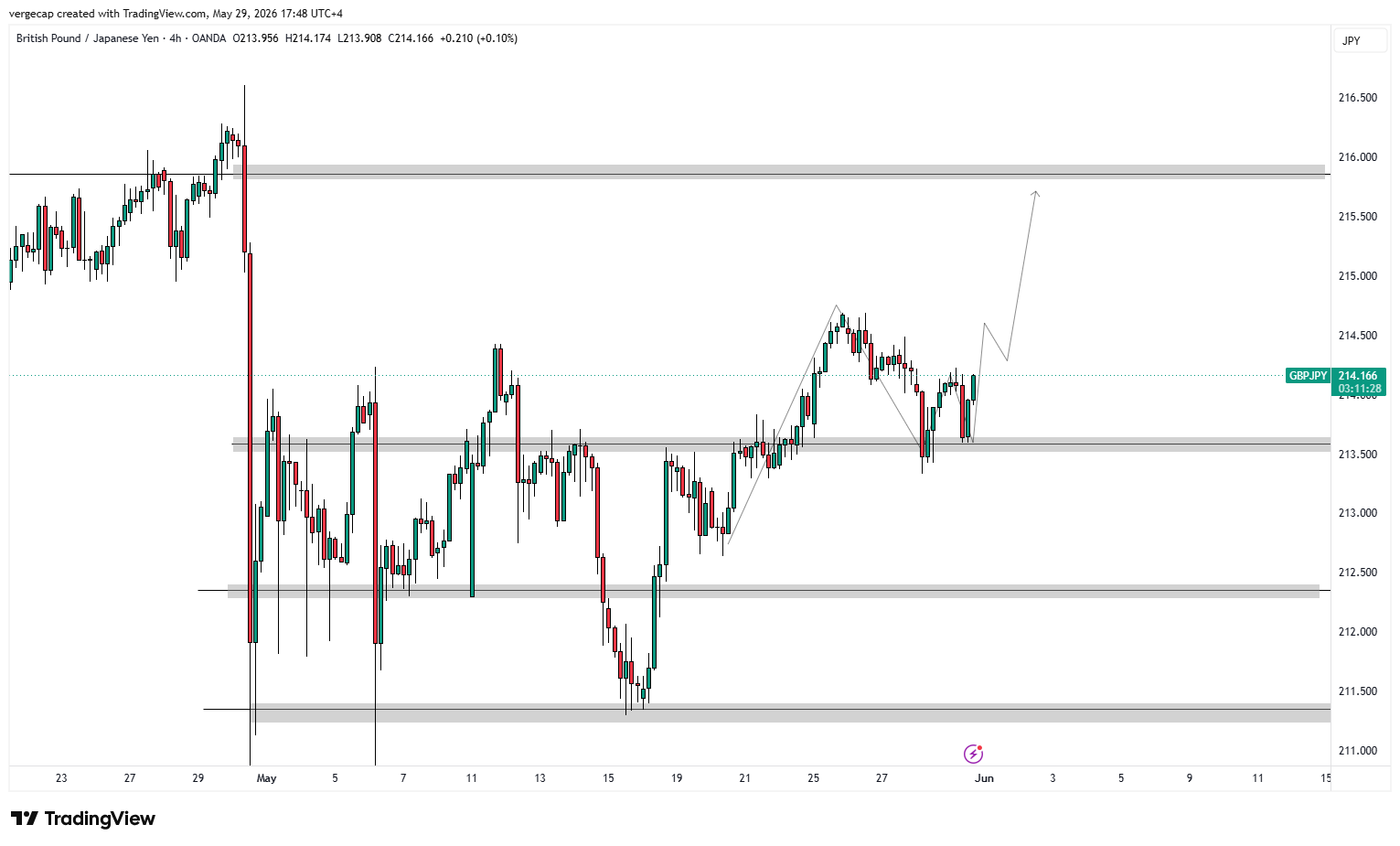
From a technical perspective, GBP/JPY remains positioned within a broader bullish structure despite recent corrective price action, with the pair continuing to trade comfortably above key medium-term support levels on the 4-hour chart. The recent pullback from the 214.70–214.80 region appears corrective rather than trend reversing, as buyers successfully defended the critical 213.50–213.60 support zone, an area that has repeatedly acted as both resistance and support throughout the recent consolidation phase.
Price action suggests the cross is attempting to establish a higher low formation after rebounding sharply from the latest dip, reinforcing the broader sequence of higher highs and higher lows that has dominated the structure since mid-May. The chart also shows a developing bullish continuation setup following the recent descending corrective channel, with the pair now attempting to break back above short-term resistance near 214.30.
The broader trend remains constructive as long as GBP/JPY holds above the 213.50 support region. A sustained defense of this zone would likely encourage fresh upside momentum toward the 214.70 swing high, followed by the major resistance band near 215.80–216.00, which represents the next significant upside target and a key liquidity zone visible on the chart.
A decisive breakout above the 216.00 barrier would confirm a continuation of the prevailing bullish trend and could expose a fresh leg higher toward multi-year highs beyond 216.50. Such a move would likely be driven by continued policy divergence between the Bank of England and the Bank of Japan, alongside persistent carry trade demand favoring Sterling over the Yen.
On the downside, failure to maintain support above 213.50 would weaken the immediate bullish outlook and increase the risk of a deeper retracement toward the next major demand zone around 212.30–212.40. This area previously served as a strong accumulation base and remains an important structural support for bulls.
A sustained breakdown below 212.30 would represent a more meaningful deterioration in market structure and could shift momentum decisively in favor of sellers, potentially exposing the 211.20–211.30 region where the pair previously formed a medium-term bottom during May’s recovery cycle.
From a momentum standpoint, price action suggests consolidation rather than exhaustion. The recent decline unfolded within a controlled corrective move rather than impulsive bearish selling, while the sharp rebound from support indicates buyers remain active on dips. The market currently appears to be transitioning from consolidation into a potential continuation phase, especially if bullish momentum accelerates above 214.30.
Overall, the technical structure continues to favor upside continuation while price remains above the 213.50 support zone. The combination of higher lows, defended support, and renewed bullish recovery keeps the near-term outlook tilted to the upside heading into the next trading sessions.
TRADE RECOMMENDATION
BUY GBP/JPY
ENTRY PRICE: 214.10
STOP LOSS: 213.20
TAKE PROFIT: 216.00


