Gold prices extended their recovery during Friday’s trading session, with bullion climbing steadily after suffering one of its sharpest declines in recent weeks. The precious metal rebounded from Thursday’s two-month low near $4,366 and was trading around the $4,530 region during the European session as investors reassessed geopolitical risks and the prospects of a temporary diplomatic breakthrough between Washington and Tehran.
The rebound in XAU/USD comes as market sentiment stabilized following reports that the United States and Iran had reached a preliminary 60-day memorandum of understanding aimed at extending the current ceasefire arrangement and reopening the strategically vital Strait of Hormuz. According to Axios, the proposed framework would allow both nations to continue negotiations surrounding Tehran’s nuclear program while reducing immediate threats to global energy supply routes.
The news sparked a modest improvement in broader market risk appetite, easing fears of an imminent escalation in the Middle East conflict that had dominated sentiment across global financial markets for weeks. Oil prices reacted swiftly to the developments, with West Texas Intermediate crude sliding toward the $87 per barrel region and heading for its first monthly decline in five months.
Still, despite the recent pullback, crude prices remain significantly elevated compared with pre-war levels, meaning inflationary concerns have not disappeared entirely. That dynamic continues to complicate the outlook for financial markets, particularly as investors attempt to balance cooling geopolitical tensions against the possibility of persistently high energy costs feeding into global inflation.
In my view, Gold’s recovery reflects more of a tactical rebound from oversold conditions rather than a decisive shift back into a sustained bullish trend. While the ceasefire proposal has temporarily reduced panic across markets, traders remain highly cautious because the agreement itself is still far from finalized. That lingering uncertainty continues to preserve an underlying layer of safe-haven demand beneath the surface.
Indeed, Iranian state-linked Tasnim news agency later reported that no final agreement had yet been confirmed, injecting another wave of uncertainty into the narrative and reminding investors how fragile the diplomatic process remains. Markets have repeatedly seen negotiations between Washington and Tehran collapse unexpectedly in recent years, making traders reluctant to fully unwind defensive positions.
Additional caution came from comments made by US Treasury Secretary Scott Bessent, who outlined three key conditions required by US President Donald Trump before any agreement could receive final approval. According to Bessent, Iran must fully reopen the Strait of Hormuz, surrender its enriched uranium stockpile, and completely terminate its nuclear program.
Those demands underscore how significant the remaining divisions between both sides still are. While markets welcomed the headline of a ceasefire extension, the practical implementation of a broader agreement remains politically and diplomatically complex. That reality is preventing investors from aggressively selling the US Dollar or fully abandoning safe-haven assets such as Gold.
The Greenback itself remains relatively stable despite the modest improvement in global risk sentiment. The US Dollar Index (DXY) continues consolidating above the 99.00 level within a broader two-week trading range, highlighting how traders remain reluctant to establish large bearish positions against the currency while geopolitical tensions continue simmering.
Treasury yields have also remained relatively firm, limiting upside momentum for non-yielding assets like Gold. Investors continue to closely monitor the Federal Reserve’s policy outlook, particularly as elevated Oil prices and lingering supply-chain disruptions keep inflation risks alive despite the recent easing in geopolitical tensions.
Technical Analysis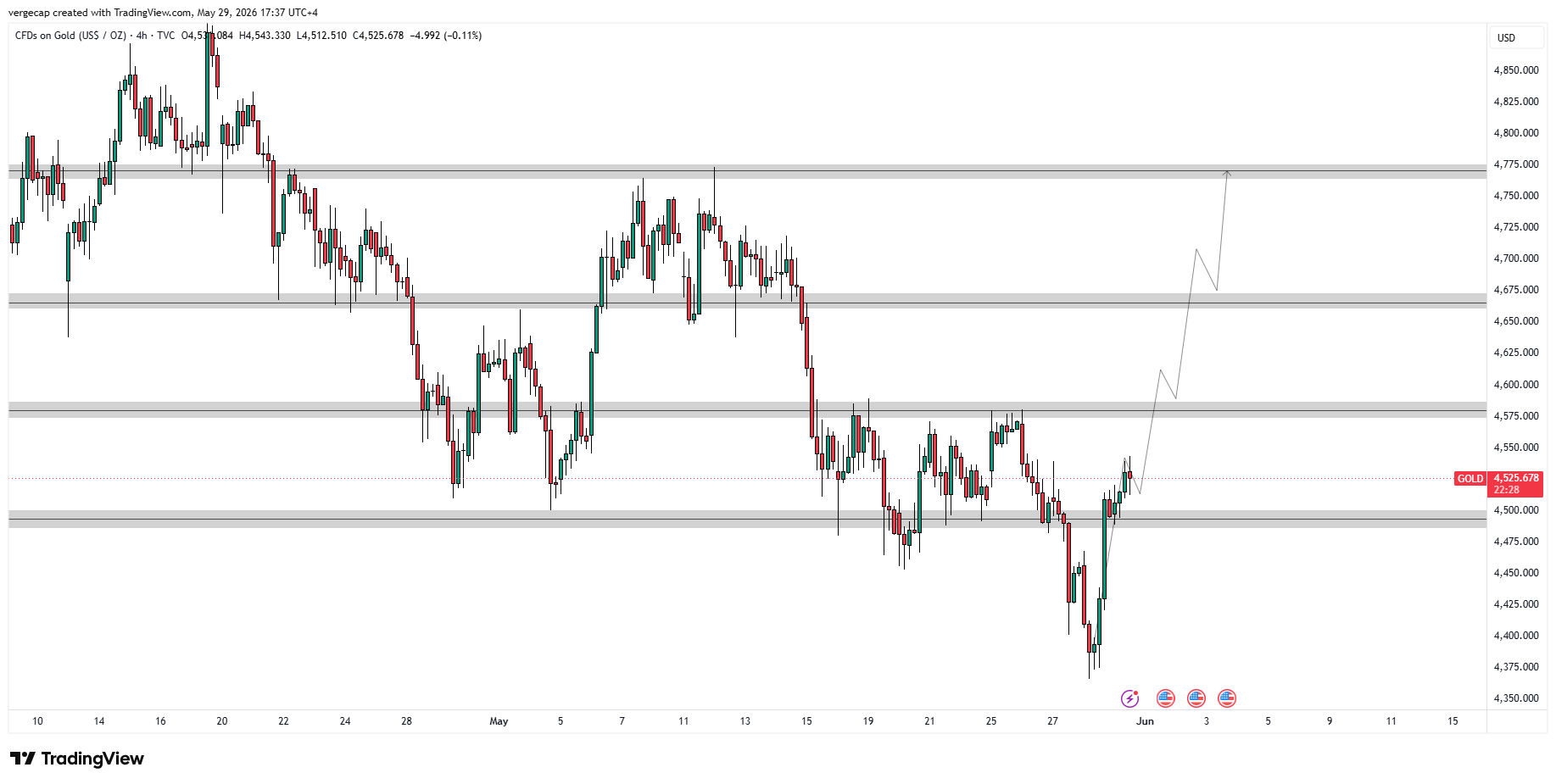
From a technical perspective, Gold remains in a fragile recovery phase following a sharp corrective selloff that dragged prices to a two-month low near the $4,366 region earlier this week. On the 4-hour chart, XAU/USD is attempting to stabilize after aggressively rebounding from oversold territory, with buyers reclaiming the critical $4,500 psychological level. Despite the rebound, the broader structure still reflects a market recovering from significant bearish pressure rather than a fully confirmed bullish reversal.
The recent bounce developed after Gold found strong support near the $4,400–$4,370 demand zone, an area that triggered an aggressive wave of dip-buying and short-covering activity. The recovery has since pushed prices back toward the $4,525 region, though bulls continue to face heavy resistance around the $4,550–$4,580 supply zone. This area previously acted as an important breakdown level during the latest decline and now represents the first major barrier preventing a broader upside continuation.
While the rebound has improved short-term sentiment, Gold still remains below several critical resistance clusters visible across the broader chart structure. The $4,675 region stands out as the next major upside hurdle should buyers successfully clear immediate resistance. A sustained break above that level would likely strengthen bullish momentum considerably and open the door for a retest of the key $4,775 zone, which marked a major distribution area earlier in May.
Importantly, the chart suggests that bullish momentum is beginning to rebuild gradually following the sharp capitulation move seen late in the week. The formation of higher lows near the $4,480–$4,500 region indicates that buyers are attempting to regain near-term control. However, the recovery remains vulnerable unless Gold can establish sustained acceptance above the $4,550–$4,580 resistance band.
On the downside, failure to hold above the $4,500 handle could expose Gold to another wave of liquidation pressure. Initial support is now seen around the $4,480 zone, followed by stronger structural support near $4,400. A decisive breakdown beneath that level would invalidate the current recovery structure and expose the recent swing low around $4,366 once again. Should bearish momentum intensify below that area, traders could begin targeting deeper downside levels toward the broader $4,300 region.
Momentum indicators suggest that bearish pressure is beginning to ease, though confirmation of a sustained bullish reversal remains limited for now. The Relative Strength Index (RSI) appears to have rebounded sharply from oversold territory and is gradually moving back toward neutral levels, signaling improving momentum conditions. However, RSI has not yet entered firmly bullish territory, suggesting that the recovery remains cautious rather than explosive.
Meanwhile, the Moving Average Convergence Divergence (MACD) is attempting to form a bullish crossover after spending several sessions deeply below the zero line. This signals that downside momentum is slowing significantly and that buyers may continue regaining confidence in the short term. Nevertheless, the indicator still reflects broader trend weakness, reinforcing expectations for continued volatility and possible consolidation before the next major directional move develops.
From a broader market perspective, Gold remains highly sensitive to geopolitical headlines surrounding the US-Iran situation, fluctuations in Treasury yields, and shifting Federal Reserve rate expectations. Any deterioration in diplomatic negotiations or resurgence in inflation fears could quickly revive safe-haven demand and accelerate the current recovery structure.
TRADE RECOMMENDATION
BUY GOLD (XAU/USD)
ENTRY PRICE: 4,530
STOP LOSS: 4,430
TAKE PROFIT: 4,775


