The British Pound extended its advance against the Japanese Yen on Tuesday, pushing GBP/JPY above the psychologically important 215.00 threshold for the first time since April 30 as investors continued to favor higher-yielding currencies over the increasingly pressured Japanese currency.
The move marks another chapter in the Yen’s prolonged decline, with traders showing little hesitation in testing levels that have historically attracted heightened scrutiny from Japanese policymakers. The rally in GBP/JPY comes as USD/JPY also trades just below the closely watched 160.00 mark, a level widely regarded by market participants as the upper boundary of weakness that Japanese authorities may be willing to tolerate before considering stronger intervention measures.
Sterling's gains were supported by a modest improvement in global risk sentiment following reports suggesting progress toward a negotiated resolution of tensions linked to the conflict involving Iran. Investor confidence also received a boost from news surrounding a ceasefire in Lebanon, helping reduce demand for traditional safe-haven assets such as the Japanese Yen.
While geopolitical developments provided a supportive backdrop for the Pound, the primary driver behind the latest surge in GBP/JPY remains the persistent divergence between Japanese monetary policy and that of other major economies. Investors continue to view the Yen as one of the least attractive currencies in the developed world due to Japan’s exceptionally low interest-rate environment and subdued government bond yields.
Japanese Government Bond yields remain significantly below those available in the United Kingdom, the United States, and several other advanced economies. This yield differential has encouraged investors to maintain carry trade positions, borrowing in Yen and investing in higher-yielding assets elsewhere. As long as this gap remains substantial, demand for the Japanese currency is likely to remain limited.
Adding to the Yen's challenges is ongoing uncertainty surrounding the future policy trajectory of the Bank of Japan. Although the central bank has gradually moved away from its ultra-loose monetary stance, markets remain unconvinced that policymakers are prepared to deliver the type of aggressive tightening necessary to materially support the currency. The pace of normalization has been measured, and investors continue to question whether future rate increases will be sufficient to close the yield gap with other major economies.
Japanese Finance Minister Satsuki Katayama attempted to reinforce Tokyo’s commitment to addressing excessive currency volatility, reiterating on Tuesday that authorities stand ready to take appropriate action regarding foreign exchange markets when necessary. The comments were widely interpreted as another verbal warning directed at speculative traders betting against the Yen.
However, the market reaction was notably muted.
Currency traders have become increasingly accustomed to intervention rhetoric from Japanese officials, and many appear unwilling to adjust positions based solely on verbal guidance. Instead, investors are demanding concrete policy action or direct market intervention before reassessing bearish Yen positions. This explains why repeated warnings from Tokyo have failed to generate a sustained recovery in the currency over recent months.
The broader market perception is that intervention alone may provide only temporary relief unless accompanied by a meaningful shift in monetary policy fundamentals. Previous episodes have demonstrated that while direct intervention can trigger sharp short-term corrections, underlying trends tend to reassert themselves if yield differentials remain unchanged.
Technical Analysis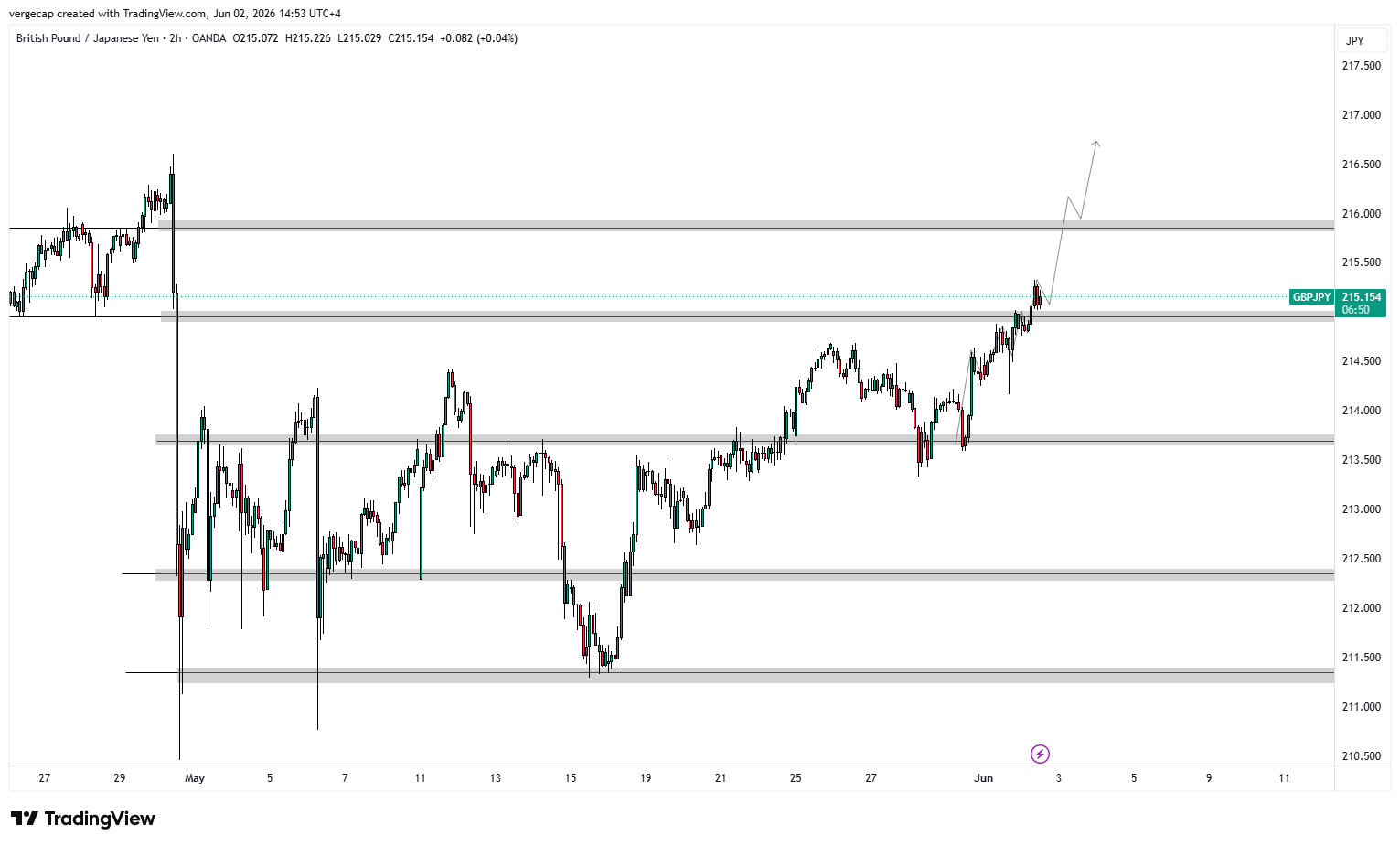
From a technical perspective, GBP/JPY remains firmly embedded within a well-defined bullish structure, with the pair extending its recovery trend after successfully breaking above several key resistance zones visible on the 2-hour chart. Price action has been characterized by a sequence of higher highs and higher lows since the mid-May bottom near 211.40, highlighting sustained bullish momentum and strong underlying demand for Sterling against the Japanese Yen.
The recent breakout above the 214.90–215.00 resistance zone, which had previously acted as a supply area, represents a significant technical development. This level has now transitioned into immediate support and will be closely monitored by traders for confirmation of a bullish continuation pattern. As long as GBP/JPY remains above this region, the broader upward trajectory remains intact.
The chart also shows that buyers have successfully reclaimed the former congestion zone around 213.60–213.70, which now serves as the next major layer of support. A pullback toward this area would likely attract dip-buying interest given its confluence with previous breakout levels and market structure support. A sustained move below 213.60 would be the first indication that bullish momentum is beginning to weaken and could trigger a deeper corrective retracement toward the 212.30–212.40 support zone, where previous accumulation activity emerged throughout May.
Below that, the major structural floor remains near 211.30–211.40, the location of the mid-May swing low. A decisive break beneath this region would invalidate the current sequence of higher lows and signal a more meaningful trend reversal, potentially exposing downside risks toward the psychological 210.00 handle.
On the upside, bullish traders remain focused on the next resistance cluster located around 215.80–216.00, a zone that capped advances during late April before the broader correction unfolded. The market is currently attempting to establish acceptance above 215.00, and a sustained breakout through 216.00 would likely attract fresh momentum buying and accelerate gains toward the 216.80–217.00 region, which represents the next significant upside objective visible on the chart.
The overall market structure remains constructive. The aggressive recovery from the May lows has been accompanied by consistent bullish follow-through, indicating that buyers remain firmly in control. Furthermore, the breakout above multiple resistance levels without any significant rejection suggests underlying demand remains robust despite the pair trading near multi-week highs.
While the chart does not display momentum indicators such as RSI or MACD, price action itself suggests momentum remains positive. The recent consolidation beneath resistance was followed by a decisive breakout, a pattern typically associated with trend continuation rather than exhaustion. The absence of any major bearish reversal formations further supports the bullish outlook.
In my view, the technical picture continues to favor additional upside as long as GBP/JPY maintains support above the 214.90 breakout area. The combination of strong trend structure, higher-low formations, and successful resistance-to-support flips suggests buyers remain in control. Any short-term pullbacks are likely to be viewed as buying opportunities unless the pair falls back below 213.60 and begins to invalidate the current bullish market structure.
TRADE RECOMMENDATION
BUY GBP/JPY
ENTRY PRICE: 215.15
STOP LOSS: 213.60
TAKE PROFIT : 216.80


