The British Pound strengthened against the US Dollar during Tuesday's European session, with GBP/USD climbing toward the 1.3470 area as investors reduced safe-haven positioning following signs of de-escalation in the conflict between Israel and Hezbollah.
The move higher in Sterling came primarily from broad-based US Dollar weakness rather than renewed confidence in the UK economy. Investors cautiously embraced reports suggesting that immediate fears of a wider regional conflict had eased, prompting a modest improvement in global risk sentiment and reducing demand for traditional safe-haven assets.
Market attention focused on comments from US President Donald Trump, who announced that Israel had agreed to withdraw forces that were reportedly preparing for military operations in Beirut and Hezbollah-controlled suburbs. Trump also indicated that diplomatic channels had secured assurances from Hezbollah that it would refrain from launching attacks against Israel, offering markets a rare sign of progress in a region that has remained a major source of volatility throughout the year.
The easing of tensions prompted traders to unwind some defensive Dollar positions accumulated in recent weeks as fears of disruptions to global energy markets intensified. As a result, GBP/USD recovered from Monday's weakness and regained traction despite lingering concerns about the UK's domestic economic outlook.
Yet beneath the market's initial optimism, significant risks remain. Investors remain wary that any improvement in sentiment could prove temporary as tensions between Iran and the United States continue to escalate. Reports from Iran's Tasnim News Agency suggested that Tehran has suspended indirect negotiations with Washington, raising concerns that diplomatic efforts aimed at reducing regional hostilities may be losing momentum.
Adding to those concerns, Iran and its regional allies have reportedly discussed plans to intensify pressure on Western interests through strategic maritime routes. Market participants remain particularly focused on developments surrounding the Strait of Hormuz, one of the world's most important energy transit corridors. Any prolonged disruption to shipping through the strait would threaten global crude oil and liquefied natural gas supplies, potentially reigniting inflationary pressures worldwide.
Reports from Axios further heightened investor caution after indicating that Iran deployed additional naval mines in the Strait of Hormuz during the previous week. Such developments have reinforced concerns that even if direct military confrontations remain limited, the broader geopolitical landscape remains highly unstable.
For currency markets, the implications extend beyond energy prices. Any escalation that drives oil prices significantly higher would likely support the US Dollar through safe-haven demand while simultaneously complicating inflation and monetary policy expectations across major economies.
In the United Kingdom, investors continue to assess the policy outlook from the Bank of England. Governor Andrew Bailey struck a cautious tone last week, emphasizing that policymakers are not under pressure to tighten monetary policy aggressively despite persistent inflation risks. Bailey pointed to sluggish domestic growth conditions and uncertainty surrounding geopolitical developments as reasons for patience.
His comments have tempered expectations for additional UK rate increases. Money markets currently price approximately 32 basis points of tightening over the remainder of the year, effectively implying one quarter-point increase with a modest probability of a second move before year-end.
While those expectations continue to offer some support to Sterling, they also highlight the growing challenge facing the Bank of England. Policymakers must balance elevated inflation against signs of weakening economic momentum, a combination that has prevented traders from embracing a more aggressively bullish view on the Pound.
Technical Analysis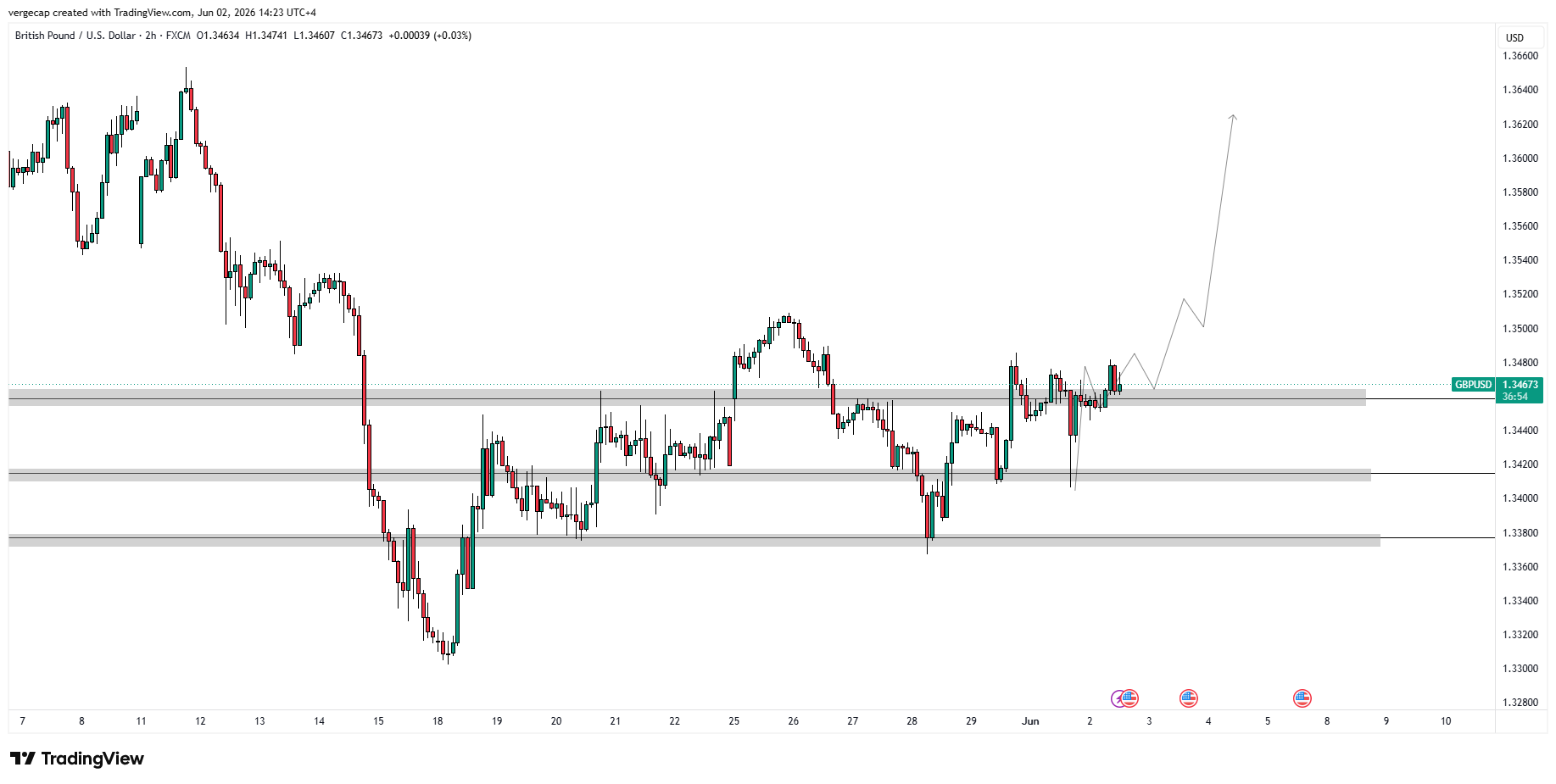
From a technical perspective, GBP/USD remains positioned within a constructive bullish structure on the 2-hour chart, with price action continuing to print higher lows and higher highs following the sharp recovery from the mid-May low near 1.3310. The pair is currently consolidating around the 1.3470 region after reclaiming a key resistance zone between 1.3450 and 1.3470, suggesting that bullish momentum remains intact despite a brief pause in upside progress.
Recent price action shows the pair successfully defending an ascending trendline that has guided the recovery since May 20. Multiple rebounds from this trendline reinforce its significance as dynamic support and indicate that buyers continue to step in on dips. The latest breakout above the 1.3420 resistance area has transformed that zone into an important support level, adding another layer of protection for the broader uptrend.
The immediate hurdle for bulls is the 1.3470-1.3480 supply area, where price is currently consolidating. A decisive break and sustained close above this barrier would confirm continuation of the bullish sequence and open the door toward the next resistance target near 1.3520. Beyond that, attention would shift toward the 1.3600-1.3620 region, which represents a significant technical objective and aligns with the projected upside path highlighted on the chart.
On the downside, initial support is located at 1.3420, followed by stronger support around the 1.3370-1.3380 zone. This area has repeatedly acted as a demand region throughout the recent recovery phase. A break below 1.3370 would weaken the bullish structure and could trigger a deeper retracement toward 1.3310. However, unless sellers force a sustained move beneath that level, the broader bias remains tilted to the upside.
Momentum conditions continue to favor buyers. Although the rally has paused beneath resistance, the consolidation appears corrective rather than indicative of trend exhaustion. The price structure suggests accumulation rather than distribution, with each pullback being relatively shallow compared to preceding advances. This behavior is typically associated with healthy bullish trends preparing for another leg higher.
Assuming the Relative Strength Index (RSI) is aligned with recent price action, it is likely holding above the neutral 50 mark, reflecting positive momentum without entering severely overbought territory. Similarly, the Moving Average Convergence Divergence (MACD) would likely remain above the zero line, supporting the underlying bullish trend while signaling a temporary pause in momentum rather than a reversal.
Overall, the technical outlook remains constructive as long as GBP/USD continues holding above the 1.3420 support region. The combination of rising trendline support, higher-low formations, and repeated bullish defenses suggests that buyers retain control of the near-term trend. A breakout above 1.3480 would strengthen the bullish case and potentially accelerate gains toward the 1.3520 and 1.3600 objectives in the sessions ahead.
TRADE RECOMMENDATION
BUY GBP/USD
ENTRY PRICE: 1.3470
STOP LOSS: 1.3390
TAKE PROFIT: 1.3620


