Fundamentals
The pound is under increased pressure from heightened market risk aversion, adding to existing stresses from a weak UK economic outlook and domestic political uncertainty. Recent geopolitical tensions, resulting from US-Israel military strikes on Iran, have driven up global energy prices, sparking investor concerns over renewed inflationary pressures. Data from the London Stock Exchange Group shows traders now assign only a 22% probability to a Bank of England rate cut later this month, a significant drop from the 75% expectation last Friday. Meanwhile, UK government bond yields rose substantially for the second consecutive day. Against this backdrop of escalating conflicts, UK Chancellor Rachel Reeves delivered a budget update speech to Parliament. The Office for Budget Responsibility's latest forecasts project UK economic growth at 1.1% this year, revised down from 1.4% in its November outlook report. Reeves stated, "This government has set the right economic plan for our country, which is especially vital as global conditions have grown more uncertain in recent days." Regarding inflation, the OBR expects UK consumer price inflation to average 2.3% in 2026, lowered from the 2.5% forecast in November. For 2027 and 2028, inflation is projected to remain at 2.0%, unchanged from prior estimates. However, these projections were made before the recent Middle East conflict escalation, which has already boosted global energy prices and could influence future inflation trends. Paul Dales, chief UK economist at Capital Economics, stated: "We believe that under all circumstances, the Bank of England will demonstrate heightened sensitivity to upside risks to inflation relative to certain other central banks." He emphasized that the conflict's evolution, duration, and impact on energy prices will be pivotal in determining the future monetary policy path. Regarding UK economic fundamentals, data released last month showed the economy registered negligible growth in the final quarter of 2025, imposing additional pressure on the Labour government. Simultaneously, Labour's defeat in the Manchester by-election has intensified political pressure on Prime Minister Keir Starmer, a factor likely to exacerbate investor unease. Dales added: "Much depends on how the conflict progresses and its duration, as well as the consequences for energy prices." This outlook underscores the close interplay between the UK's economic prospects and geopolitical developments, reflecting the complex challenges policymakers face in crafting monetary policy.
A Tuesday report from the Federal Reserve indicates that U.S. small businesses faced headwinds last year, impacted by the broad tariffs imposed on imports by President Donald Trump and general inflationary pressures. In its 2025 Small Business Credit Survey, all 12 regional Federal Reserve Banks uniformly identified "the most widespread challenge" for small firms in 2025 as the persistent increase in costs for goods, services, and wages. The survey reveals that over 40% of respondents cited "increased costs from tariffs as a financial challenge," with retail and manufacturing businesses feeling this most acutely. Among affected firms, 76% passed some costs on to consumers, while 60% absorbed a portion of the expenses. The report noted that nearly half of companies source at least some materials from outside the U.S., and a significant majority of those reported that prices for foreign-sourced materials rose between 2024 and 2025. Overall, businesses have not responded to rising costs by switching suppliers or moving operations back to the U.S. Trump's tariff policies were a primary driver of inflation in 2025, with most Federal Reserve officials attributing the bulk of that year's inflation above the 2% target to them. Most Fed officials anticipate the effects of these tariffs will gradually fade this year. The Trump administration has repeatedly argued that the tariffs are borne by foreign countries, with the stated aims of reshoring manufacturing to the U.S., increasing government revenue, and serving as a tool of foreign policy. However, recent reports from the New York Federal Reserve and the Congressional Budget Office both conclude that nearly the entire cost of the tariffs has been passed on to consumers within the U.S. A Supreme Court ruling that Trump's massive levy exceeded his authority has introduced uncertainty into the tariff policy's future. Despite this, Trump subsequently imposed additional tariffs on imported goods.
Technical Analysis
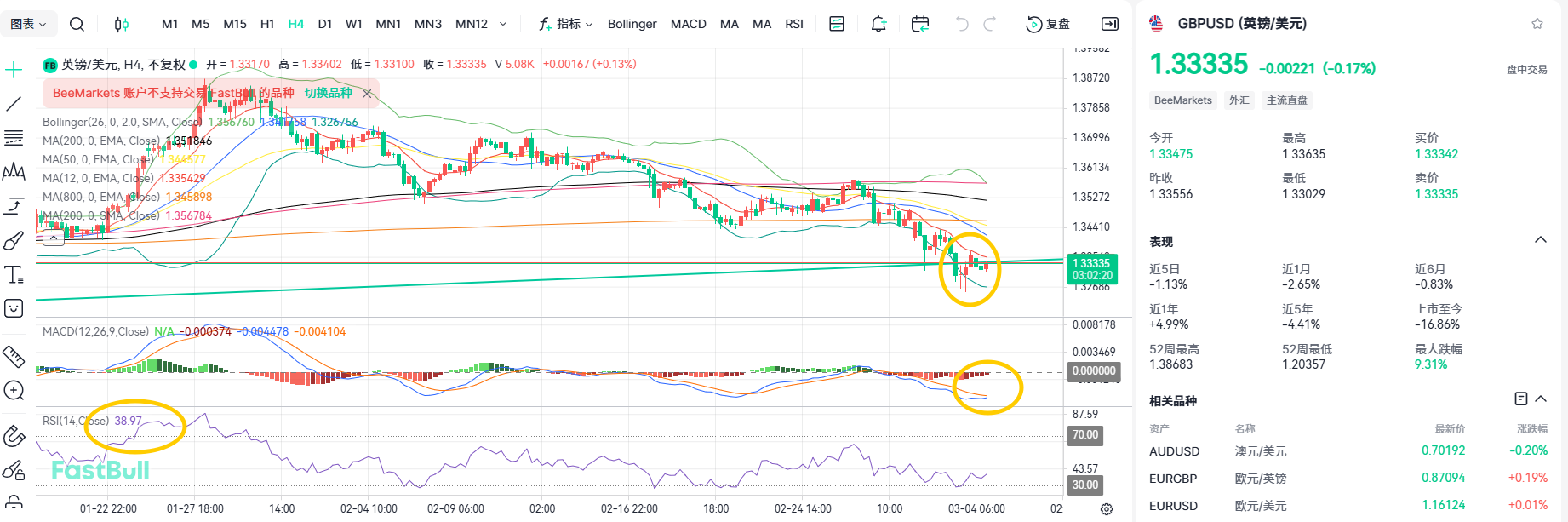
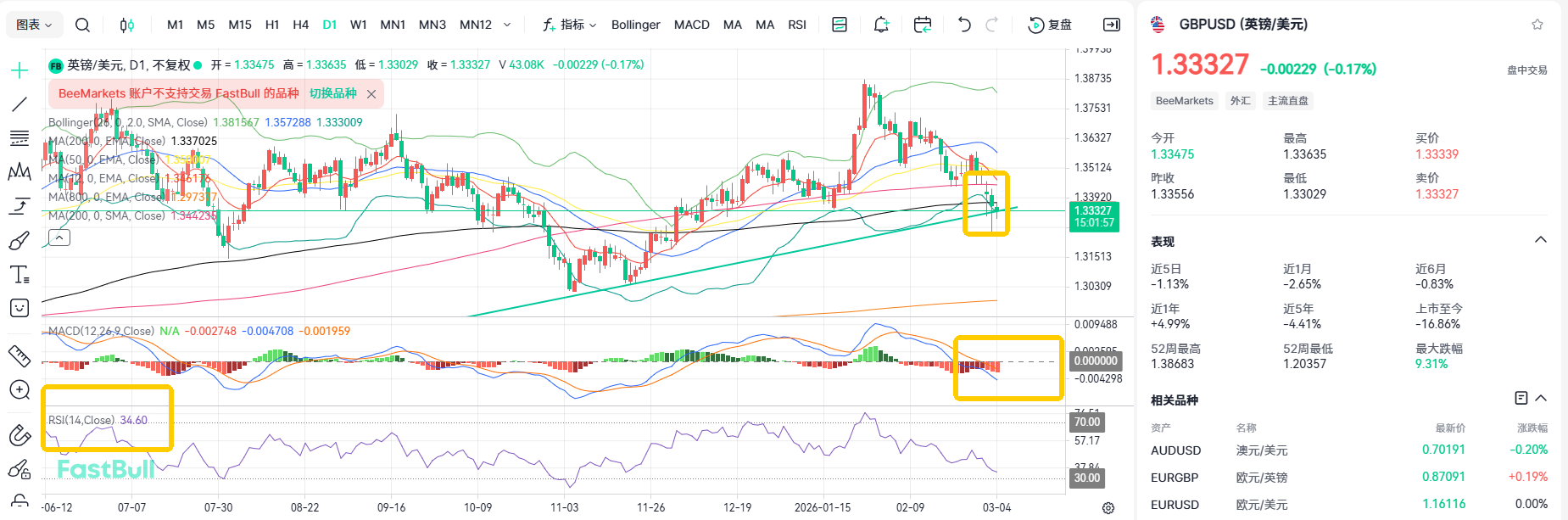
In the 1D timeframe, the GBPUSD has breached the Bollinger Lower Band and the EMA200. Although the short-term downtrend remains unbroken, a rebound emerged after support was found at the rising trendline and a key integer level. A sustained hold above support could lead to a corrective move. The Bollinger Bands are beginning to expand downwards, with moving averages diverging lower, indicating a shift to a bearish trend. Following a MACD death cross, the MACD line and signal line have fallen below the zero line, forming a "death kiss" pattern, which confirms the market's entry into a bearish phase. The RSI reading of 34 has entered oversold territory, with market participants predominantly engaged in selling. In the 4H timeframe, the Bollinger Bands are expanding downwards, moving averages are diverging lower, and the price is oscillating downwards along the EMA12 and the Bollinger Lower Band. In the near term, the decline is not yet complete. A break above the EMA12 could prompt a rebound to approximately 1.34. The MACD is nearing a golden cross, suggesting a reduction in downward momentum. An RSI of 38 reflects prevailing pessimism in the market. Overall, GBPUSD is expected to stabilize around the 1.33 level, with a high likelihood of a rebound. Consequently, the strategy favors buying on dips.
Trading Recommendations
Trading Direction: Buy
Entry Price: 1.33
Target Price: 1.38
Stop Loss: 1.3
Support: 1.32, 1.3, 1.28
Resistance: 1.38, 1.4, 1.41