In a classic display of the crude market’s current dichotomy, West Texas Intermediate (WTI) futures retreated from multi-session highs on Friday, yet held firmly on track for a striking monthly advance. The benchmark was last seen trading near $64.00 per barrel during the Asian session, a mild pullback after a three-day rally that underscores the complex tug-of-war between tangible supply risks and lingering macroeconomic anxieties.
Make no mistake: the dominant narrative for January has been one of resilience. Despite concerns over global demand growth and persistent warnings of an oversupplied market later this year, WTI is poised to close the month with a gain of roughly 12%. This impressive performance isn’t born from a surge of bullish economic data. Instead, it is almost entirely constructed atop an elevated—and still rising—geopolitical risk premium. The market is, in essence, pricing in a world where the flow of crude is perpetually one headline away from disruption.
This week, that premium received fresh and highly volatile injections from the world’s most precarious energy flashpoint. Tensions between the United States and Iran escalated dramatically, moving beyond diplomatic posturing into the realm of tangible military threat. The catalyst was a renewed volley of threats from former U.S. President Donald Trump directed at Tehran, urging a return to nuclear talks. Iran’s response was not calibrated for de-escalation. A senior commander of the Islamic Revolutionary Guard Corps (IRGC) warned the nation would “defend itself and respond like never before” if provoked.
The situation was immediately compounded by a significant political move from Europe. The European Union’s decision to formally designate Iran’s IRGC as a terrorist organization has further isolated the regime and narrowed the avenues for diplomatic maneuvering. The geopolitical chessboard saw pieces move rapidly: reports emerged of the U.S. bolstering its military footprint in the region, while Tehran, in a direct and provocative counter, announced plans for live-fire military exercises in the Strait of Hormuz.
For traders and analysts, the Strait of Hormuz is the only square on this chessboard that truly matters. This narrow passage between the Persian Gulf and the Gulf of Oman is the artery of global energy transit, with about a fifth of the world’s daily oil consumption passing through its waters. Any credible threat of its disruption sends a reflexive shiver through trading desks from Singapore to London. As strategists at Westpac noted via Dow Jones Newswires, the market is grappling with the potential for "chaotic" outcomes, a scenario far removed from the relatively controlled "surgical strikes" of the past.
Yet, even as one geopolitical front heated up, another saw a surprising, if tactical, thaw. In a notable shift, the Trump administration selectively eased certain sanctions on Venezuela’s beleaguered oil industry on Thursday. The move, clearly designed to lure U.S. investment following the U.S.-backed removal of President Nicolás Maduro earlier this month, grants specific licenses for American companies to engage in production, transport, and refining activities involving Venezuelan-origin crude. While this is a long-term play for reshaping Venezuela’s oil sector—and a strategic counter to Russian and Chinese influence there—its immediate market impact is psychological, reminding participants that barrels can re-enter the market from unexpected quarters.
This month’s price support has been a mosaic of such disruptions. The rally was initially bolstered by a confluence of unplanned outages: production hiccups in Kazakhstan’s Tengiz field, operational freeze-offs that curtailed output in the Permian Basin, and tighter U.S. enforcement of sanctions on Russian oil purchases. These factors collectively tightened the near-term physical balance sheet, providing a fundamental floor for prices that the geopolitical drama then built upon.
The market is walking a precarious tightrope. The 12% monthly gain is a testament to oil’s enduring sensitivity to supply shocks, real or imagined. However, the failure to hold above $64.50 suggests a market that is bullish, but not reckless. There is a palpable caution, a recognition that the current risk premium is substantial and vulnerable to rapid deflation should any of the geopolitical sparks fail to ignite a wider fire, or should tangible evidence of a supply overhang emerge.
Technical Analysis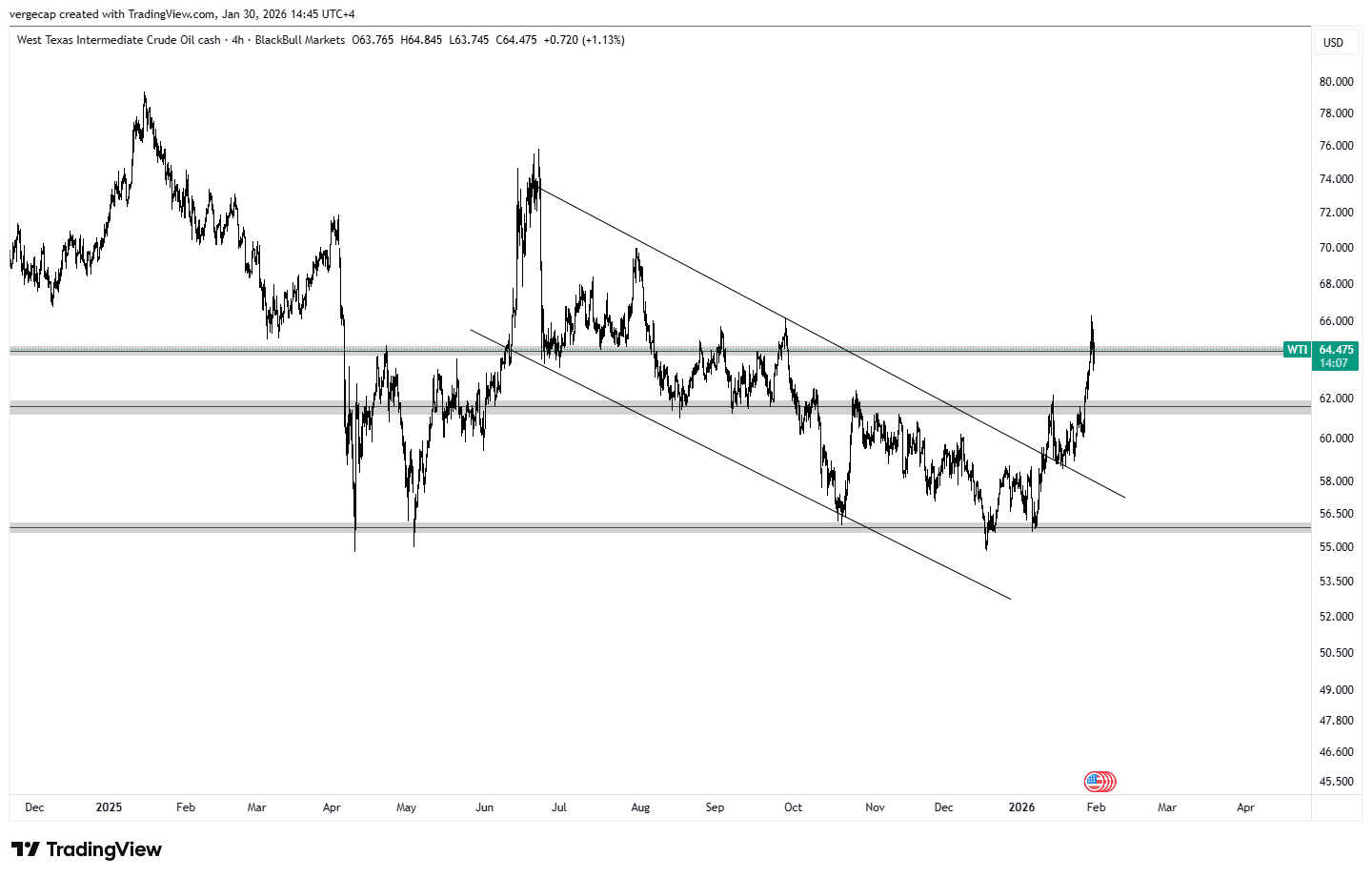
From a technical perspective, WTI Crude Oil is showing early signs of a trend transition following a prolonged bearish phase on the 4-hour chart. Price had been entrenched in a well-defined descending channel for several months, consistently producing lower highs and lower lows. However, recent price action shows a decisive bullish break above the upper boundary of that channel, signaling a meaningful shift in market structure and increasing the probability that a medium-term base has been established.
WTI is currently trading around the $64.00–$64.50 zone, which aligns with a major horizontal resistance-turned-support area. This level previously acted as a distribution zone during mid-2025 and has now been reclaimed with strong bullish momentum, suggesting acceptance above former supply. Holding above this region is critical; sustained price action above $63.50–$64.00 would confirm the breakout and reinforce the bullish reversal narrative. A failure to hold this level would imply a false breakout and could trigger a pullback toward $62.00, followed by the $60.00–$59.50 demand zone, where buyers previously stepped in aggressively.
To the downside, the $56.00–$57.00 region represents the most important structural support. This area marks the cycle low and the lower bound of the broader accumulation range. A decisive break below this zone would negate the bullish thesis entirely and reopen downside risk toward the $53.00–$50.00 region, signaling a continuation of the longer-term bearish trend.
On the upside, the next key resistance is located near $66.00–$68.00, a zone defined by prior swing highs and heavy historical trading activity. A clean break and hold above this region would likely accelerate upside momentum and expose higher targets toward $72.00, followed by the $75.00 psychological level, where sellers previously regained control. The sharp bullish expansion seen during the breakout suggests improving participation and a potential shift from corrective price action into trend continuation.
Momentum characteristics favor continuation rather than exhaustion. The impulsive nature of the breakout contrasts sharply with the overlapping, corrective structure that preceded it—often a hallmark of trend reversals rather than short-lived retracements. Volatility expansion following prolonged compression further supports the case for sustained directional movement.
TRADE RECOMMENDATION
BUY WTI CRUDE OIL
ENTRY PRICE: 64.50
STOP LOSS: 60.90
TAKE PROFIT: 72.00


