The oil market is suddenly wide awake, and it’s grinding higher with a intensity not seen in months. West Texas Intermediate (WTI) tore through the $75 per barrel ceiling in Tuesday trading, last changing hands near $76.16, a peak that takes us back to the scorching summer of 2025. This isn't just a technical bounce; this is pure, unadulterated geopolitical panic being priced in barrel by barrel.
The trigger is as clear as it is terrifying: the specter of the Strait of Hormuz closing for business. Over the weekend and into Monday, rhetoric from Tehran shifted from diplomatic posturing to outright military threat. Senior officials from Iran's Islamic Revolutionary Guard Corps (IRGC) have reportedly declared the strait closed, warning that any vessel attempting to run the gauntlet could be "set ablaze." While the final decision rests with Iran's Supreme National Security Council, the parliament in Tehran has already approved the measure, and the market is not waiting for the formalities .
Let’s be clear about what is at stake here. The Strait of Hormuz is not just a stretch of water; it is the world’s most important energy artery. Roughly 20 million barrels of crude oil flow through its narrow confines every single day—that is about a fifth of global consumption . To put that in perspective, closing it would be the economic equivalent of shutting down the entire output of OPEC’s second-largest producer. The fear is palpable.
And the fear is translating into real-world action. Shipping data is already painting a picture of a industry in retreat. According to ship brokers and tracking data, a growing number of tankers are simply refusing to enter the danger zone. At least three vessels, including the "Mary C" and the "Ruby," have dropped anchor near the UAE port of Fujairah rather than proceed . Major operators like Japan’s Nippon Yusen are implementing "standby" policies, ordering their fleets to minimize time in the Gulf . The traffic jam outside the strait is growing, and with it, the insurance premiums and the risk of delays .
As if the threat of a blockade wasn't enough, the conflict has already drawn first blood on critical infrastructure. On Monday, Saudi Aramco was forced to suspend operations at its massive Ras Tanura refinery. Initial reports of a drone strike have been confirmed by satellite imagery showing the aftermath of the attack . While Saudi officials stated that debris from intercepted drones caused a fire, the facility—which processes a staggering 550,000 barrels per day—is now offline for safety inspections . This is not just a symbolic hit; Ras Tanura is a linchpin for global refined product supplies, and its shutdown is sending shudders through diesel and gasoline markets .
So, what is the "right" price for oil when an aircraft carrier group is maneuvering and missiles are flying? The number-crunchers at Goldman Sachs have taken a stab at it. In a note published over the weekend, the bank estimated that a real-time geopolitical risk premium of roughly $18 per barrel has been baked into the current price [citation:original source data]. However, that is just a baseline. Goldman’s models suggest that if traffic through the Strait of Hormuz is halved for a month—a very plausible scenario—prices could spike far higher, with Brent potentially testing $110
Technical Analysis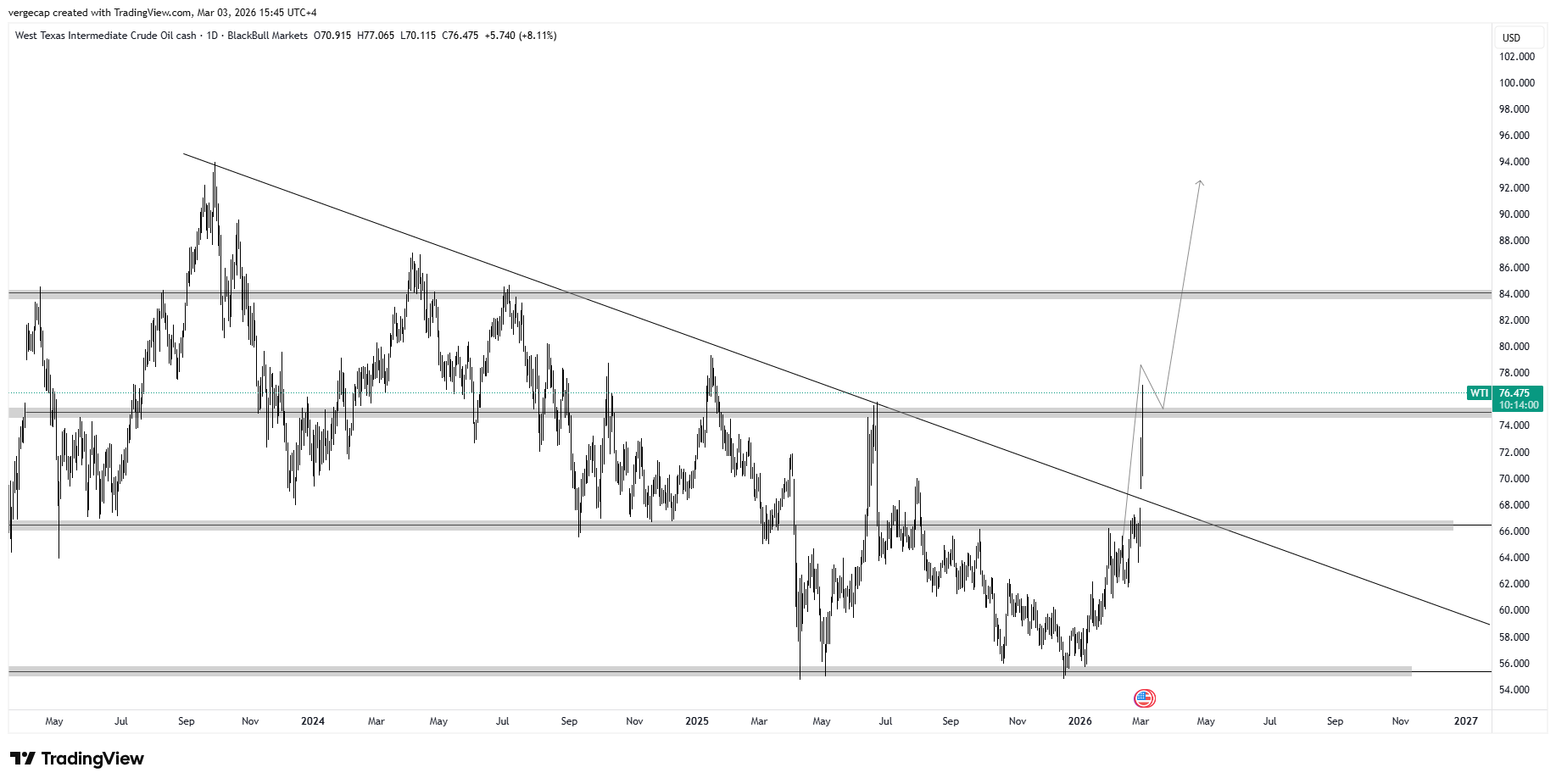
From a technical perspective, WTI crude oil is showing early signs of a structural trend reversal after an extended period within a descending channel. On the daily chart, price action has respected a well-defined downward sloping trendline since late 2023, consistently printing lower highs and lower lows. However, the recent impulsive rally from the $55.00–$58.00 demand zone signals a potential shift in market character, with buyers aggressively reclaiming lost ground.
Price has now surged toward the $74.00–$76.00 resistance zone, an area that previously acted as both support and resistance throughout 2024 and 2025. This region represents a critical supply barrier and aligns closely with the descending trendline, making it a key inflection point. While the current breakout attempt is strong, a confirmed daily close above $76.00 would be required to validate a structural breakout and formally end the series of lower highs that has defined the broader downtrend.
On the downside, the $66.00–$68.00 zone now serves as immediate support following the breakout impulse. This level previously acted as resistance and has now transitioned into a potential demand area. A sustained move back below this zone would weaken the bullish thesis and suggest the rally was a corrective bounce rather than a true trend reversal. Further weakness beneath $65.00 would likely expose the $58.00 support base once again, signaling continuation within the broader descending structure.
If bulls secure a clean break above $76.00, upside momentum could accelerate toward the $84.00–$85.00 major resistance zone, which marks a significant historical supply region. A sustained move beyond that barrier would open the path toward the $92.00–$94.00 area, representing a more substantial macro recovery phase rather than a short-term retracement.
Momentum conditions support the developing bullish case. The Relative Strength Index (RSI) has rebounded sharply from oversold territory and is now pushing into positive ground, indicating strengthening upside momentum without yet reaching extreme overbought levels. This suggests room for further appreciation before exhaustion risks intensify. Meanwhile, the MACD appears to be crossing higher with expanding bullish momentum, reinforcing the probability of continued upside follow-through if resistance levels give way.
Overall, WTI is at a technically decisive juncture. A confirmed breakout above $76.00 would signal a meaningful shift in long-term structure, while failure at this level would keep price confined within the broader bearish channel.
TRADE RECOMMENDATION
BUY WTI CRUDE
OILENTRY PRICE: 76.00
STOP LOSS: 69.00
TAKE PROFIT: 92.00


